

What is an SEO agency? SEO Agency is a firm that specializes in developing and optimizing websites for Google and AI-powered search engines to increase visibility, reach the right customers, and generate quality leads. Unlike traditional SEO approaches that focus solely on traffic or rankings, modern SEO focuses on visibility, trust, and conversion.
This article will help you understand what an SEO agency is, when to hire one, how to evaluate them, and 12 criteria for choosing the right partner before signing a contract.
What is an SEO agency?
An SEO agency (Search Engine Optimization Agency) is a partner that helps businesses optimize their websites to increase discoverability on Google and AI search systems. Their work involves research, implementation, measurement, and continuous optimization to improve visibility, qualified traffic, and business conversion.
Key activities typically include: market and keyword research, technical SEO optimization, content strategy development, on-page optimization, building website authority and credibility, and tracking data and performance to continuously adjust and improve results over time.
But that definition is still missing a crucial piece.
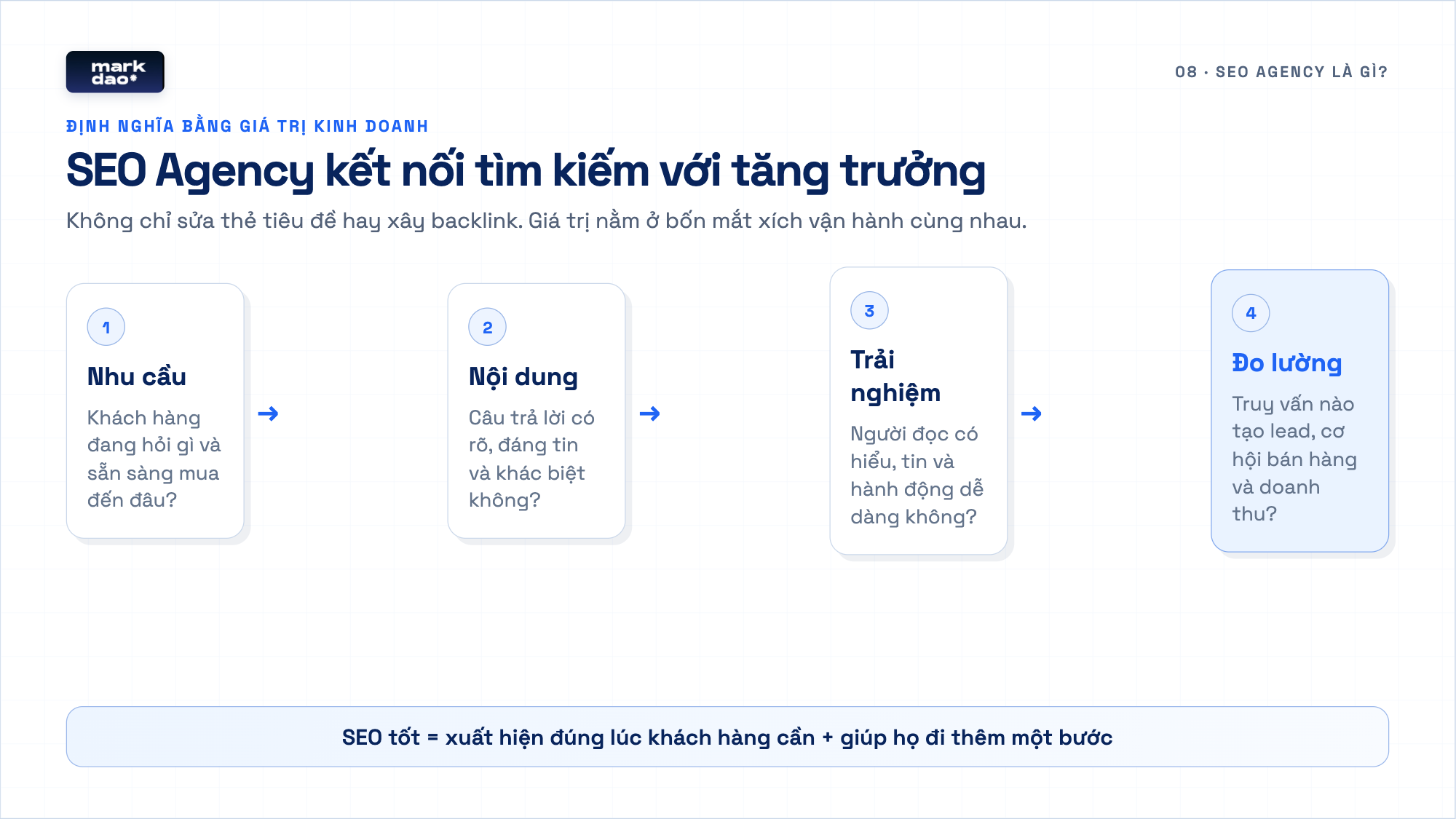
Businesses don't buy title tags, schema, or backlinks. They buy the ability to appear exactly when a customer has a need. Therefore, SEO agency services only provide real value when they connect these four links:
- Search intent: What are customers asking, and how ready are they to buy?
- Content: Does the website provide clear, trustworthy, and unique answers?
- Experience: Can readers understand, trust, and easily take action?
- Measurement: Does the business know which search queries are driving leads, sales opportunities, and revenue?
Google also recommends prioritizing helpful, reliable content created primarily for people. With AI Overviews and AI Mode, the core foundations of SEO remain essential; there is no "GEO hack" that can replace unique content, clear technical structure, and a great user experience.
Top 10 SEO Agencies in Vietnam to consider based on your needs
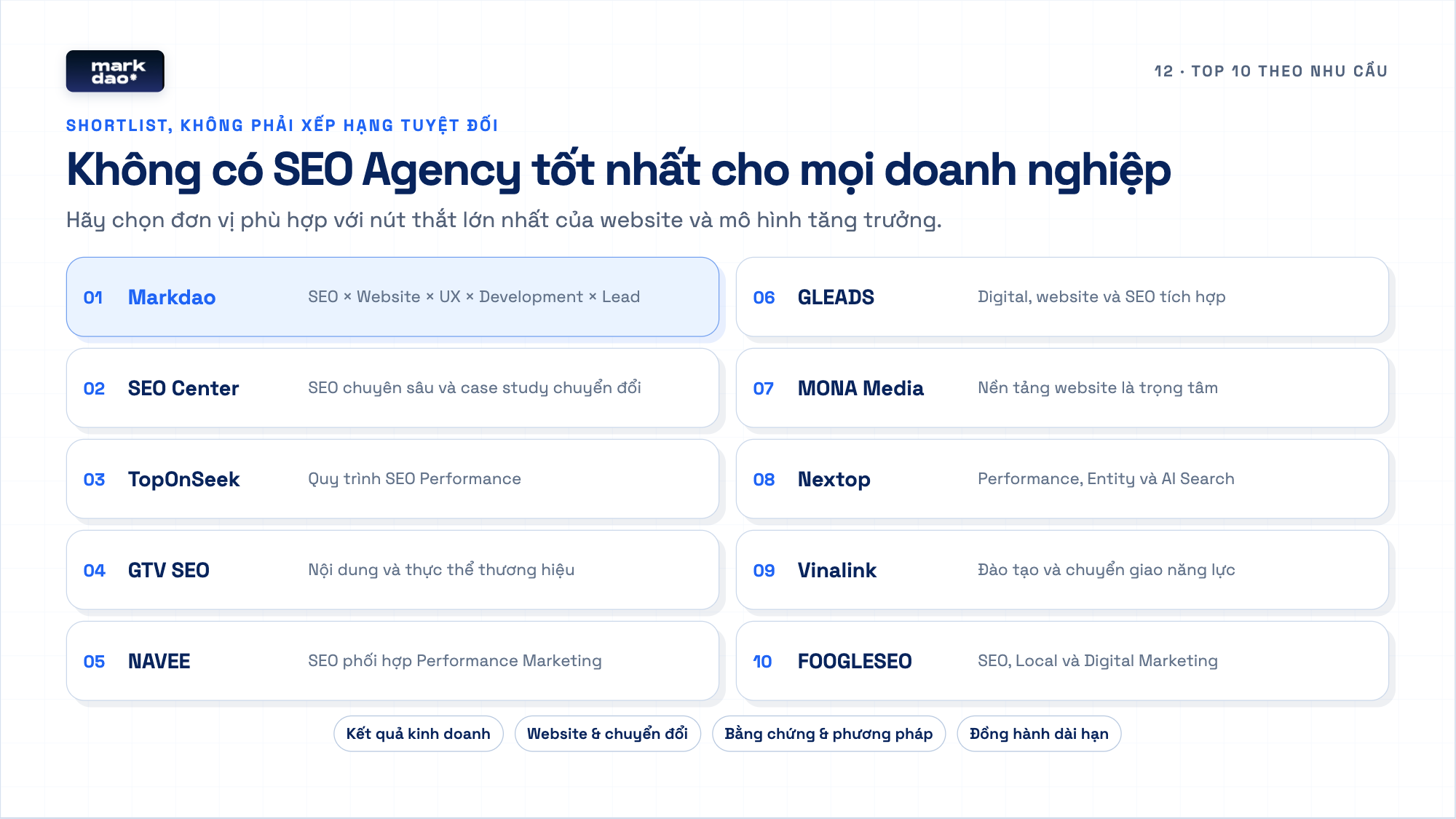
The list below is an editorial shortlist, not an absolute ranking. The order is based on four criteria relevant to our readers: the ability to connect SEO with business results, website and conversion capabilities, transparency of methodology or evidence, and the capacity for long-term partnership. Figures published by each agency should be verified during consultations and project proposals.
1. Markdao: Best when SEO, website, and conversion need to be solved together
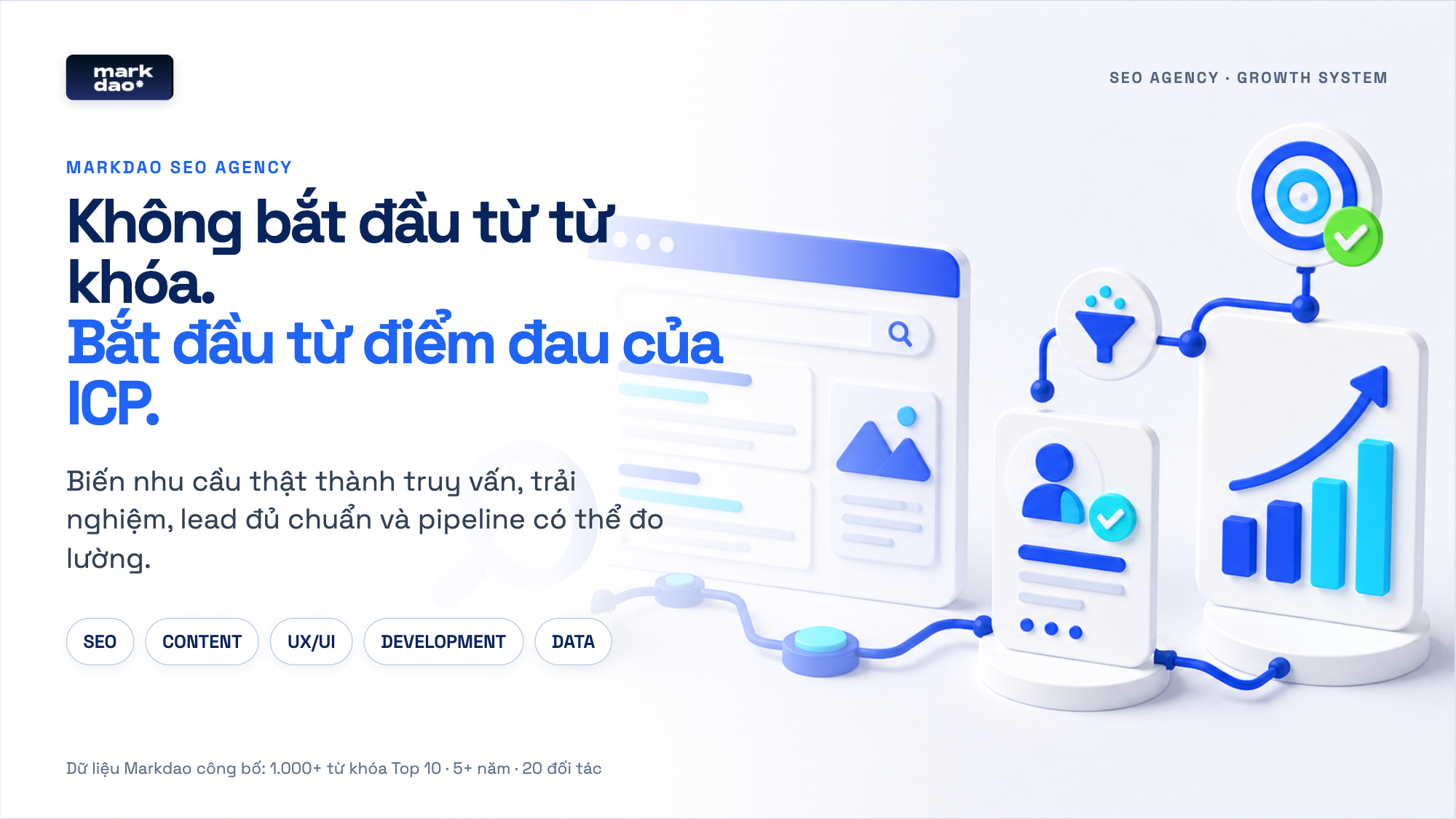
Markdao stands out for its interdisciplinary approach. Comprehensive SEO services are integrated with website design, UX/UI, speed, content, and conversion optimization. This is particularly suitable for businesses with outdated websites, unclear positioning, unconvincing service pages, or SEO projects that are often stalled due to a lack of web development support.
According to information published by Markdao, the team has ranked over 1,000 keywords in the Top 10 over their 5+ years of operation; they do not use fake views or clicks, and they do not purchase backlinks that are removed after the project ends. Markdao's website also showcases experience working with brands such as TPBank, King Koil, HSC, Buymed, and Phenikaa. These are strong indicators to include Markdao in your initial evaluation round, though businesses should still request to see anonymized industry data, measurement timeframes, and the conversion methodology from traffic to leads.
Best fit for:
- B2B businesses or services with long customer journeys.
- Websites that need improvements in structure, content, UX, and performance.
- Brands looking to build long-term search assets rather than just buying short-term rankings.
- Teams that need a partner capable of coordinating SEO, Content, Design, and Development.
Questions to ask Markdao: “In the first 90 days, what is the biggest bottleneck on our website, and which tasks will Markdao implement directly rather than just recommending?”
2. SEO Center: Best for specialized services and conversion-focused case studies
SEO Center publishes extensive content on SEO combined with CRO, processes, case studies, and service packages. This is a strong option to consider when a business prioritizes a team specialized in SEO and wants to see project-specific results.
Questions to ask: “Did the increase in leads in your case studies come from SEO, UX changes, other budgets, or a combination of factors?”
3. TopOnSeek: Best for businesses needing performance-based SEO processes
TopOnSeek has a strong content presence around the topic of SEO agencies, emphasizing ROI, reporting, case studies, and how to select a provider. This agency is worth considering for relatively large-scale projects that require performance-based management.
Questions to ask: “To what extent are performance KPIs converted: clicks, leads, opportunities, or revenue?”
4. GTV SEO: Best when a business prioritizes content and brand entities
GTV SEO has a strong presence in the SEO community and ranks prominently in local search results for the queries tested. They are a strong candidate for businesses looking for a Content SEO system, training, or building internal capabilities alongside implementation.
Key question to ask: “How will the expertise of our internal specialists be integrated into the content process?”
5. NAVEE: Suitable when SEO needs to be integrated with Performance Marketing
NAVEE appears in content roundups of well-known SEO agencies and has a broader positioning in Performance Marketing. Businesses running multi-channel campaigns should evaluate their ability to integrate paid, organic, and conversion data.
Key question to ask: “When paid search and organic search reach the same customer, how does your team measure and attribute value?”
6. GLEADS: Suitable when you need to combine digital, website, and SEO services
GLEADS’ content covers definitions, agency lists, selection criteria, and questions to ask. This is a good option to consider when your business needs a partner with a wide range of digital services.
Key question to ask: “Who is ultimately responsible for SEO results when multiple service teams are involved in the project?”
7. MONA Media: Suitable when the website platform is a major part of the challenge
MONA has a clear strength in both website development and SEO services. This is worth noting for businesses that need to build a new site, restructure, or manage complex web systems.
Key question to ask: “Is SEO involved from the website architecture stage, or does it only begin after the website is completed?”
8. Nextop Agency: Suitable when focusing on Performance SEO, Entity, and AI Search
Nextop positions itself around SEO linked to performance, content, entities, and GEO/AEO. This is an option to include in your discussions if your business wants to test how an agency transitions from foundational SEO to visibility in AI-driven search experiences.
Key question to ask: “How does GEO differ from foundational SEO, what data is used to measure it, and how can it be verified?”
9. Vinalink: Suitable when the business needs training and capability transfer
Vinalink has a long-standing training ecosystem and offers models such as comprehensive SEO, outsourced SEO departments, and mentoring. This is well-suited for businesses that want to outsource while simultaneously building an in-house team.
Key question to ask: “After 12 months, which parts of the process will our internal team be able to handle on their own?”
10. FOOGLESEO: Suitable when a broad scope of SEO, Local, and Digital Marketing is required
FOOGLESEO offers comprehensive SEO, Local SEO, GEO/AEO, advertising, and training services. This agency may be a good fit for businesses looking to compare a multi-channel solution within their shortlist.
Key question to ask: “How will resources be allocated to ensure that SEO efforts are not diluted across too many categories?”
What should a professional SEO agency be able to do?
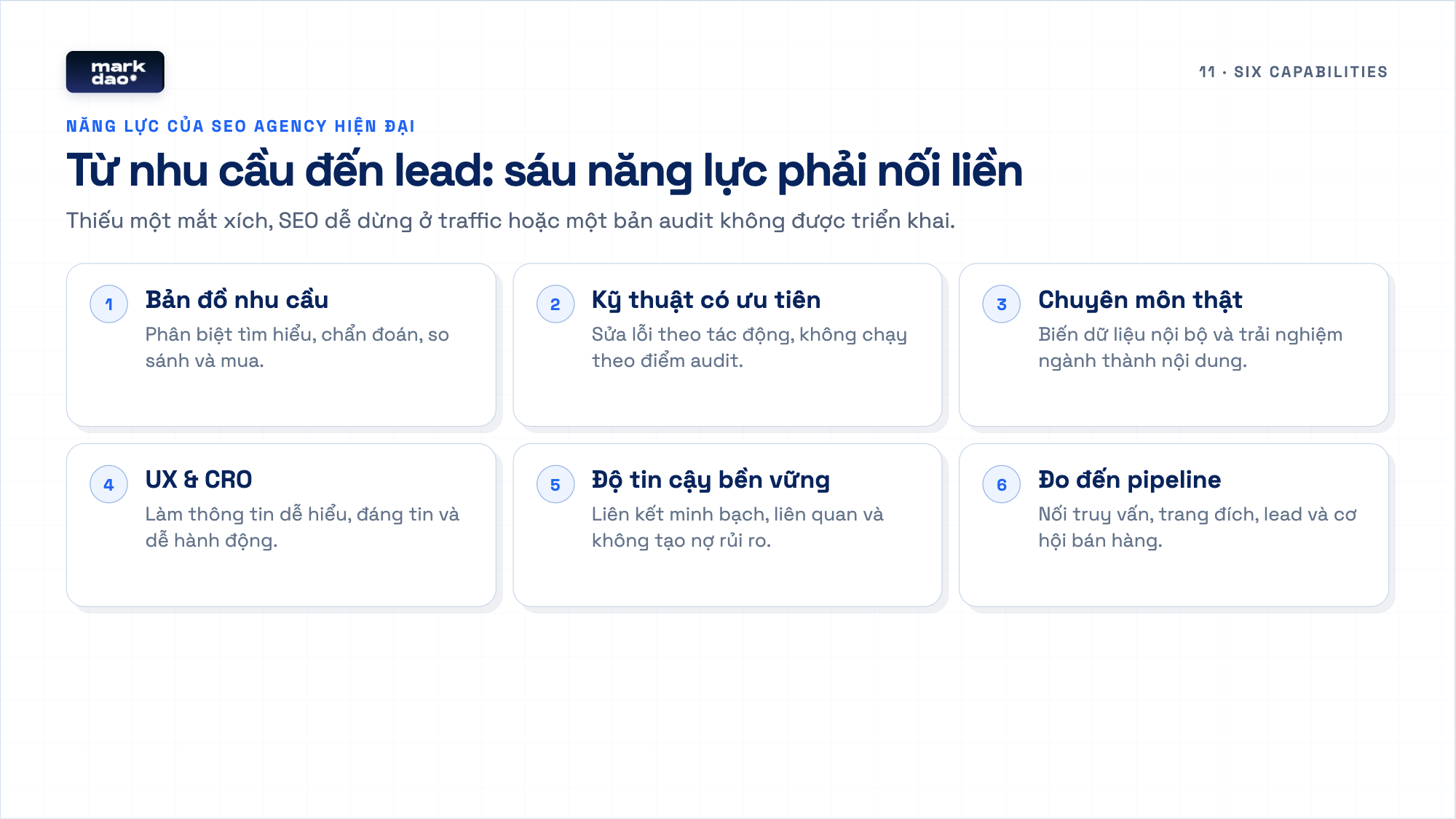
Map out user intent, don't just compile keyword lists
Effective keyword research must identify who the users are, what stage they are in, what questions are preventing them from making a decision, and which page should answer those questions. Keywords are just breadcrumbs; the underlying intent is what needs to be optimized.
For example, "what is an SEO agency" indicates a need for information. "B2B SEO agency pricing" is closer to a purchase decision. "Are revenue-guaranteed SEO agencies real" reflects a fear of risk. These three queries require three different approaches.
Fix technical foundations based on impact
Not every error found in an audit tool carries the same weight. A good agency will prioritize based on the impact on crawling, indexing, user experience, and conversion.
A canonical error across thousands of pages should be handled before 30 missing alt tags. A service page that cannot be indexed must be addressed before fine-tuning performance metrics that don't affect the user. Prioritization is the clearest indicator of professional competence.
Create content with new information and real-world experience
Content that simply aggregates the top 10 existing articles will struggle to give readers a reason to remember or cite it. Agencies need to tap into internal knowledge: interview the sales team, listen to consultation calls, analyze lost sales opportunities, leverage project data, and turn that experience into answers not yet available on the market.
This is "information gain": the new value readers receive instead of just a rewritten version of the Internet.
Optimize websites to turn intent into action
SEO and CRO should not be siloed. Agencies need to audit messaging, information hierarchy, social proof, CTAs, forms, mobile experience, and speed. When a page has 1,000 visits but generates no consultation requests, driving another 1,000 visits may not be the best decision.
Build authority without putting the website at risk
Google considers link building primarily intended to manipulate rankings as link spam. Therefore, businesses need to know where backlinks come from, why the links exist, who owns the accounts, and what happens when the contract ends.
Good links are usually the result of reference-worthy content, industry relationships, proprietary data, relevant PR, or a genuine brand presence. A spreadsheet of thousands of cheap backlinks is not an advantage if it turns into a liability later on.
Measure both SEO signals and business results
The KPI system should have two tiers:
- Leading indicators: quality pages indexed, non-branded query coverage, clicks from priority keyword groups, resolved technical errors, and page-level conversion rates.
- Business results: qualified leads from organic search, lead-to-opportunity conversion rate, SEO-assisted pipeline, cost per qualified lead, and return on investment timeframe.
The first layer helps the team manage weekly tasks. The second layer helps leadership decide whether to continue or increase investment.
Why does an SEO agency increase traffic while revenue remains stagnant?
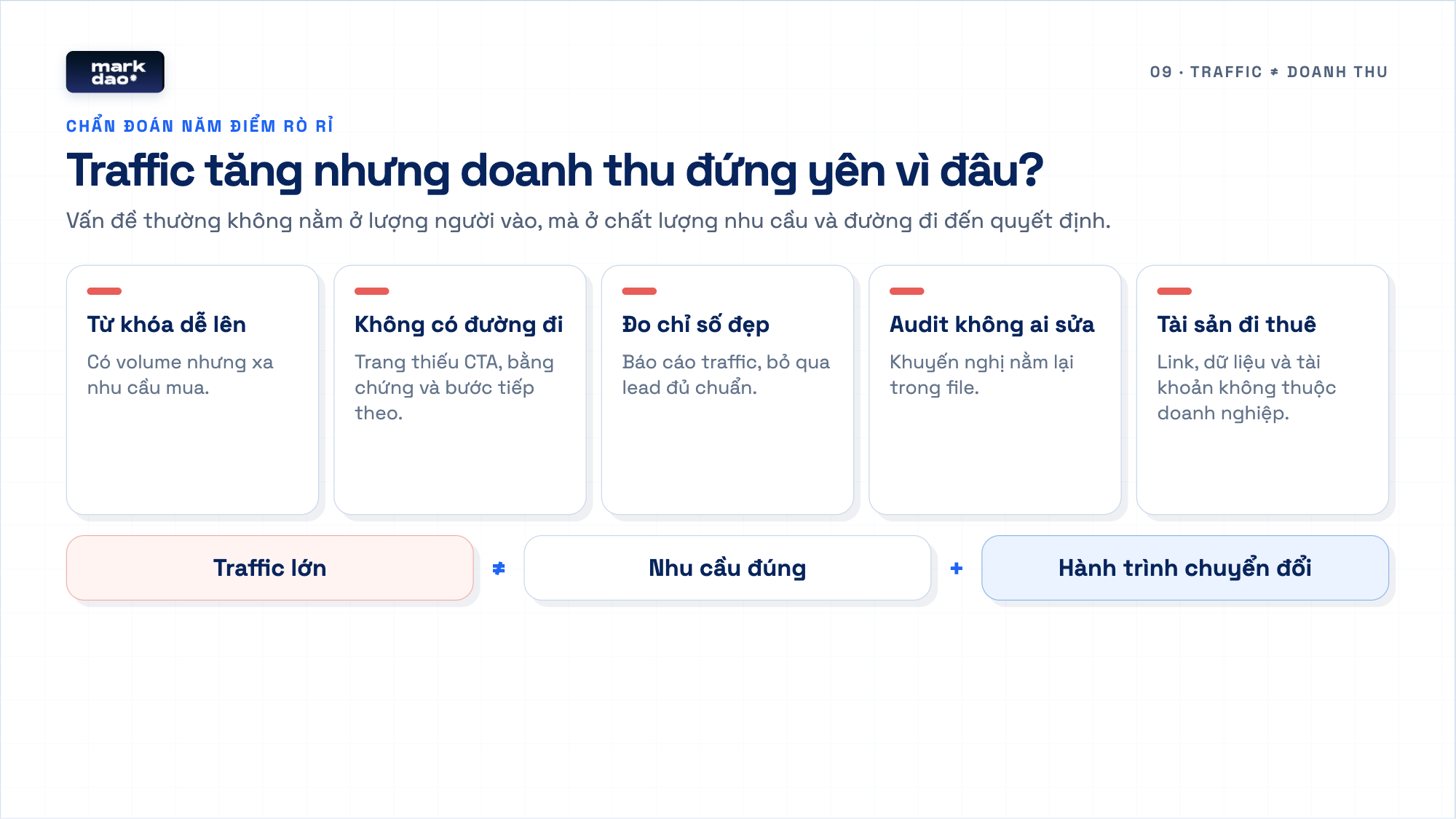
1. Choosing easy-to-rank keywords instead of high-value ones
An article titled "100 Great Quotes for Every Day" might bring in more traffic than a page for "internal audit services for manufacturing companies." However, readers of the former have almost no intention of purchasing the services mentioned in the latter.
If a contract only rewards traffic or the number of Top 10 keywords, the agency is incentivized to choose topics that generate impressive numbers. A sound strategy must distinguish between:
- Awareness-building keywords.
- Problem-identifying keywords.
- Solution-comparison keywords.
- Intent-to-contact or purchase keywords.
Each group serves a different role. You shouldn't expect every article to generate leads immediately, but you also can't have an entire website dedicated solely to people who are just "browsing for information."
2. The website gets visitors but offers no path forward
Imagine a store with a huge sign outside, but inside there are no price tags, no staff to guide you, and the checkout counter is hidden behind a door. Your website might be facing that exact problem.
Service pages are too generic. Case studies lack data. Forms are too long. Contact buttons only appear at the bottom of the page. The mobile version is hard to read. In these cases, SEO brings users in, but the website fails to help them make a decision.
This is why SEO-optimized web design capabilities and CRO need to be part of the agency evaluation scope, not something to be "done later."
3. Reporting many metrics but lacking a clear decision
A good report must answer three questions:
- What has changed?
- Why did it change?
- What should be done differently next month?
If a report only lists impressions, clicks, average position, and the number of posts, the business only knows the team has been busy. It doesn't tell them whether the investment is moving closer to business goals.
4. Thorough audits with no one to implement fixes
An audit file can be 80 pages long. But without someone to update templates, improve speed, change navigation structures, add tracking, or adjust forms, that file is just a list of symptoms without a prescription.
Modern SEO requires coordination between SEO specialists, content creators, designers, developers, and product experts. An agency that can only identify errors without a mechanism to push fixes to the website will slow down the project from the very first month.
5. SEO assets that don't truly belong to the business
Risks often only surface when the contract ends: accounts held by the agency, no source files for content, backlinks removed, dashboards shut down, or the business having no knowledge of the processes used.
Sustainable SEO must strengthen the business's assets every month. These assets include content, data, accounts, processes, testing history, publishing relationships, and customer insights.
Markdao's SEO Principle: Start with the ICP's pain points, not keywords.
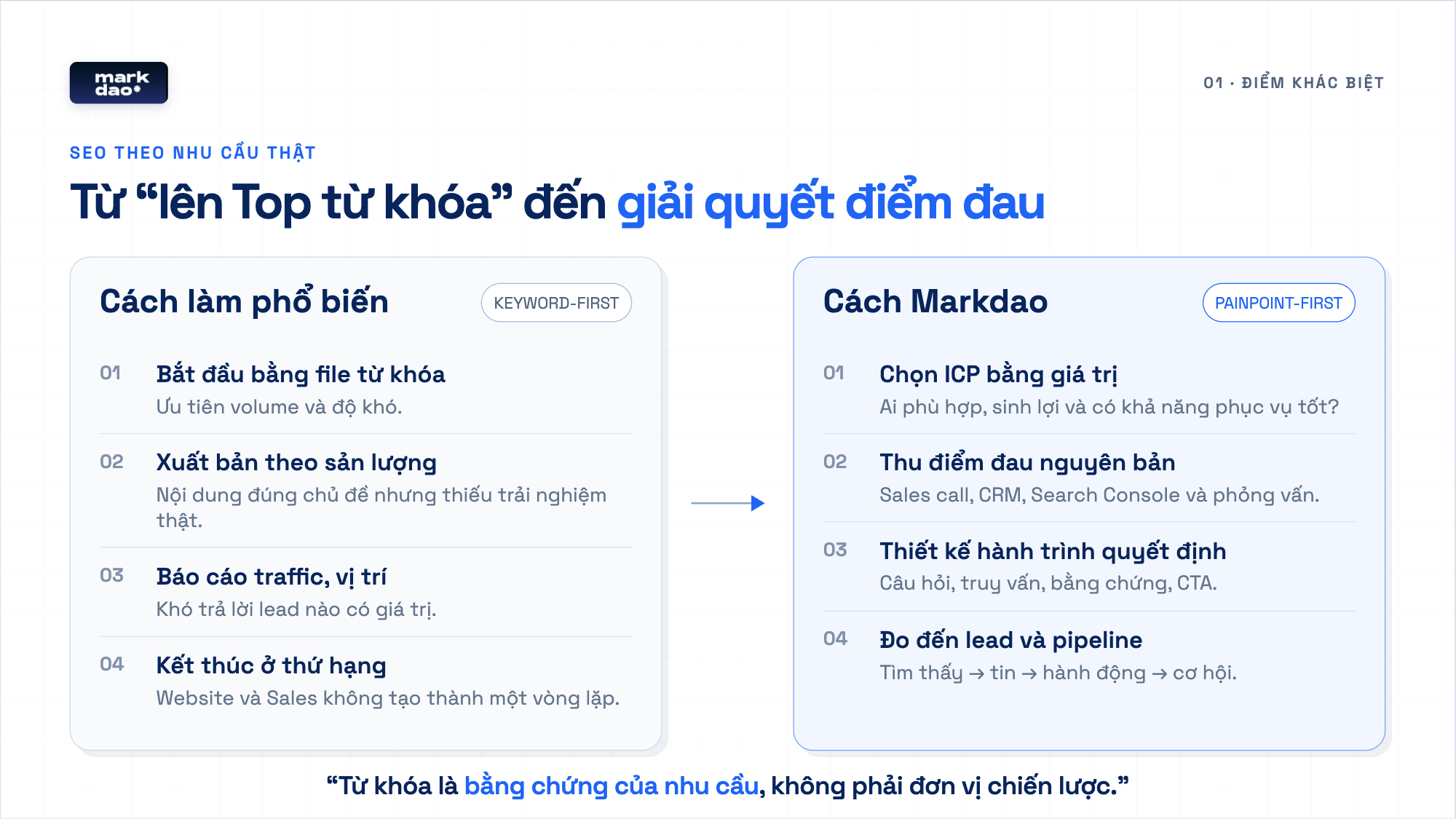
Keywords are not needs. Keywords are simply how a person expresses a need at a specific moment in time.
Two people searching for "inventory management software" could be in very different situations. One is a shop owner losing stock due to manual record-keeping. The other is an operations director needing to connect data across three warehouses. If you group both under the same keyword, the content might be on-topic, but it won't address their specific decision-making needs.
Therefore, Markdao does not start a strategy by asking, "Which keywords does the business want to rank for?" The correct sequence is:
- Which ICP generates the best business value?
- What job are they trying to get done?
- What makes that job difficult, slow, risky, or expensive?
- What event makes the problem urgent?
- What questions do they ask before they even know the name of the solution?
- Once they know the solution, what criteria do they use to compare options?
- What evidence does the business need to provide for them to trust and take action?
- Finally, define the keywords, page types, CTAs, and success metrics.
This approach can be summarized in a single sequence:
ICP → jobs to be done → pain points → triggers → questions → queries → content → evidence → action → business metrics.
If you skip the first half of this sequence, SEO easily becomes just a race to publish content. By following the full sequence, every keyword has a clear business reason to exist.
Principle 1: Keywords are evidence of demand, not a strategic unit.
Markdao still researches search volume, competition, SERPs, and trends. However, these metrics are used to validate and prioritize demand, not to replace a deep understanding of the customer.
A keyword with 50 searches per month may be more worth investing in than one with 5,000 if it comes from the right person at the right time with a high contract value. Conversely, high volume does not mean a big opportunity if the searcher is not part of your ICP or if the content lacks a clear path to action.
Principle 2: Every page must serve a user decision.
Pages should not be created just because "there is a keyword." Every page must answer:
- What is the reader trying to decide?
- What is holding them back from making that decision?
- What information and evidence will help them take the next step?
- Is the logical next step to keep reading, self-assess, download a resource, or get in touch?
If you cannot answer these four questions, the page does not have a clear role in your SEO journey.
Principle 3: Prioritize based on value, winnability, and feasibility.
Markdao does not prioritize content based on volume alone. Each opportunity is evaluated across three axes:
- Business value: Proximity to revenue, contract value, and alignment with the ICP.
- Winnability: Content gaps, competitor strength, existing authority, and the business's subject matter expertise.
- Feasibility: Do you have the experts, data, evidence, budget, and technical resources to execute?
A topic with attractive volume will not be prioritized just because a tool ranks it highly if the business lacks the evidence or if the product is not a true fit.
Principle 4: SEO is a cross-departmental system
SEO does not belong solely to the Content team. Sales knows what objections customers have. Customer Success knows why customers stay or leave. Product knows the limitations of the solution. Developers know what can be implemented. Leadership knows which markets are worth prioritizing.
Markdao consolidates these insights into a unified system. Consequently, content is not only keyword-optimized but also aligned with the product, brand promises, and the reality of the purchasing process.
Principle 5: Every significant claim requires evidence
A statement like "our solution saves time" is too generic. Better evidence includes before-and-after processes, specific steps where processing time is reduced, screenshots, project data, user testimonials, or technical explanations from experts.
The closer the content is to a purchasing decision, the higher the standard for evidence.
Principle 6: Measure the quality of demand, not just traffic volume
SEO can bring the right people to the wrong page, or the wrong people to the right page. Therefore, Markdao tracks queries, landing pages, behavior, CTAs, forms, lead quality, and CRM outcomes whenever data permits.
The goal is not to make every chart go up. The goal is to identify which demand segments are creating value and which are draining resources.
Principle 7: Every SEO cycle must build assets owned by the business
After each quarter, the business should have gained more data, content, landing pages, evidence, internal links, processes, and customer insights. Even if rankings fluctuate, these assets help the website serve users better and provide a foundation for the next phase of growth.
Principle 8: Do not scale before proving an effective loop
Publishing 100 articles will not fix a flawed strategy. Markdao prioritizes proving a small loop first:
- Select one ICP and one critical pain point.
- Build a cluster of pages that covers the entire journey.
- Guide users to the appropriate CTA.
- Measure lead quality.
- Learn from data and sales calls.
- Only then should you expand to the next cluster.
Markdao's Painpoint-to-Pipeline Methodology
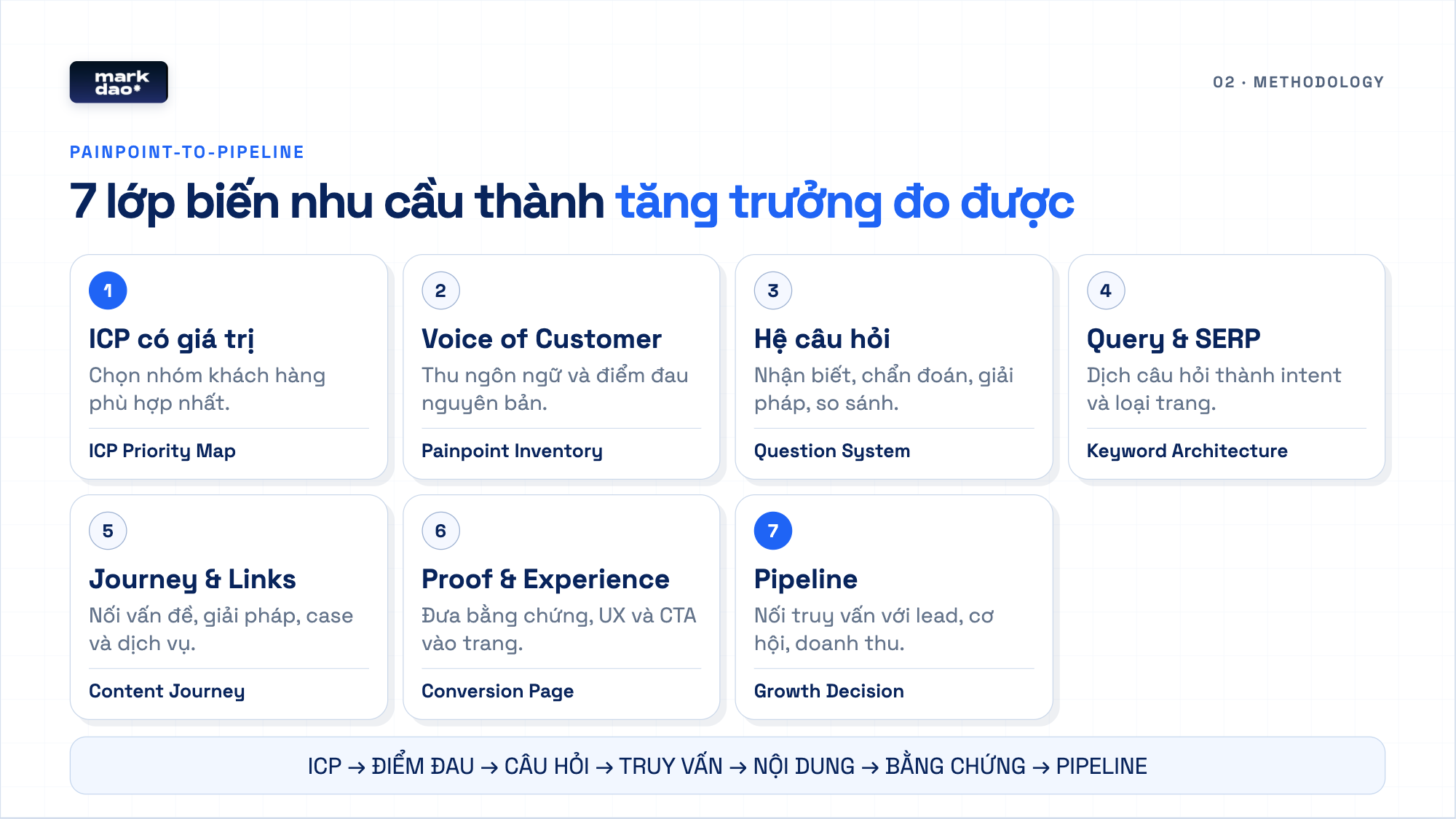
The Painpoint-to-Pipeline methodology transforms real customer pain points into a measurable search system, from query to sales opportunity. The method consists of seven layers, executed in sequence but continuously revisited and updated as new data becomes available.
Layer 1. Select ICP based on business value
Not every customer who can buy is an ICP. An ICP is the group of businesses or users with whom Markdao and the client can create the most value for each other.
Required outputs:
- Industry, size, business model, and location.
- User roles, influencers, and budget approvers.
- Contract value, profit margins, sales cycle, and retention rate.
- Qualification and disqualification criteria.
- Priority 1 ICP, Priority 2 ICP, and non-focus groups.
Avoid using personas like "32-year-old male who likes reading" if that information doesn't change how they buy. SEO personas should focus on context, responsibilities, risks, goals, and decision-making criteria.
Layer 2. Collect pain points in their original language
A good pain point isn't a sentence made up by the marketing team. It should come from:
- Consultation calls and sales notes.
- Contact forms and pre-purchase questions.
- Support tickets and churn reasons.
- Reviews, communities, forums, and comments.
- Actual queries in Google Search Console.
- Internal website search.
- Interview customers who have purchased, declined, or churned.
Markdao records exactly how customers phrase things. For example, they might not search for "website performance optimization"; they say "the site takes too long to load, customers click the ad and leave." That everyday language is the key to finding queries, creating content, and writing more intuitive CTAs.
Layer 3. Turning pain points into a question system
Each pain point is expanded into five types of questions:
- Awareness: "What are the signs that I have a problem?"
- Diagnosis: "What is causing the problem?"
- Solution: "What are the ways to handle this?"
- Comparison: "Should I do it myself, use a tool, or hire an expert?"
- Decision: "Which provider is the right fit, and what are the costs and risks?"
This step helps Markdao move beyond the "one keyword, one article" mindset. A single pain point usually forms a cluster of needs, not just a single page.
Layer 4. Translating questions into queries and SERP intent
Only at this stage are keywords introduced. Markdao combines:
- The customer's original language.
- Google search suggestions and related questions.
- Data from Search Console, Ads, CRM, and internal search.
- Keywords currently covered by competitors.
- The type of page Google prioritizes in the SERP.
- Search volume and competition levels once reliable data is available.
Every keyword must be tied to a specific question, an ICP, a stage in the customer journey, and a page type. Keywords that cannot be mapped to these four fields will not be added to the content calendar just to inflate volume.
Layer 5. Designing the content journey and internal linking
Markdao identifies which pages capture demand, which explain, which provide proof, and which convert. Internal links are built based on the decision-making path, not just by matching keywords.
Example:
- The article "How to fix high LCP?" leads to a website speed checklist.
- The checklist leads to a page explaining website audit and optimization services.
- The service page leads to before-and-after case studies.
- The case study leads to a consultation request form.
Readers always have a logical next step, while Google clearly understands the relationship between the problem, solution, evidence, and service.
Layer 6. Integrating evidence and experience into pages
Every page is built on three tiers:
- Quick answer: Helps readers understand the issue in seconds.
- Guidance and evidence: Explains causes, processes, examples, images, data, or expert insights.
- Next action: Checklist, tool, related article, case study, or consultation.
Bottom-of-funnel pages need to include selection criteria, service scope, methodology, point of contact, limitations, and proof. Top-of-funnel pages should help readers identify their problems without pushing for contact too early.
Layer 7. Connecting SEO data to the pipeline
Each content group has a tailored measurement system. Markdao does not use the same KPIs for educational articles and service pages.
The ideal measurement chain is:
Query → impressions → clicks → landing page → micro-conversion → form or call → qualified lead → opportunity → revenue.
Not every business has a fully integrated CRM. When data is limited, Markdao implements a tiered approach: starting with Search Console and GA4, standardizing events, adding source tracking to forms, and then connecting the CRM once the sales process is ready.
The true SEO journey: From identifying the problem to being ready to buy
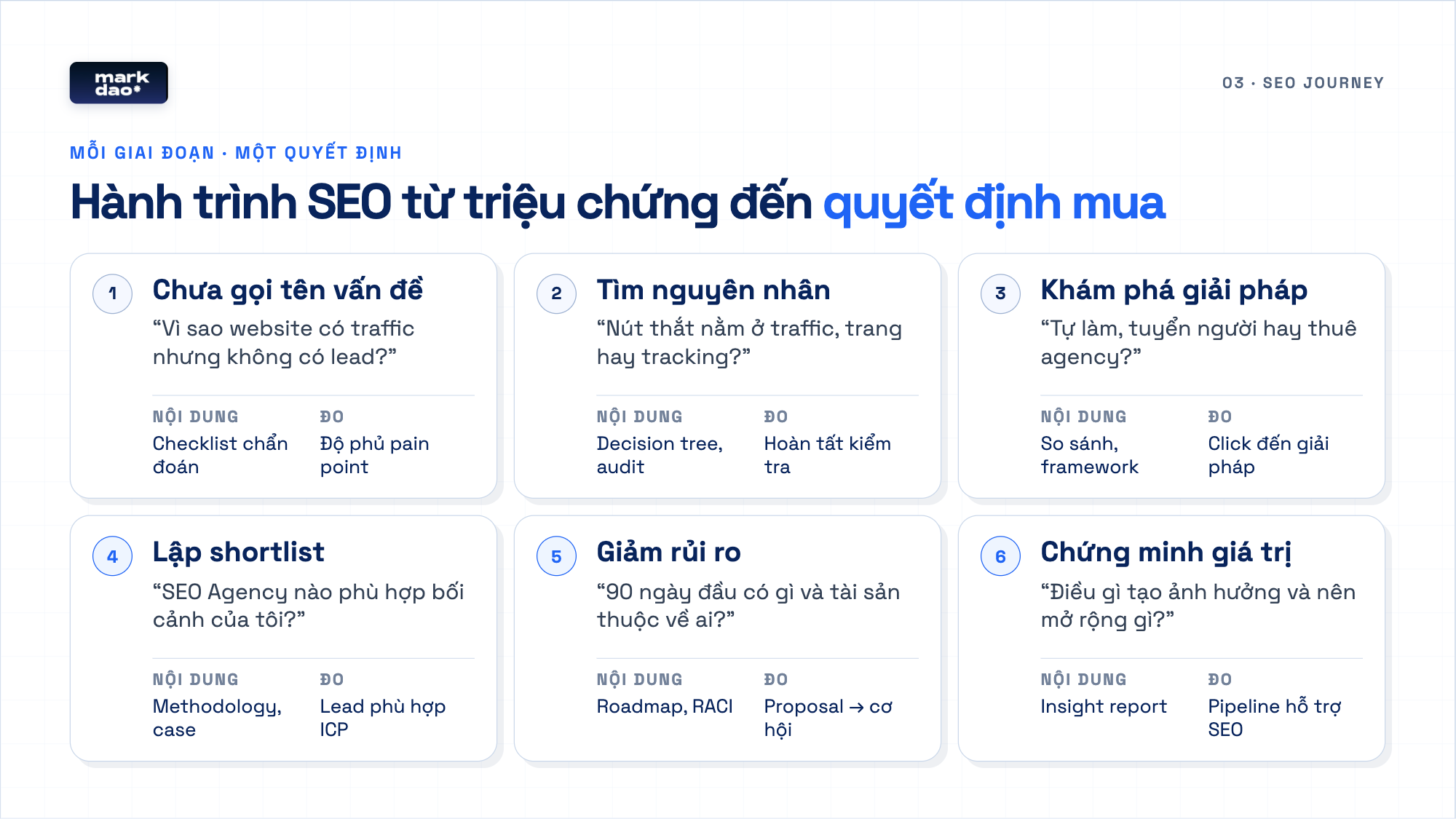
An SEO journey isn't just about slapping TOFU, MOFU, and BOFU labels on content. It must reflect what the user is thinking, what evidence they need, and what action makes sense at each stage.
Stage 1. Unaware of the problem
Users only see the symptoms: low website conversions, high bounce rates, wasted time for the sales team, or rising advertising costs.
Their questions:
- Why does my website have traffic but no leads?
- Why do visitors leave my site immediately?
- What are the signs that my website is hurting sales?
- Why is my cost per lead increasing?
Keyword types: symptoms, signs, causes, benchmarks, and "why" questions.
Content format: diagnostic articles, self-assessment checklists, simple tools, and before-and-after infographics.
Effective CTAs: self-scoring, quick checks, and links to follow-up diagnostic articles.
Key metrics: non-branded query coverage, problem-based CTR, depth of engagement, checklist usage, and click-through rates to diagnostic pages.
Stage 2. Understanding the problem and seeking causes
Users know the website is slow, the SEO structure is weak, or leads are low quality, but they don't know where the bottleneck is.
Their questions:
- How do I fix a high LCP?
- Why is my website not being indexed?
- Why did organic traffic drop after the update?
- Why are my SEO leads not the right target audience?
Keyword types: diagnosis, testing, errors, causes, measurement methods.
Suitable content: step-by-step guides, decision trees, audit templates, instructional videos, data-driven examples.
Suitable CTAs: download checklist, run test, submit results for expert review.
Key metrics: number of people completing tools or checklists, return visits, clicks to solutions, and number of qualified issues identified.
Stage 3. Exploring solutions
Users understand the problem and are starting to compare ways to handle it.
Their questions:
- Should I fix the old website or redesign it?
- Should I hire in-house SEO staff or outsource to an agency?
- How does holistic SEO differ from keyword-based SEO?
- Is it necessary to do CRO alongside SEO?
Keyword types: how-to, methods, comparisons, selection, opportunity costs.
Suitable content: honest comparison articles, decision frameworks, resource estimation guides, and situational case studies.
Suitable CTAs: view methodology, download RFP template, view similar case studies.
Key metrics: clicks to solution pages, case study views, return rates, micro-conversions, and number of leads who correctly self-identify their problem.
Stage 4. Creating a provider shortlist
Users know the type of solution they need and are starting to evaluate providers.
Their questions:
- Which SEO agency is suitable for B2B businesses?
- What are the criteria for choosing an SEO company?
- What does an SEO agency quote include?
- Does the agency make direct changes to the website?
Keyword types: agency, services, pricing, top, reviews, case studies, process.
Relevant content: service pages, methodology, SOPs, team, case studies, scorecards, and FAQs regarding scope and risks.
Relevant CTAs: get a diagnosis, request a proposal, schedule a consultation.
Key metrics: service page conversion rate, qualified leads, booking success rate, and ICP fit.
Stage 5. De-risking the decision
Buyers are close to signing but are still concerned about timelines, ownership, performance, and collaboration.
Their questions:
- How long until we see results, and what are the early indicators?
- What happens if the goals aren't met?
- Who owns the data and content?
- Who is responsible for website updates?
- Are the case study results relevant to my specific situation?
Keyword types: guarantees, contracts, timelines, risks, handovers, vendor evaluation.
Relevant content: personalized proposals, 90-day plans, responsibility matrices, handover terms, and contextualized case studies.
Relevant CTAs: diagnostic workshop, scope approval, baseline alignment.
Key metrics: proposal-to-opportunity rate, close rate, decision-making time, and win/loss analysis.
Stage 6. Proving value and scaling post-purchase
SEO doesn't end when the contract is signed. Buyers need to justify the investment to leadership and coordinate internally.
Their questions:
- What have we learned this month?
- Which task had the greatest impact?
- What support does the internal team need?
- Which demand cluster should we expand into next?
Relevant content: dashboards with conclusions, handover documentation, prioritized backlogs, experiment reports, and quarterly plans.
Key metrics: deployment velocity, acceptance rate of items, growth in qualified leads, SEO-supported pipeline, content asset utilization, and scalability into new clusters.
A questionnaire to outline ICPs and map them to keywords in the correct sequence
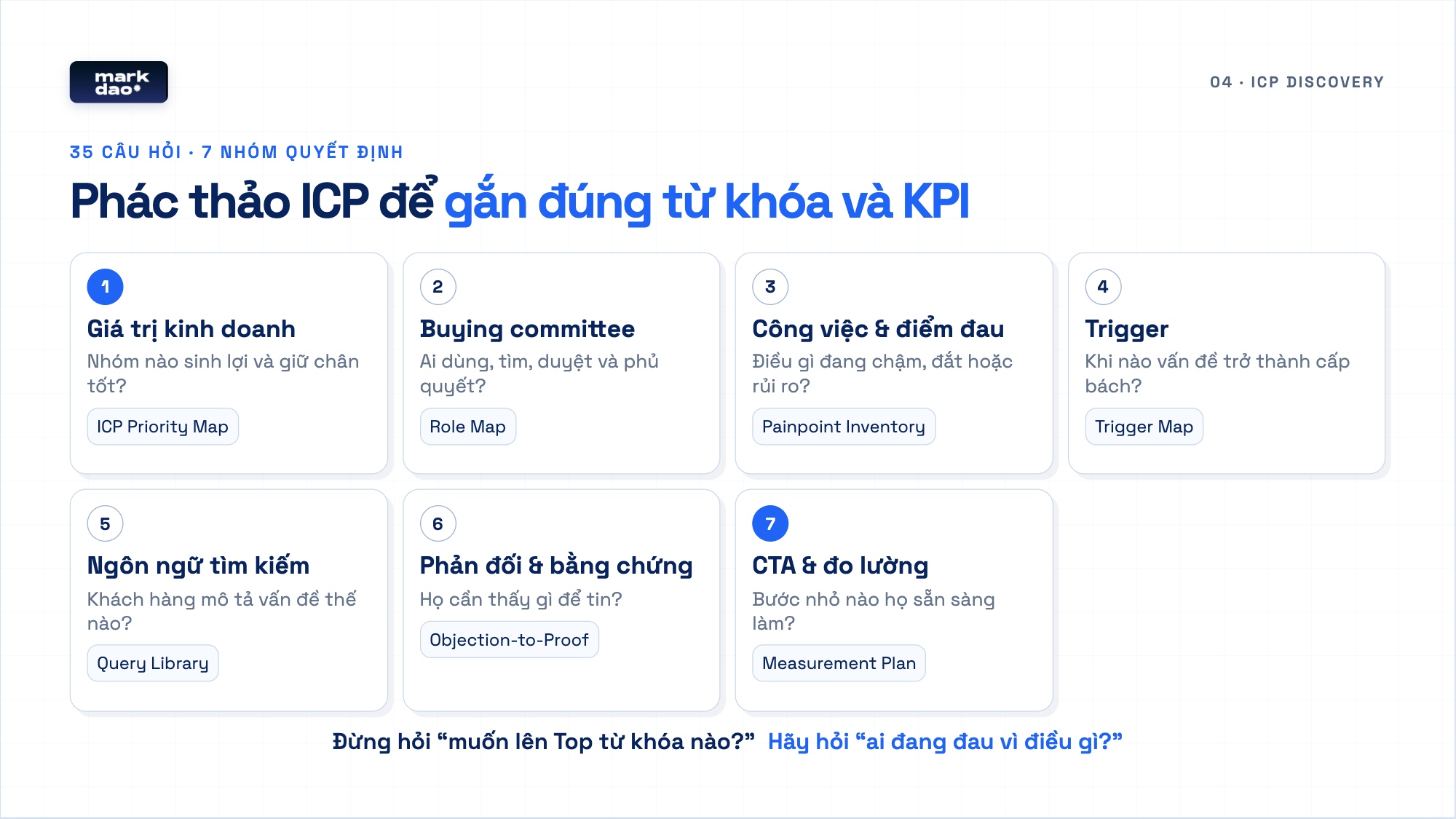
Don't just ask a business "who is your target customer?" and accept "small to medium-sized companies" as the answer. The following questionnaire moves from business economics to search language to avoid creating personas that look good but are unusable.
Step 1. Define business value
- Which product or service does the business most want to grow over the next 6 to 12 months?
- Which customer segments generate the best revenue, profit margins, or retention rates?
- Which segments generate high revenue but consume too many resources to serve?
- What are the current average contract value, sales cycle, and close rate?
- Are there any limitations on delivery capacity regarding industry, location, size, or volume?
Output: A list of ICPs prioritized by value and serviceability, not by intuition.
Step 2. Understand roles and decision-making contexts
- Who encounters the problem on a daily basis?
- Who researches information and creates the shortlist?
- Who approves technical requirements, budgets, and contracts?
- What is each person afraid of losing if they make the wrong decision?
- Which departments or conditions typically cause decisions to be delayed?
Output: The buying committee includes users, seekers, influencers, approvers, and vetoers.
Step 3. Clarify jobs and pain points
- What job is the ICP trying to get done before even considering your product?
- What makes that job slow, expensive, difficult, or risky?
- What workarounds are they currently using to handle it?
- What tangible and intangible costs do these workarounds create?
- If it isn't addressed in 3, 6, or 12 months, what happens?
Output: A pain point inventory categorized by severity, frequency, and business impact.
Step 4. Identify demand triggers
- What event turns a problem from "annoying" into "must-solve now"?
- Are there any budget cycles, seasonal factors, personnel changes, regulations, or new systems involved?
- Once the event occurs, how long do users spend searching for information?
- Do they ask colleagues, communities, Google, or AI first?
- What signals indicate that a lead is at the right moment to buy?
Output: A trigger map to prioritize content based on peak demand moments.
Step 5. Capture original language and queries
- What specific phrases do customers use to describe the problem during calls or in forms?
- Do they use industry jargon or everyday language?
- Before they know the name of the solution, what “signs,” “causes,” or “how-to” terms do they search for?
- Once they know the solution, what words do they add, such as “price,” “service,” “comparison,” “review,” or location-based terms?
- Are there any low-traffic queries that appear frequently in high-quality sales opportunities?
Output: Voice-of-customer library and a list of queries based on actual language.
Step 6. Understand criteria, objections, and proof
- What are the three criteria that get a provider onto a shortlist?
- What are the three most common reasons businesses lose sales opportunities?
- Do customers need to see data, processes, certifications, product samples, or testimonials?
- Do they compare with competitors, try to do it themselves, procrastinate, or do nothing at all?
- What questions must Sales repeatedly answer toward the end of the cycle?
Output: Objection-to-Proof map connecting each concern with the evidence needed on the website.
Step 7. Close on action and measurement systems
- At each stage, what is the smallest next step the user is willing to take?
- What is the minimum information needed to qualify a lead without making the form too long?
- What criteria define a qualified lead?
- To what extent does the CRM currently track the source, landing page, needs, and opportunity value?
- Who is responsible for responding to leads and updating the results?
Output: CTA map, lead qualification rules, and measurement plan.
Painpoint-to-Keyword-to-Metric Matrix
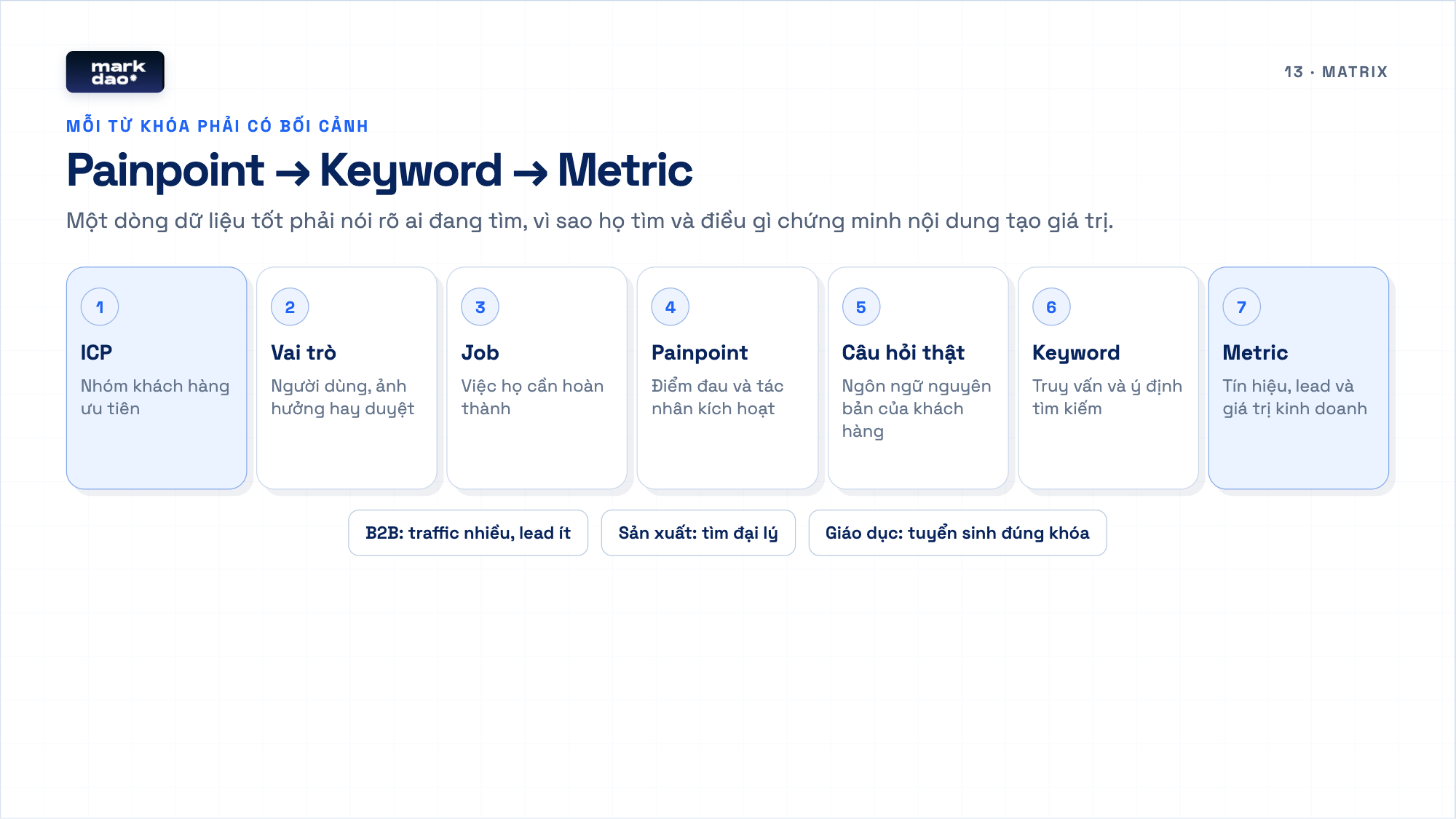
After the workshop, Markdao does not hand over a standalone keyword file. Each row in the matrix must include the following fields:
- ICP: Priority audience or business segments.
- Role: User, seeker, influencer, or approver.
- Jobs to be done.
- Pain points and triggers.
- Original question.
- Query or keyword cluster.
- Journey stage.
- Page type and destination URL.
- Required evidence.
- Relevant CTA.
- Leading metrics.
- Business metrics.
- Data sources and owners.
Example 1. B2B business with traffic but few leads
ICP: Marketing Director of a B2B company with a website active for over 12 months.
Pain point: The content team produces many articles, but Sales says the leads are not the right fit.
Question: “Why is SEO traffic increasing while potential leads are not?”
Keywords: traffic up but no conversions; SEO not generating leads; how to measure SEO leads; organic traffic conversion optimization.
Journey: Problem awareness and diagnosis.
Relevant page: Diagnostic article with a decision tree, query audit template, and landing page.
Evidence: Example of classifying 100 queries by intent, dashboard screenshots before and after, and an explanation of how to link forms to sources.
CTA: Download the “Organic Lead Quality Audit” template.
Leading indicators: Checklist usage, clicks to service pages, and return visitor rate.
Business metrics: Qualified organic leads, lead-to-opportunity conversion rate, and SEO-supported pipeline.
Example 2. Manufacturers looking for distributors or project-based clients
ICP: Sales or Marketing Managers at manufacturing companies with long sales cycles.
Pain points: Website is full of technical specifications but fails to help buyers select configurations or evaluate supplier capabilities.
Question: “How can technical buyers find the right product and submit a quote request?”
Keyword clusters: specifications, applications, material comparisons, standards, capacity-based pricing, and industry-specific suppliers.
Journey: From solution discovery to shortlisting.
Relevant pages: Application hubs, comparison pages, product selectors, industry case studies, and capability pages.
Evidence: Blueprints, certifications, factory photos, specifications, lead times, and real-world use cases.
CTA: Submit a configuration request or download the specification sheet.
Leading indicators: Filter usage, document downloads, and case study views.
Business metrics: Information-rich quote requests, industry-specific opportunities, and organic pipeline value.
Example 3. Educational centers needing to enroll students in the right courses
ICP: Parents or learners with specific needs based on age, goals, and schedule.
Pain points: High volume of inquiries, but from people at the wrong level, with conflicting schedules, or who are not ready to enroll.
Question: “Which course fits my goals and schedule?”
Keyword clusters: courses by goal, age, prerequisites, schedule, tuition, reviews, and roadmap comparisons.
Journey: Explore solutions, compare options, and mitigate risks.
Relevant pages: Roadmap page, self-assessment quiz, tuition FAQ, class schedule, and student success stories.
Evidence: Sample tests, course outcomes, instructor profiles, and contextualized student results.
CTA: Take the assessment or request a roadmap consultation.
Navigation metrics: Completion rate for assessments, schedule selection, and tuition page views.
Business metrics: Leads within the target age or proficiency range, consultation booking rate, and enrollment rate.
Markdao's systematic SEO implementation SOP
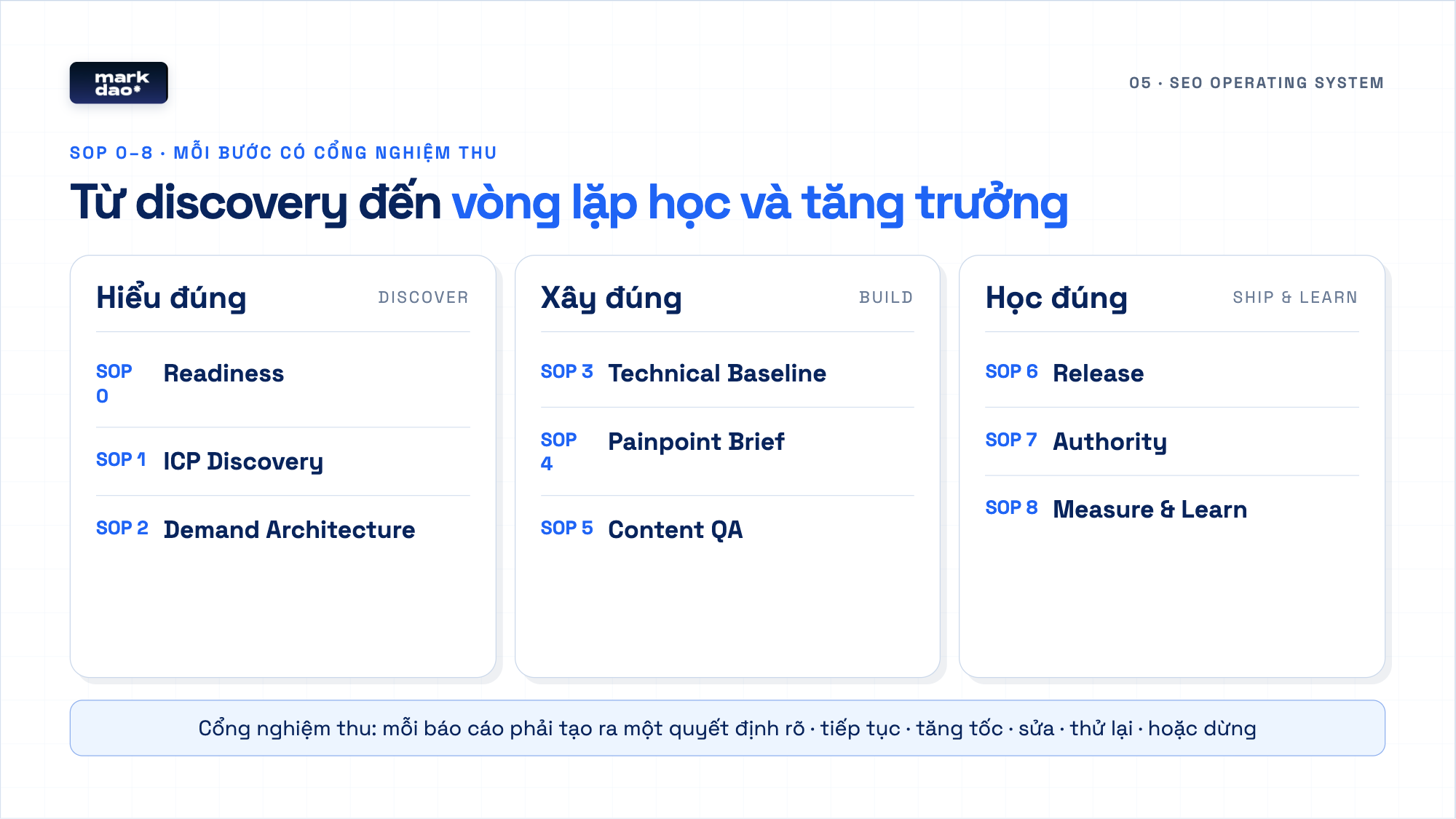
The following SOP is designed to avoid two extremes: spending too long planning without publishing, or publishing too quickly without learning anything. Each SOP includes inputs, actions, outputs, and a sign-off gate.
SOP 0. Pre-project readiness check
Inputs:
- Business goals, product scope, and target market.
- Access to the website, Search Console, GA4, Tag Manager, and CRM (if applicable).
- Content approvers, website developers, and industry experts.
- Legal, branding, and data constraints.
Actions:
- Verify tracking, access permissions, and point of contact.
- Define tasks handled directly by Markdao, collaborative tasks, and tasks owned by the client.
- Document risks that could delay the project.
Outputs: Project charter, RACI matrix, access list, and risk log.
Sign-off gate: Do not commit to output targets without an owner, baseline, and a defined process for implementing revisions.
SOP 1. ICP Discovery and Growth Strategy
Inputs: Business data, customer lists, sales calls, website, and product information.
Actions:
- Workshops with leadership, Marketing, Sales, and product experts.
- Segment customers based on value, serviceability, and fit.
- Identify the buying committee, pain points, triggers, objections, and buying criteria.
- Clearly document any hypotheses that lack supporting data.
Outputs: ICP priority map, pain point inventory, trigger map, and objection-to-proof map.
Acceptance criteria: Each ICP must have a clear rationale for priority, exclusion criteria, and identified decision-makers.
SOP 2. Demand Research and Keyword Architecture
Inputs: SOP 1 documentation, Search Console, ad data, SERPs, competitors, and customer language.
Actions:
- Expand each pain point into a system of questions.
- Collect queries and group them by intent, not just by keyword match.
- Analyze SERPs to determine the content types Google prioritizes.
- Score opportunities based on value, win rate, and feasibility.
- Assign a primary URL for each intent to prevent keyword cannibalization.
Outputs: Pain point-to-keyword matrix, opportunity scores, and content architecture.
Acceptance criteria: No keywords without an assigned ICP, intent, URL, CTA, or KPI. No two URLs competing for the same intent without a clear justification.
SOP 3. Technical Baseline and Measurement
Inputs: Website, tool access, and content architecture.
Actions:
- Audit crawl, index, robots, sitemap, canonical, redirects, status codes, and URL structure.
- Audit Core Web Vitals, mobile, JavaScript, templates, and structured data based on impact level.
- Verify GA4 events, forms, calls, lead sources, and CRM integration.
- Create a backlog based on Impact, Effort, Confidence, and Dependency.
Outputs: Technical baseline, measurement plan, and prioritized backlog.
Acceptance criteria: Each issue must include evidence, scope of impact, owner, verification method, and expected completion date.
SOP 4. Writing content briefs based on pain points
Inputs: A priority row from the Painpoint-to-Keyword matrix.
Actions:
- Define the core question and the decision the reader needs to make.
- Analyze top search results without mechanically copying the outline.
- Identify information gaps and evidence that Markdao or the client can provide.
- Prepare interview questions for subject matter experts.
- Specify headings, examples, illustrations, internal links, CTAs, and KPIs.
Outputs: Content brief include ICP, pain points, intent, promise, outline, evidence plan, visual plan, and conversion path.
Acceptance criteria: The brief must state the new value of the article. "Writing more comprehensively than competitors" is not considered new value.
SOP 5. Content production and review
Input: Approved brief, data, and expert interview schedule.
Actions:
- Interview experts, prioritizing examples, difficult decisions, and lessons learned from failures.
- Write quick answers first, then expand with explanations and instructions.
- Cite sources for data, clearly state assumptions, and avoid absolute promises.
- Check for natural language, keyword density, headings, internal links, alt text, and CTAs.
- Review for expertise, brand alignment, and SEO before publishing.
Output: Content ready for the page, image package, and QA checklist.
Acceptance criteria: The target reader must be able to do or decide something after reading. The content must not simply rephrase what competitors have written.
SOP 6. Publishing, internal linking, and technical checks
Input: Approved content and URL map.
Actions:
- Upload content to the correct template, check for a single H1, and verify H2/H3 structure.
- Set appropriate title, meta, canonical, schema, and Open Graph tags.
- Add internal links from relevant pages and paths to the next step.
- Check mobile responsiveness, speed, forms, tracking, indexability, and post-publish display.
- Request indexing when necessary and record the release date.
Deliverables: Live URL, release checklist, and testing evidence.
Acceptance criteria: The page must be mobile-responsive, CTAs must be functional, data tracking must be accurate, and the page must be crawlable by Google.
SOP 7. Building Authority and Distribution
Inputs: Content or assets with citation value.
Actions:
- Identify relevant individuals, communities, or websites.
- Turn data, checklists, tools, expert opinions, or case studies into reasons to be featured.
- Distribute via LinkedIn, email, partners, communities, and contextual PR.
- Track sources, link types, and ownership.
Deliverables: Distribution log, mention/backlink record, and referral performance.
Acceptance criteria: Every activity must have a target audience, value exchange, and relevant context; avoid buying low-quality, meaningless links.
SOP 8. Measurement, Learning, and Optimization
Inputs: Search Console, GA4, CRM, rank tracking, content, and deployment logs.
Weekly actions:
- Check indexing, new errors, query fluctuations, and anomalous CTA performance.
- Compare priority pages against the baseline.
- Log events that may impact performance, such as releases, campaigns, or algorithm updates.
Monthly actions:
- Evaluate by pain point clusters and user journey stages, rather than just total website performance.
- Compare traffic against conversions and lead quality.
- Select the pages to update, merge, expand, or discontinue.
- Feed sales feedback back into the Voice-of-customer library.
Output: Insight report, decision log, and next month's backlog.
Acceptance gate: Each report must result in at least one clear decision: continue, accelerate, revise, retry, or stop.
Markdao's recommended SEO metrics system
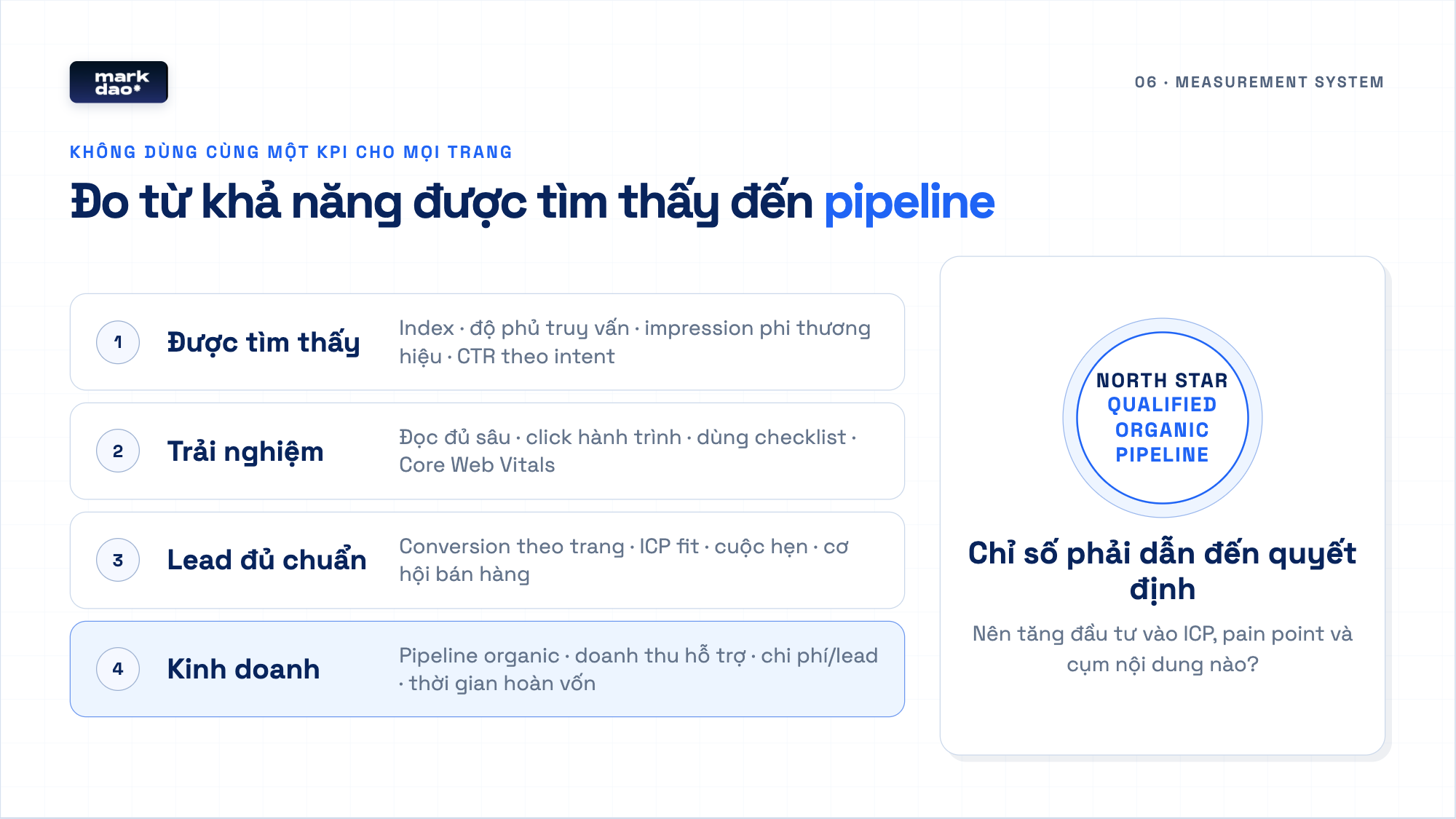
A metric is only useful if it leads to a decision. Markdao divides the measurement system into four tiers to avoid jumping straight from "published" to "revenue growth."
Tier 1. Discoverability
- Number of priority pages crawled and indexed.
- Query coverage by pain point and stage.
- Non-branded impressions and share of voice for target query groups.
- Rankings and CTR by intent group, rather than just site-wide.
Supporting decision: Has Google understood and delivered the right page for the right need?
Tier 2. Experience quality
- Engagement rate by page and device.
- Clicks to subsequent content, case studies, or service pages.
- Completion rate for checklists, tools, or videos.
- Core Web Vitals and experience issues on priority pages.
Supporting decision: Did the user get their answer and take the next step?
Tier 3. Conversion and lead quality
- Conversion rate by landing page and pain point cluster.
- Leads have sufficient classification fields.
- Lead-to-ICP fit rate.
- Lead-to-appointment or opportunity conversion rate.
Decision support: Is SEO generating valuable demand or just activity?
Level 4. Business results
- Pipeline directly generated by organic search.
- Pipeline supported by organic search.
- Revenue, profit margins, or contract value by source where measurable.
- Cost per qualified lead and payback period.
- Sales cycle of organic leads compared to other sources.
Decision support: Which ICPs, pain points, and content clusters should receive increased investment?
Three principles for interpreting data
- Do not compare top-of-funnel content with service pages using the same conversion rate.
- Do not draw conclusions from a single metric without checking queries, pages, devices, timeframes, and implementation changes.
- Do not optimize just to make the numbers look good if lead quality or user experience suffers.
12 criteria for selecting an SEO agency before signing a contract
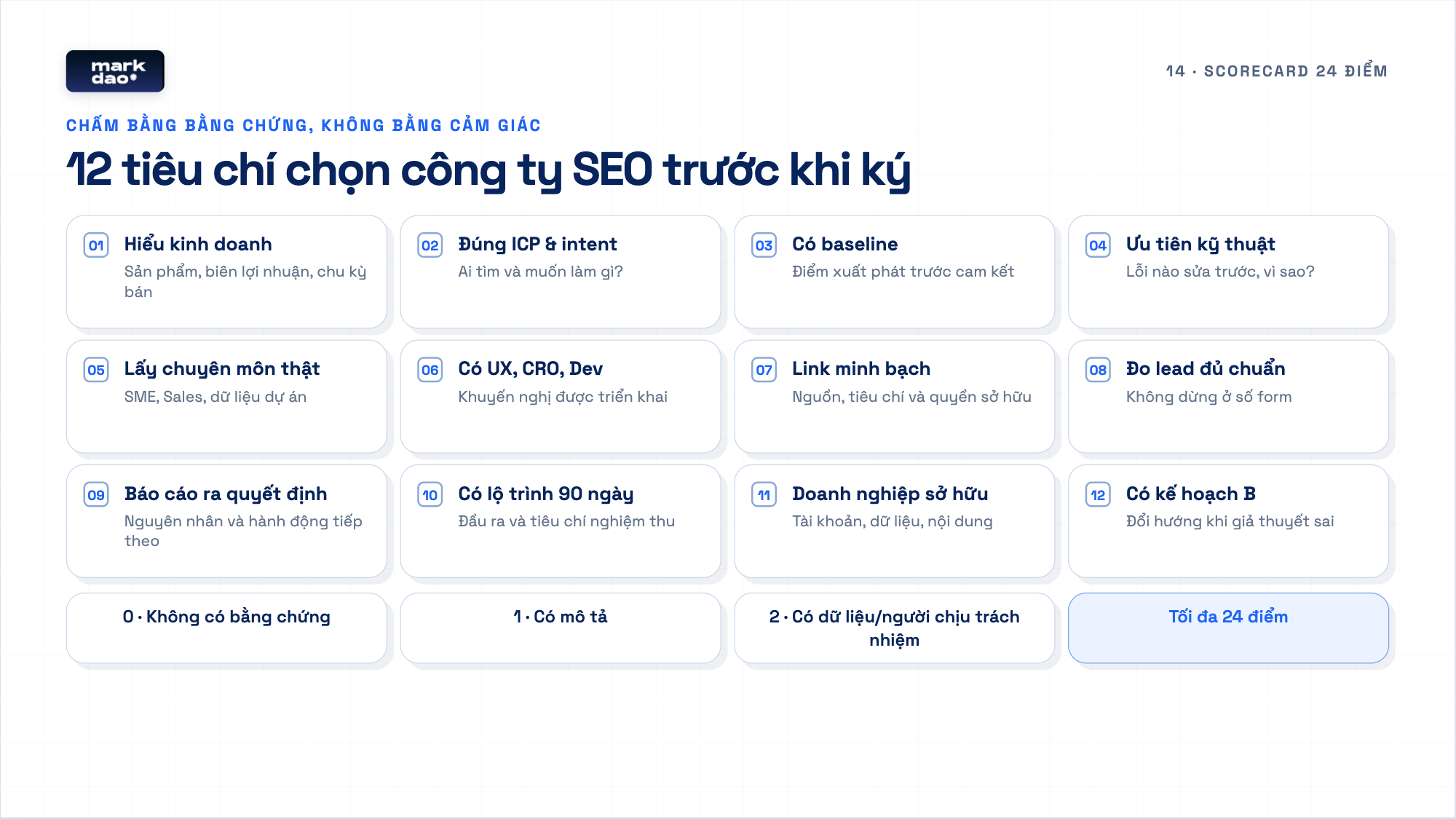
Score each criterion from 0 to 2: 0 for no evidence, 1 for a description without verification, and 2 for clear examples, data, or a designated point of contact. The maximum score is 24.
1. Understanding the business problem
Does the agency ask about your product, profit margins, sales cycle, market, closing rate, and growth goals? If the conversation starts and ends with keyword volume, they do not understand the business problem.
2. Identifying the right customers and search intent
An agency must be able to explain who is searching, what they want to achieve, and what content will help them take the next step. A file containing thousands of keywords is not a strategy.
3. Establish a baseline before promising results
A baseline should include index status, non-branded traffic, lead-generating page groups, conversion rates, technical issues, content coverage, and tracking quality. Without a starting point, any growth commitment is vague.
4. Prioritize technical tasks
Ask the agency to select the three most critical errors to fix first and explain their impact. A good expert doesn't just find many errors; they know which ones are worth allocating resources to first.
5. Have a mechanism to extract real expertise from the business
Content requires a schedule for expert interviews, internal data, questions from Sales, and an approval process. If an agency just takes keywords and mass-produces content, it may be grammatically correct but factually inaccurate.
6. Possess UX, CRO, and Developer capabilities
Check who will handle changes to templates, forms, navigation, speed, and tracking. If every recommendation is pushed back to the business without a collaborative partner, progress will get stuck in a backlog with no owner.
7. Transparency regarding links
The business needs to know the link sources, approval criteria, account ownership, and policies for contract termination. Do not accept lists that only show DA and DR without relevant context.
8. Measure qualified leads, not just form submissions
A spam form and a high-value opportunity are both counted as "one conversion" in basic reports. The agency should integrate with your CRM or at least have a mechanism to categorize lead sources and quality.
9. Reports that drive action
Every report should include conclusions, root causes, completed tasks, upcoming tasks, and decisions requiring business support. Dashboards do not create improvements on their own.
10. Have a 90-day roadmap and acceptance criteria
Clearly ask what assets will be delivered by days 30, 60, and 90. "Continuous optimization" is not sufficient for project sign-off.
11. Ownership belongs to the business
Google accounts, websites, content, design files, dashboards, data, and process documentation must have clear ownership terms defined in the contract.
12. Have a plan for when hypotheses are wrong
SEO is an experimental process within a system of many variables. A trustworthy agency won't pretend to know everything. They will propose hypotheses, measurement methods, testing timelines, and conditions for pivoting.
Scoring guide:
- 20 to 24 points: You have a solid foundation to move into the final negotiation round.
- 15 to 19 points: You have the capability, but need to clarify gaps in the scope and contract.
- Below 15 points: High risk; do not make a decision based solely on price or promises of rankings.
When should you hire an SEO agency versus building an in-house team?
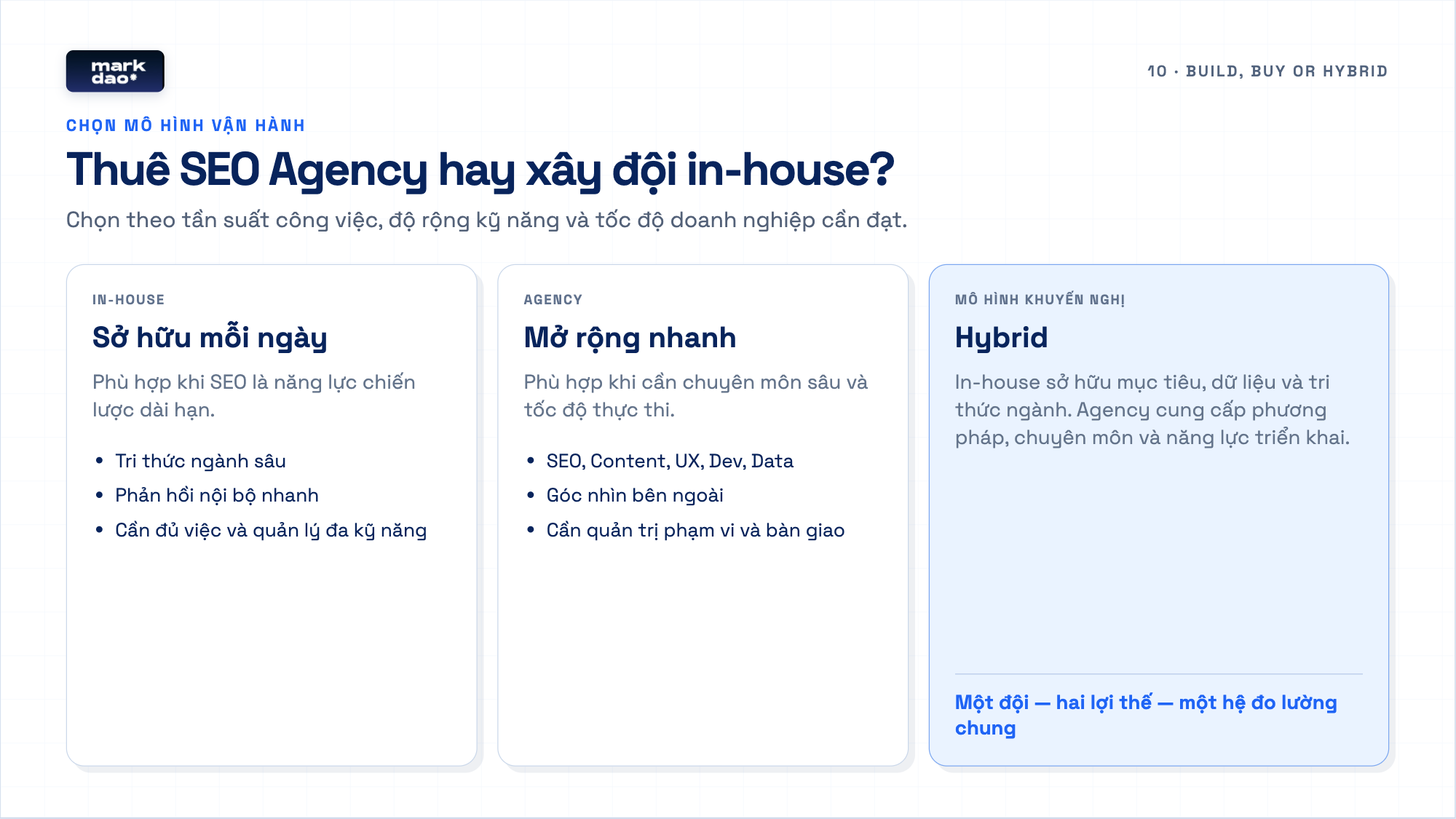
You should consider hiring an SEO agency if your business faces one of the following situations:
- Your website has potential, but traffic or leads have been stagnant for months.
- Your marketing team understands your customers but lacks expertise in technical SEO, content SEO, or development.
- Your business is preparing to redesign the website, switch platforms, or migrate domains.
- Your market includes many product categories, locations, or segments that need rapid expansion.
- Leadership requires a clearer measurement system before increasing the budget.
The in-house model is more suitable when SEO is a strategic competency required daily, and the business has enough long-term workload to hire and manage a multi-skilled team.
In practice, the most effective model is often a hybrid: in-house staff own the goals, data, and industry knowledge, while the SEO agency provides the methodology, specialized expertise, and execution speed.
10 questions to ask an SEO agency during a consultation
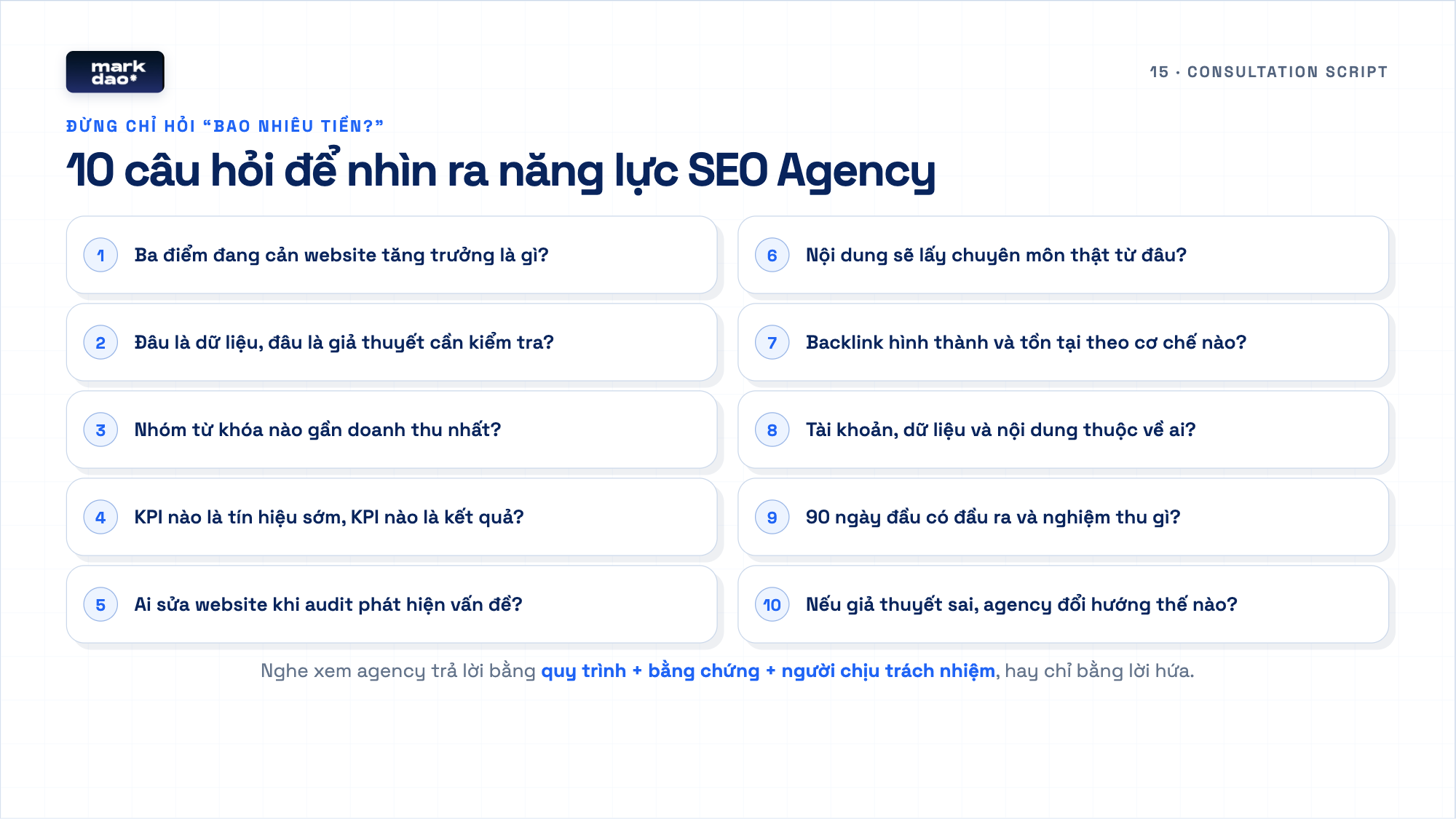
- What are the three biggest factors currently hindering your website's growth?
- Of those three, which are based on observed data and which are hypotheses that need testing?
- Which keyword groups are closest to generating revenue, and why?
- Which KPIs are leading indicators, and which are business outcomes?
- Who will make changes to the website when an audit identifies technical or conversion issues?
- Where will the real-world experience and industry expertise for the content come from?
- How are backlinks generated, and will they remain after the contract ends?
- Who owns the accounts, data, content, and dashboard?
- If the hypothesis proves incorrect after 90 days, what is the process for pivoting?
- Please show us a case study similar to our situation, including the starting point, actions taken, measurement period, and the limitations of the results.
A good agency won't be bothered by these questions. They might not have every answer right away, but they will be clear about what additional data is needed rather than filling the gaps with empty promises.
7 red flags when hiring an SEO agency
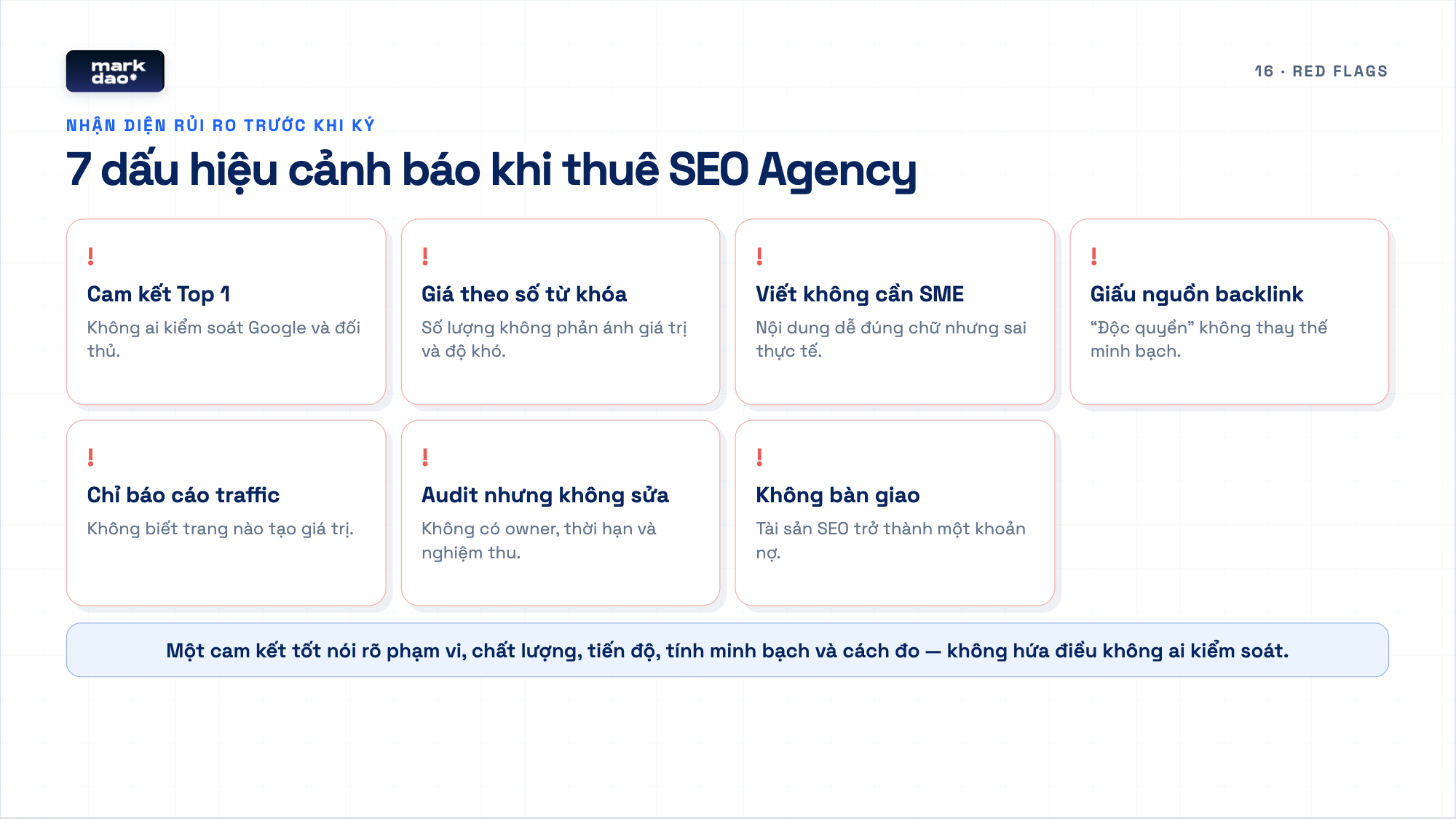
Guaranteeing Top 1 rankings for every keyword
No agency can control Google, competitors, or every algorithm update. Absolute guarantees often mask the selection of overly easy keywords, favorable acceptance criteria for the provider, or risky techniques.
Pricing based solely on the number of keywords
Two keywords can differ completely in intent, competition, value, and the type of page required. Quantity cannot replace the scope of work.
Mass-producing content without consulting experts
If an agency can write about complex products without asking your team, it is highly likely the content is just a compilation of common knowledge.
Refusing to disclose backlink sources
"Proprietary backlinks" is not a valid reason to hide sources, link types, selection criteria, or post-contract policies.
Reporting only on traffic and rankings
Without data on landing pages, query groups, conversions, and lead quality, a business cannot know what is actually driving value.
Providing an audit without an implementation roadmap
Ask who will handle the fixes, the deadlines, and the acceptance criteria. If the answer for most items is "the client handles it," you need to account for additional costs and the risk of delays.
No handover terms
Assets with unclear ownership are a liability. Don't wait until the contract ends to ask.
The first 90-day roadmap with a good SEO agency
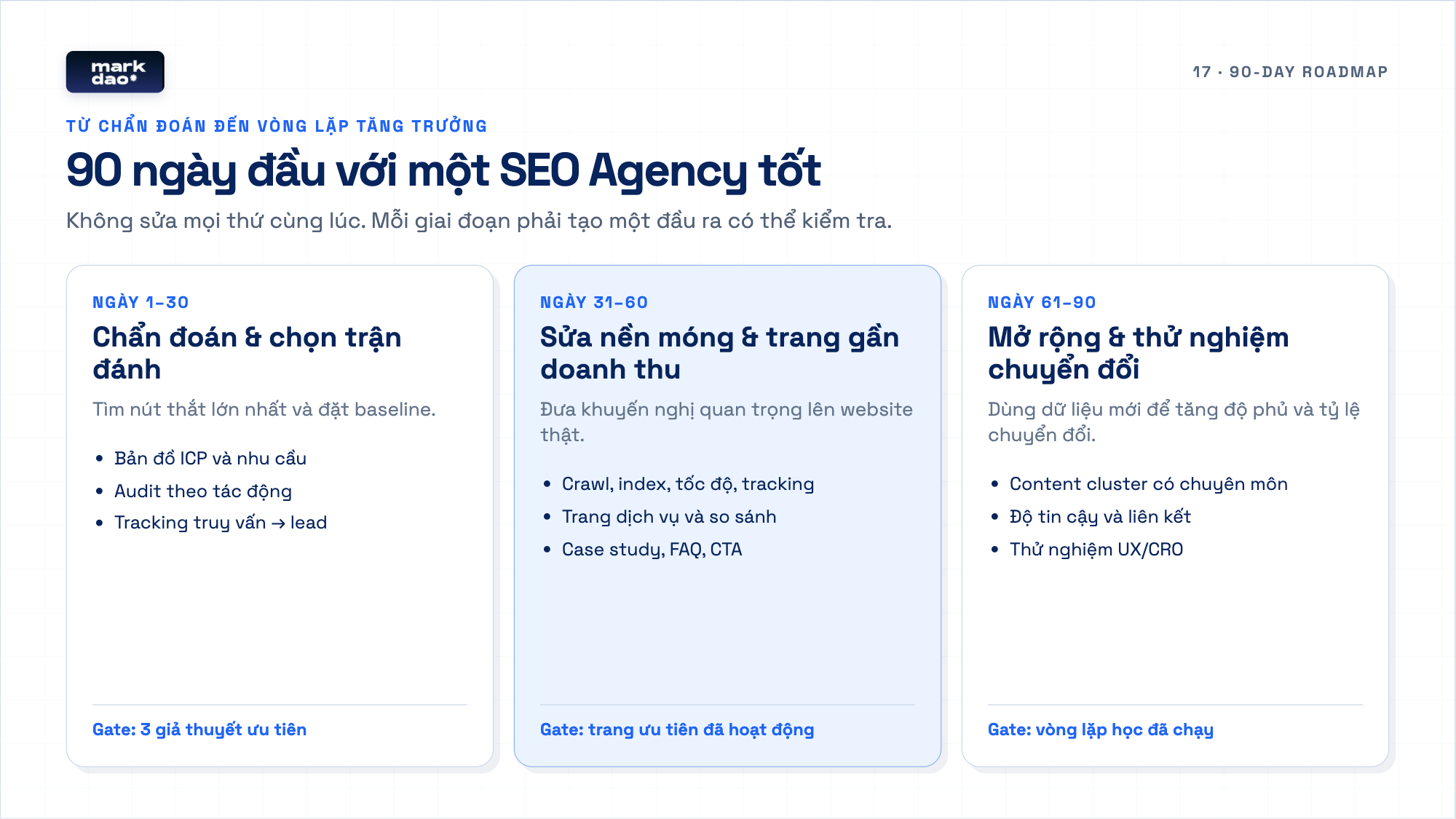
Days 1 to 30: Diagnosis and choosing the right battles
The goal isn't to fix every error. The goal is to identify the biggest bottleneck.
Deliverables should include:
- SEO and conversion baseline.
- Customer journey map, search intent, and page clusters.
- A list of issues prioritized by impact and effort.
- A tracking plan from queries and landing pages to leads.
- Three growth hypotheses to test first.
Days 31 to 60: Fixing the foundation and building revenue-driving pages
The team handles crawl, index, speed, or tracking issues while improving service pages, comparison pages, case studies, and FAQs that are close to the point of purchase.
Deliverables should include:
- Priority technical fixes deployed to the live environment.
- Website structure and new internal links.
- A set of BOFU pages with clear messaging, social proof, and CTAs.
- A process for expert interviews and content approval.
Days 61 to 90: Scaling content, authority, and conversion testing
Once the foundation is stable, the agency accelerates content and reach. Each cluster should have a pillar page, supporting articles, links to service pages, and specific measurement criteria.
Deliverables should include:
- The first cluster of content published and indexed.
- A link-building or brand-mention strategy with clear sources.
- Testing of CTAs, forms, or social proof on priority pages.
- A 90-day report outlining key learnings, what to stop doing, and the plan for the next quarter.
SEO isn't a tree that grows to full size in 90 days. However, after 90 days, a business should see enough of a foundation, assets, and signals to know if the strategy is heading in the right direction.
How should an SEO agency quote be structured?
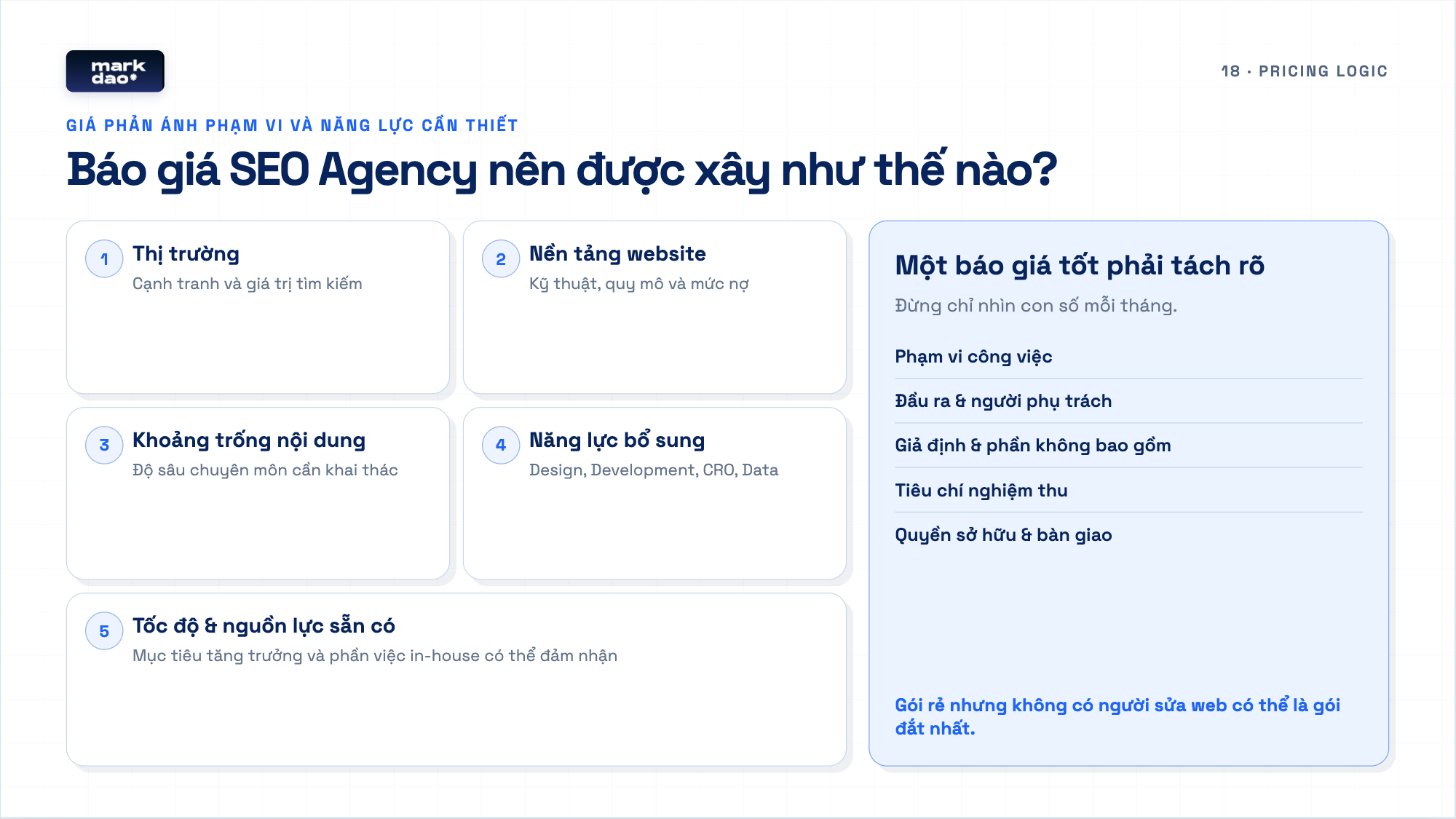
There is no one-size-fits-all price for every website. A reasonable cost depends on at least five variables:
- The level of competition and the value of the search market.
- The technical status, platform, and scale of the website.
- Content gaps and the level of expertise required.
- Needs regarding design, development, CRO, and data.
- Desired growth rate and available in-house resources.
Instead of just asking "how much per month," request a quote broken down by scope, deliverables, personnel, assumptions, exclusions, and acceptance criteria. A cheap package that leaves all website fixes to the client can end up being more expensive than an integrated package that accounts for all necessary resources.
Why is Markdao at the top of this SEO agency shortlist?
The market is not short on teams that know how to research keywords or write articles. The harder gap to fill lies in connecting SEO with a website that is capable of persuading and converting.
Markdao has an advantage by viewing the website as a unified growth system:
- SEO identifies needs and opportunities.
- Content transforms expertise into credible answers.
- UX/UI helps readers understand and make decisions.
- Development publishes recommendations directly to the live website.
- Data reveals what constitutes a qualified lead.
This approach is particularly well-suited for businesses that have previously "done SEO without generating sales," are currently redesigning their website, or need a partner to take full responsibility from diagnosis to implementation.
Markdao should not just prove its capabilities through keyword rankings. More compelling evidence in every proposal is a brief diagnostic report including: the biggest bottleneck, the data used to reach that conclusion, three 90-day priorities, the person responsible, and lead-related KPIs. This is also the standard you should demand from any SEO agency.
If you are considering an investment, start by sending Markdao three pieces of information: your website, your priority product or service groups, and your lead goal for the next six months. Both teams can use this to define the problem that needs solving before discussing the number of articles or backlinks.
Conclusion: Don't buy rankings; buy a system for learning and growth from your SEO agency.
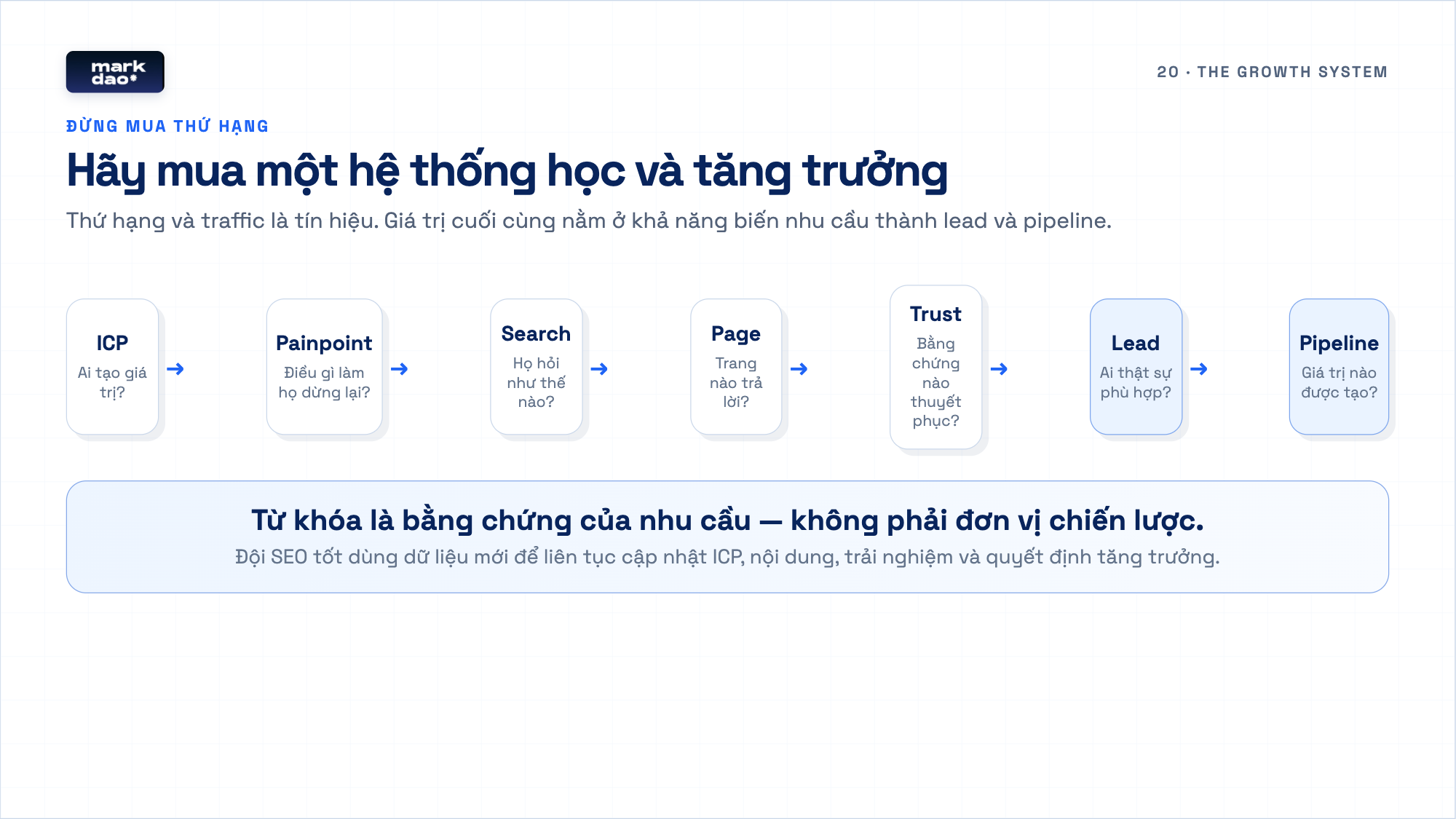
Good SEO doesn't start with the question, "How many keywords will rank on top?" It starts with, "Which customers do we want to attract, what do they need to believe, and where is the website causing them to drop off?"
A worthy SEO agency must turn those answers into prioritized tasks, assets that belong to your business, and data that drives decision-making. When that happens, rankings and traffic don't disappear from reports. They simply return to their proper role: signals on the path to leads, sales opportunities, and sustainable growth.
You can start with Markdao's comprehensive SEO services, then further evaluate our expertise in SEO-friendly website design, keyword research and optimization guides, how to use Google Search Console, SEO-optimized landing page design and Google Webmaster Guidelines principles to evaluate proposals from any agency yourself.
FAQ

No one can fully control Google, competitors, or user behavior. An agency can commit to the scope of work, quality standards, timelines, transparency, and improvement goals. Be cautious of promises of absolute #1 rankings for every keyword.
The timeline depends on the website's condition, competition, resources, and goals. In the first few weeks, businesses should see a baseline established, errors fixed, and priority pages improved. Growth in rankings, traffic, and leads typically requires more cycles of crawling, publishing, testing, and building authority.
Hiring an agency is suitable when you need rapid access to a wide range of specialized skills. In-house is better when the workload is substantial and SEO is a core daily operation. Many businesses use a hybrid model: in-house owns the goals and industry knowledge, while the agency provides the methodology and execution power.
At a minimum, it should include results by query group and page, technical issues, implemented content, conversions, lead quality (if measurable), root cause analysis, and the next action plan. Reports should be more than just screenshots of a dashboard.
According to Google's current guidelines, core SEO principles still apply to AI-powered search experiences. Businesses should prioritize unique content, genuine expertise, clear structure, machine-readable data, helpful imagery, and strong crawlability/indexability, rather than buying a "GEO" package based on unverified hacks.