


Listen up! There are many untold secrets about URLs and Domains! If you want to optimize your website quickly and effectively, check this out before it's too late! In this article, we will:
- Get familiar with the concepts of URL/URL Rating and tips to fully leverage the potential of UR.
- Discover what Domains and Domain Rating are, along with expert tips to master Domain Rating.
At the end of the article, there will be a short Q&A section to help answer common questions about URL and Domain Rating.
URL and URL Rating: Do you really know everything about them?
Before "unlocking" the secrets of URLs and UR, you need to equip yourself with the basics. What are they? What role do they play for your website, and how can you optimize them?
What are URLs and URL Rating? Why are these two factors important for your website?
URL stands for Uniform Resource Locator . Simply put, a URL is a web address. It is a reference to a web resource that specifies its location on a computer network and the mechanism for retrieving it.
Meanwhile, URL Rating—abbreviated as UR—is used to measure the backlink strength of a specific URL and its potential to rank highly on Google. It uses a 100-point scale to score link criteria. The higher the score, the stronger the website's backlink profile.
What UR hasn't told you: 3 smart tips to leverage UR most effectively.
If you are just starting to learn about SEO and UR, you might be missing some important information. So, be sure to take note of the insights we share below:
- First, UR is a page-level metric, while DR (Domain Rating—which we will cover later) is a domain-level metric. Therefore, if you plug a website into Ahrefs —one of the most popular and effective SEO analysis tools—the number you receive will be specific to that main website.
- Second, the UR scale is logarithmic, meaning it is much easier to go from a UR of 20 to 30 than it is to move from a UR of 70 to 80.
- Third, be honest! Search engine algorithms can detect and penalize "Linking Loops"—the practice of repeatedly exchanging ranking points in a loop between two websites. If you want to know more about "Linking Loop”, read more here!
What are Domain and Domain Rating? How is Domain Rating calculated?
A domain, also known as a domain name, is the name of a website. It acts like a home address, helping satellite devices guide you to the exact page you are looking for. A web server and a domain are the two most basic requirements for a website to function properly. Without a domain, you would have to enter the exact IP address of each server every time you wanted to visit a website. website.
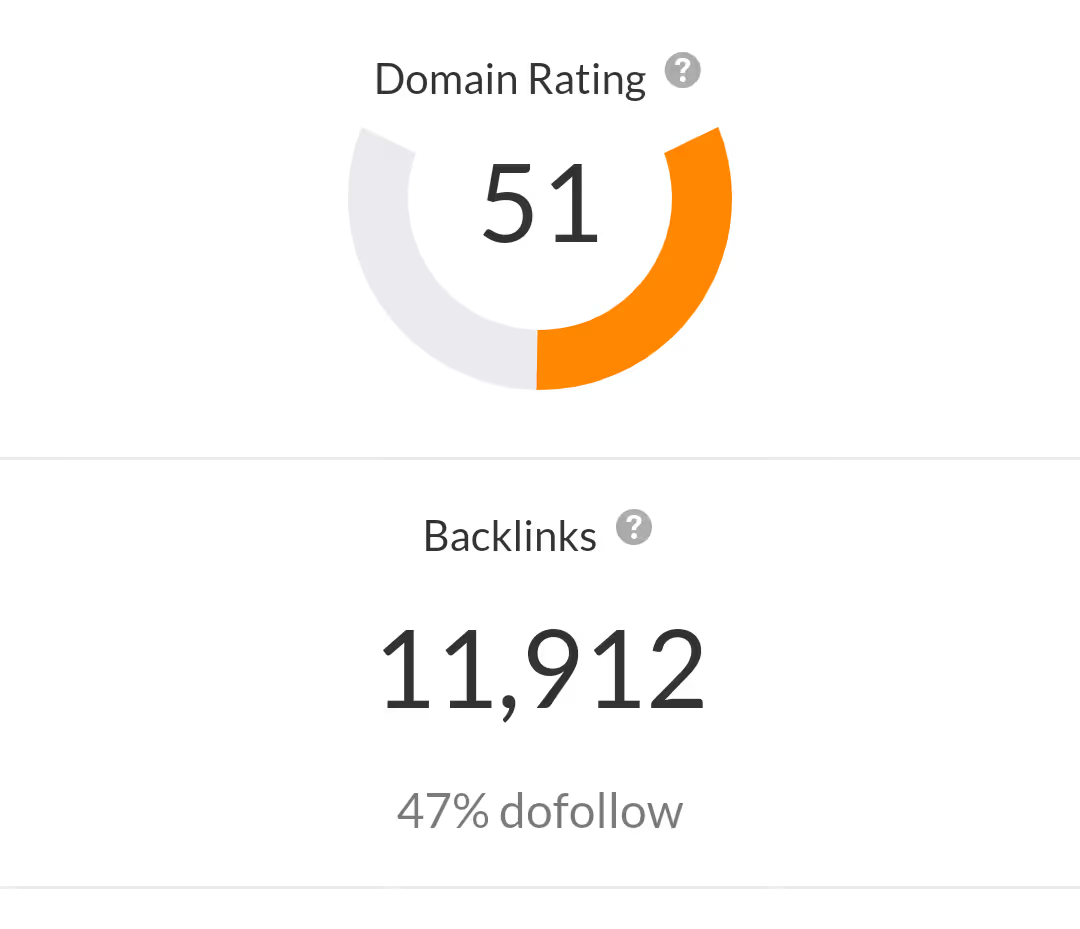
Meanwhile, Domain Rating indicates the link popularity of a website compared to others worldwide, based on a scale from 0 to 100. Essentially, it is a simplified version of Ahrefs Rating and can be considered an Off-page SEO activity.
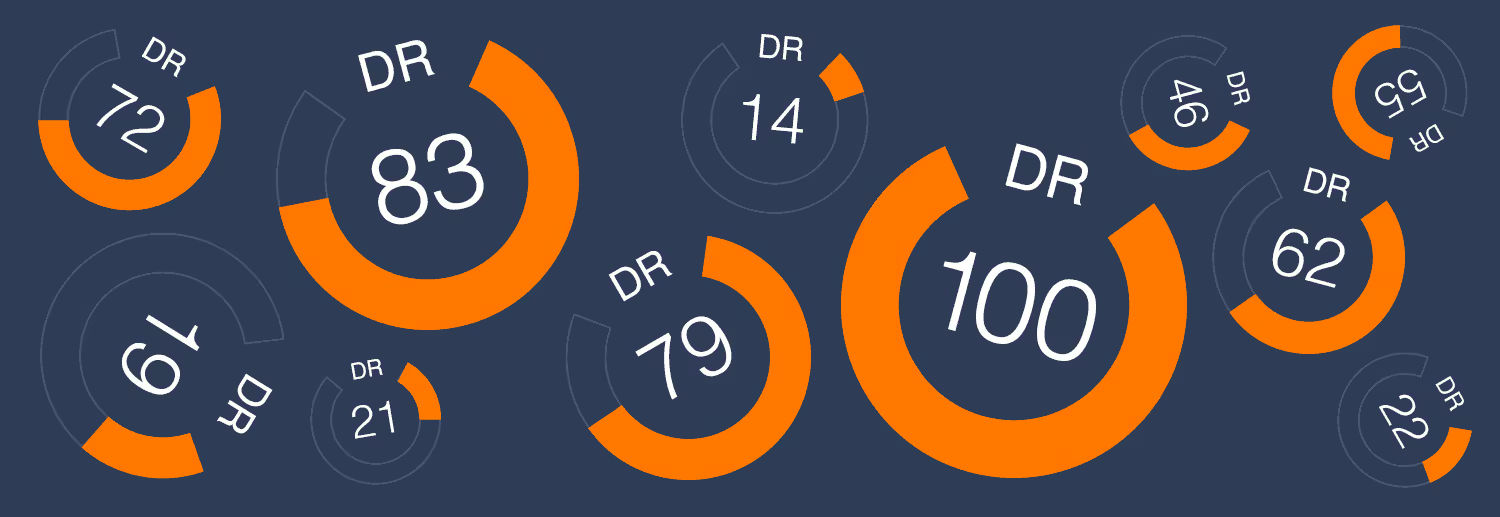
To calculate DR, two main factors are typically considered:
- Factor 1: If a domain's DR is higher, more "link juice" (a term referring to the strength or value passed to a website through external or internal links) is transferred to the linked domain.
- Factor 2: In reality, domain sources distribute their rating evenly among the domains they link to. For example, a domain with a DR of 10 linking to three other domains may influence your website's DR more than a domain with a DR of 80 linking to a million other domains.
After combining these two factors, we arrive at the DR score for each domain. The final DR value is calculated by scaling the absolute value within a range of 0 to 100.
Tips for mastering and leveraging Domain Rating for your goals
In practice, we can influence Domain Rating to some extent to maximize benefits for our website. DR depends not only on the total number of high-DR websites linking to your site but also on how many other websites those high-DR sites link to.
Therefore, view DR as a metric for selecting websites when building backlinks. To fully leverage this, target specific high-DR websites for backlinks, as they carry more "weight."
Q&A: Everything you need to know about URL Rating and Domain Rating
If you have many questions about UR and DR, you will likely find the answers here. We don't just clear up common doubts; we also help you debunk common misconceptions.
1. Why should we use UR?
All the information in this article about UR might sound complex and hard to grasp. However, take a moment to seriously consider the benefits that UR provides.
No one knows exactly how PageRank is calculated except for Google itself. However, pages with a high UR tend to rank higher in search results without needing to pay. This is because the UR formula is based on fundamental page ranking principles, closely follows Google's standards, and provides a sustainable way to evaluate a website's strength. Therefore, don't overlook UR!
2. "Is UR the same as Google's PageRank?"
Essentially, all comparisons are imperfect. While there are similarities, such as counting links between pages, using a "damping factor," and crawling websites extensively, UR and PageRank are still different. No one knows Google's exact algorithms. Basic tools like UR can only simulate how Google's algorithms—specifically PageRank—work and measure. Therefore, you cannot compare UR and PageRank due to the difference in their complexity.

3. Why might DR be much higher or lower than the UR of the same website?
Sounds illogical, right? However, if you run a website yourself, you are very likely to encounter this situation.
While both ratings are based on backlinks, DR is calculated at the domain level. This means it looks at the quantity and quality of domains linking to your entire website, whereas UR looks at the same factors for individual pages. Consequently, DR and UR scores can differ significantly.
4. Why does DR drop even when no backlinks are lost?
Websites exist within the broader landscape of the Internet and search engines. Therefore, website rankings and associated metrics like DR or UR are subject to relative changes within that overall landscape. This situation can occur when other websites gain a large number of backlinks.
Simply put, it happens when a website with a DR of 100 gains more backlinks, but the DR scale is capped at 100. To compensate, the scale for other websites must be adjusted downward.
5. Why is your website's DR lower than a competitor's even if you have more backlinks?
The answer is actually quite simple. DR considers not just the quantity but also the quality of backlinks. For example, if you have a link from a DR26 domain that links to 5 other domains, it will have more impact on your DR than a link from a DR73 domain that links to 5,000 other domains.
Hopefully, this article has provided you with an overview of both UR and DR, helping you better understand these two metrics and bring about positive changes for your website!