


In the field of online advertising, CTR (Click-Through Rate) is a key metric for evaluating the effectiveness of a Google Ads campaign. What is CTR? What does the CTR metric mean in Google Ads? A high click-through rate not only helps businesses reach their target audience effectively but also optimizes advertising costs and improves conversion rates.
So, what is a good CTR? How can you increase CTR in Google Ads? Let Markdao guide you through the details in the article below!
What is Click-Through Rate (CTR)?
CTR (Click-Through Rate) or click-through rate is a vital metric in online advertising, especially in Google Ads. This metric measures the effectiveness of an ad campaign by calculating the number of clicks an ad receives relative to the total number of times it is displayed.
CTR formula:
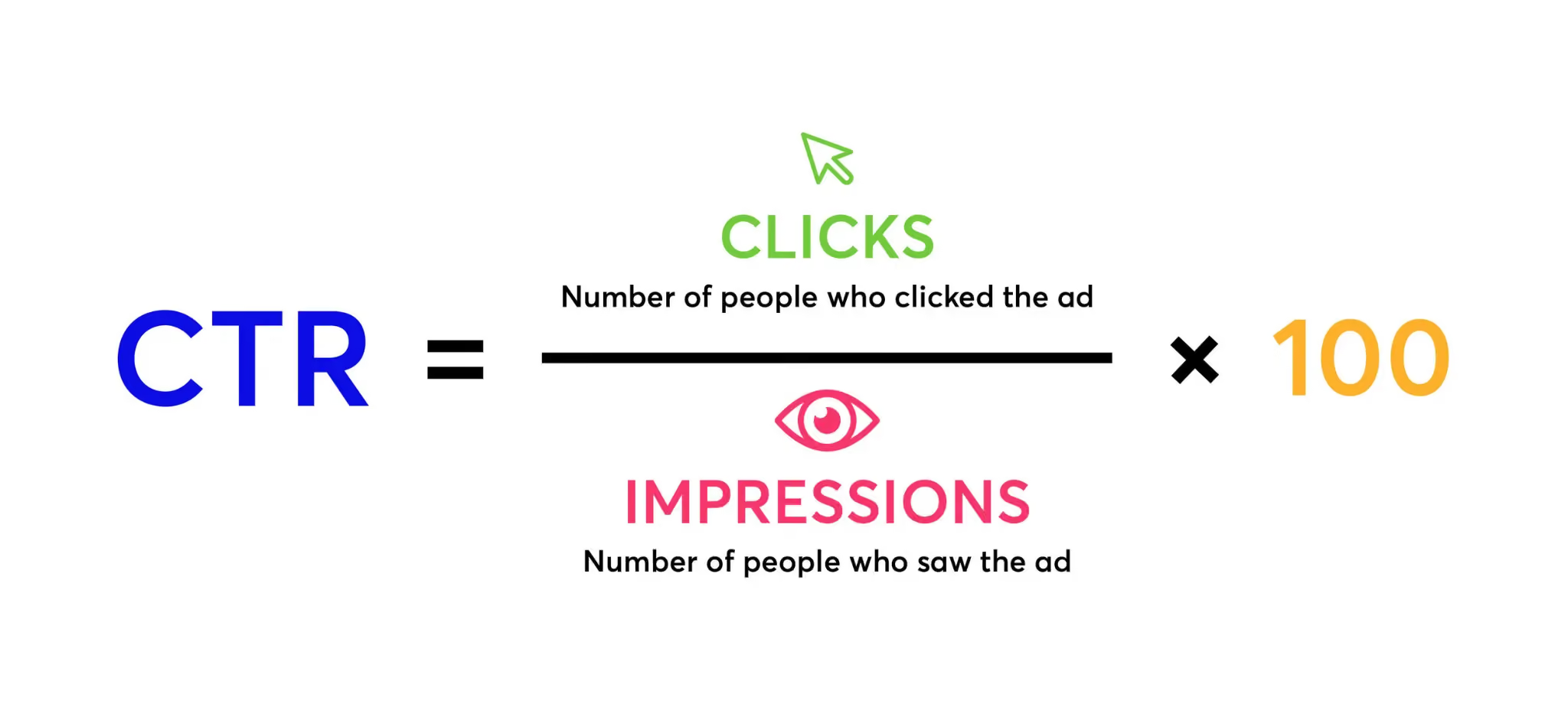
Example: If an ad is displayed 10,000 times and receives 500 clicks, the CTR would be:
CTR is a key metric for evaluating how engaging an ad is to users. A high CTR indicates that an ad is compelling, while a low CTR may be a sign that the ad content needs optimization.
The impact of CTR in Google Ads
Impact on Quality Score
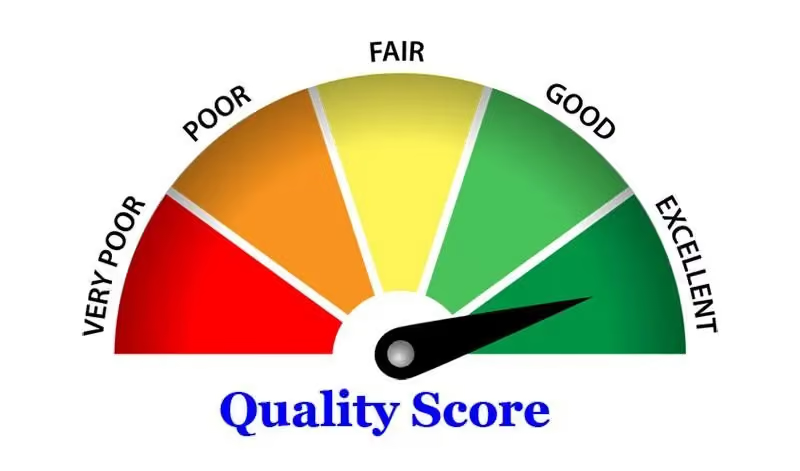
In Google Ads, CTR is a critical factor in calculating your Quality Score. A high Quality Score helps:
- Display ads in higher positions at a lower cost.
- Improve reach to potential customers.
- Optimize overall advertising costs.
Impact on CPC (Cost Per Click)
A high CTR can help reduce your cost per click (CPC). If Google determines that an ad has a high click-through rate, it considers the ad relevant and lowers the bid cost per click.

Impact on Conversion Rate
While CTR does not directly determine your conversion rate, a high CTR can increase conversion opportunities by demonstrating that the ad is attracting the right audience. However, to optimize conversions, you must ensure the landing page aligns with the ad content.
Relationship to campaign ROI (Return on Investment)
ROI depends on CTR, CPC, and conversion rate. When CTR is high, CPC decreases, and with a good conversion rate, ROI is optimized. Therefore, improving CTR in Google Ads can help businesses achieve better advertising performance at a more reasonable cost.
5 factors affecting CTR in Google Ads
1. Ad placement position
The top 3 positions on Google typically have the highest CTR. Ads appearing on the first page have a much higher click-through rate than those on the second page or lower. Therefore, optimizing your Quality Score helps improve your ad position.
2. Are your ad headlines and descriptions compelling?
Including primary keywords in your headline increases relevance. Clear descriptions of product or service benefits help users make quick decisions.
You can see that engaging headlines with specific data (Example: “50% off today”) help grab attention.
3. Use relevant keywords (Keyword Relevance)
CTR is closely linked to the alignment between keywords and ad content. Google prioritizes ads that match the user's search query. You should optimize your Ad Groups to ensure each ad targets the right keywords.
4. Display Ad Extensions
- Sitelinks: Direct users to important pages on your website.
- Callout Extensions: Highlight key benefits like “Free shipping” or “12-month warranty.”
- Structured Snippets: Provide detailed information about your product or service categories.
- Price Extensions: Display product prices to help customers make faster decisions.
5. Target the right audience
Define your target audience based on:
- Age, gender, and interests.
- Geographic location and active hours.
- Search history and online behavior.
Precise targeting increases the likelihood of attracting people who are genuinely interested in your products or services.
CTR (Click-Through Rate) is a critical metric in Google Ads that directly impacts your Quality Score, CPC, conversion rate, and ROI. To optimize CTR in Google Ads, you need to improve ad positioning, content, keywords, and extensions. A high-CTR optimization strategy not only boosts ad performance but also reduces costs and maximizes profit.
What is a good CTR in Google Ads?
When running Google Ads, many people wonder what is CTR? and what is a good CTR?. In reality, there is no fixed number considered "standard" because the ideal CTR depends on the type of ad, industry, and target audience. However, based on average statistics, here are some reference CTR levels for each type of Google Ads campaign.
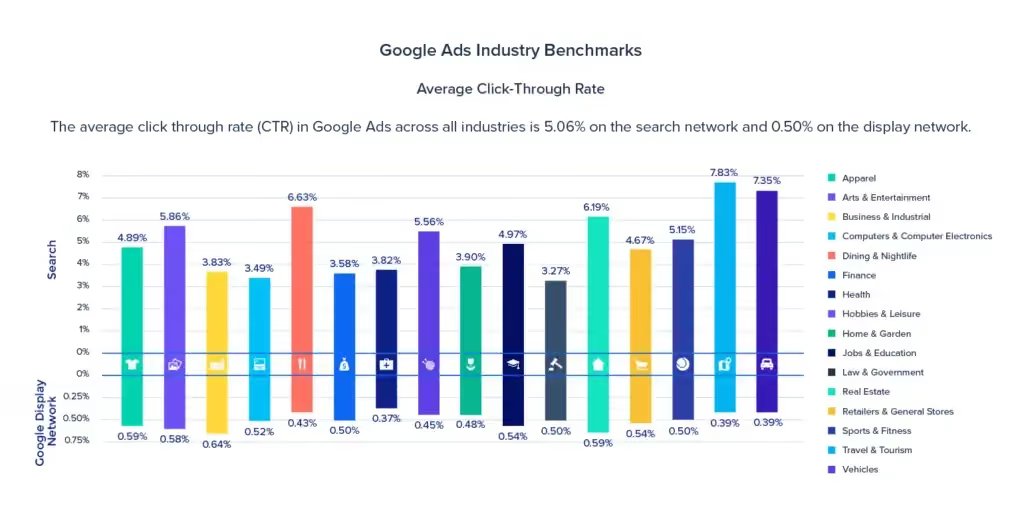
Average CTR by Google Ads campaign type
1. Search Ads
Average CTR: 3% - 6%
Characteristics:
- Appears on Google search results pages when users enter keywords.
- High purchase intent or information-seeking behavior, so CTR is typically higher than other ad formats.
Practical example: A company providing website design services runs ads with the keyword “professional website design services”. If an ad is displayed 10,000 times and receives 500 clicks, the CTR would be:
=> This is a good CTR for search ads.
2. Display Ads
Average CTR: 0.5% - 1%
Characteristics:
- Appears on the Google Display Network (GDN) in the form of image banners.
- The click-through rate is lower than Search Ads because users do not have a clear intent and are just seeing the ad incidentally.
Practical example: A luxury watch brand displays banner ads on news websites. After 100,000 impressions, the ad receives 700 clicks:
=> This CTR is acceptable for display ads.
3. Google Shopping Ads
Average CTR: 0.9% - 1.5%
Characteristics:
- Displays products along with images, prices, and store names directly on Google.
- The CTR is higher than Display Ads but lower than Search Ads.
Practical example: A shop selling sneakers run Google Shopping ads for the “Nike Air Force 1” product. After 50,000 impressions, there are 600 clicks:
=> This is a fairly good CTR for Google Shopping Ads.
4. YouTube Video Ads
Average CTR: 0.5% - 2%
Characteristics:
- Appears on YouTube before, during, or after a video.
- Users are not actively searching, so the CTR is typically low.
Real-world example: A cosmetics brand runs video ads on YouTube. The video is displayed 200,000 times and receives 2,000 clicks:
=> This is a stable CTR for YouTube video ads.
The ideal CTR also depends on the industry
Beyond the ad format, CTR also varies by industry. Below are some average CTRs by industry:
Example: A company providing spa & beauty services runs search ads with the keyword “premium skincare spa”. If the CTR reaches 6% - 7%, this is a very good rate because the beauty industry typically sees higher-than-average CTRs.
So, what is a good CTR in Google Ads? There is no fixed number, but on average:
- Search Ads: 3% - 6% (can be higher depending on the industry).
- Display Ads: 0.5% - 1%.
- Google Shopping Ads: 0.9% - 1.5%.
- YouTube Video Ads: 0.5% - 2%.
CTR also depends on the industry, keywords, ad content quality, and target audience. Therefore, instead of focusing solely on what CTR is, combine it with other metrics like CPC, Conversion Rate, and ROI to evaluate the overall effectiveness of your Google Ads campaign.
Guide to optimizing CTR in Google Ads
CTR (Click-Through Rate) measures the number of clicks on an ad relative to the number of times it is displayed. It is a key factor in determining the effectiveness of a Google Ads campaign.
A high CTR not only helps your ads reach the right audience but also improves your Quality Score, lowers your CPC (Cost Per Click), and optimizes your ROI (Return on Investment).
So, how can you improve your Google Ads CTR? Here are some essential optimization strategies.
Optimizing ad content to increase Click-Through Rate (CTR)
1. Write compelling ad headlines with a Unique Selling Proposition (USP)
The headline is the most critical factor in whether a user clicks on your ad. A compelling headline should:
- Include primary keywords to match user search queries.
- Clearly communicate the unique value of your product or service.
- Use engaging language that encourages action.
Example:
- Not optimized: "Buy men's sports shoes at a good price" (Generic, unappealing headline).
- Optimized: "Authentic Nike Sports Shoes - 50% Off Today!" (Highlights brand and attractive offer).
Use primary keywords in ad headlines and descriptions
Google favors ads with content that matches search queries. Therefore, your headlines and descriptions should include primary keywords to increase relevance.
Example: If your ad is for a website design service, instead of writing something generic:
- Not optimized: "Professional website design, cheap price".
- Optimized: "SEO-Friendly Website Design Services - Beautiful Interfaces, Lightning-Fast Speed!".
3. Add specific data to increase credibility
Specific numbers make ad content clearer, more transparent, and more persuasive.
Example:
- Not optimized: "Big promotion for new customers".
- Optimized: "50% Off - Only $20 for the First 100 Customers!".
4. Use strong and clear calls to action (CTA)
A call to action tells users what to do next. Effective CTAs should be clear, concise, and encourage immediate action.
Example:
- "Buy now - Limited stock!"
- "Sign up for free today!"
- "Get a quote now - Free consultation!".

Improve Quality Score to optimize CTR and reduce advertising costs
1. Use negative keywords to eliminate irrelevant impressions
Negative keywords help prevent wasting your advertising budget on irrelevant searches.
Example: If your business sells authentic watches, you can add negative keywords such as:
- "Fake watches"
- "Cheap watches"
- "Free watches"
This prevents your ads from appearing to users looking for low-cost or counterfeit products, thereby increasing your CTR and improving traffic quality.
2. Increase Ad Relevance
Google prioritizes ads with content that matches the user's search intent. To ensure this, your ad headlines and descriptions should align with your target keywords.
For example: If your target keyword is "online digital marketing course", your ad headline should include this phrase instead of a generic one like "Quality marketing course".
3. Improve Landing Page Experience
Your landing page should load quickly, be mobile-friendly, and deliver exactly what the ad promised. A high-quality landing page helps retain users, boosts conversion rates, and improves your Quality Score.
Leverage Ad Extensions to attract more clicks
Google Ads offers various extensions that make your ads more comprehensive, increasing their appeal to users.
1. Sitelinks - Direct users to important pages
These links help users quickly access key categories or pages.
Example: Home | Products | Promotions | Contact.
2. Callout - Highlight key benefits
This extension helps emphasize the standout values of your business.
Example: "Free shipping", "12-month warranty", "24/7 support".
3. Structured Snippets - Display product/service categories
Helps users clearly understand what your business offers.
Example: "Services: Website SEO, Google Ads, Facebook Ads".
4. Call Extension - Display phone numbers to increase direct calls
If your business wants to optimize conversions via phone calls, you should use this extension.
Example: "Call now: 0988.123.456".
Adjust bids and target the right audience to maximize CTR
1. Increase bids for keywords with high CTR and strong conversion rates
Review your Google Ads data to focus your budget on the keywords that deliver the best results.
2. Use device-specific adjustments (Mobile vs. Desktop)
If your target audience primarily searches on mobile devices, optimize your ads and landing pages for a seamless mobile experience.
3. Target by location, time, and user behavior
For example: If you run a food delivery service, focus your ads during lunch and dinner hours when demand is at its peak.
In summary, to optimize your Google Ads CTR, you need to:
- Write compelling ad headlines that include keywords and strong CTAs.
- Improve your Quality Score by optimizing ad content and the landing page experience.
- Use ad extensions to increase visibility and engagement.
- Adjust bids and target the right audience to maximize ad performance.
A high CTR not only helps your ads reach more customers but also lowers your cost-per-click (CPC) and improves your return on investment (ROI).
Conclusion
CTR is a key metric in Google Ads that directly impacts your campaign's Quality Score, cost-per-click (CPC), and conversion rate. Average CTR can vary depending on the type of ad and the industry.
To optimize CTR, businesses should focus on writing engaging headlines, optimizing ad content, improving landing pages, and utilizing ad extensions. As CTR improves, ad performance increases, helping businesses attract more customers and maximize returns from their Google Ads campaigns.