


Most Vietnamese content on sponsorship stops at definitions and lists of benefits. The difficult part lies elsewhere: how to value a sponsorship package and how to determine if that expenditure yields results. This article addresses those two questions, including a classification table, valuation formulas, and a partner evaluation checklist.
Distinguishing sponsorship from 4 easily confused forms
This is where most planning mistakes occur. The four forms below all put a brand in front of the public, but the nature of the transactions is entirely different.
Key takeaway: sponsorship is the only form in this group where you pay to purchase association rights, rather than just buying ad space for a logo. The logo is merely the surface-level manifestation of that right.
What is a sponsor?
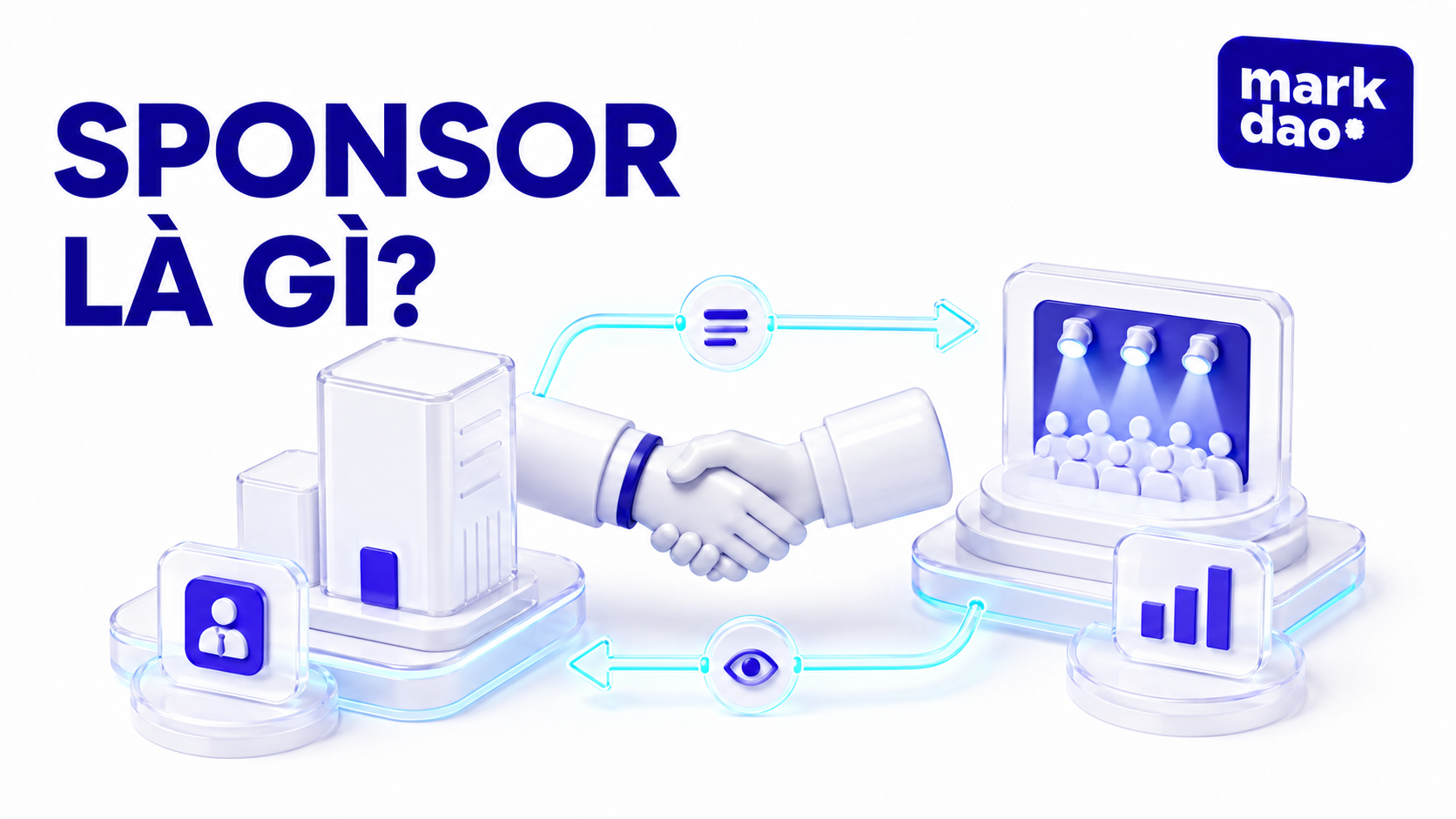
A sponsor is an individual, organization, or business that provides money, goods, or services to support an activity in exchange for the right to associate their brand with that activity. The recipient of the sponsorship is called the sponsee. This relationship is a commercial contract, not an act of charity.
The core difference from advertising lies in the asset being traded. When sponsoring a marathon, you aren't buying 500 logo impressions. You are buying the right for the public to think of your brand at the same time they think of that marathon. This asset is harder to measure, but it sticks in the memory much longer than a banner ad.

Sponsorship in non-marketing contexts
The word "sponsor" appears in many fields with different meanings. If you are looking this up for paperwork rather than marketing purposes, the section below is the answer you need.
- Study abroad and immigration: a sponsor is an individual or organization that provides financial guarantees, committing to cover costs for the applicant. In visa applications, this is a legal role with binding responsibilities.
- Employment: "visa sponsorship" means a business acts as a guarantor for a work permit for a foreign employee.
- Clinical trials: a sponsor is the organization that initiates and takes legal responsibility for the entire study, typically a pharmaceutical company.
- Project management: A project sponsor is a senior stakeholder who approves the budget and removes roadblocks for the project, not an external financial donor.
- Grammar: Sponsor functions as both a noun and a verb. "The bank sponsors the tournament" means the bank provides funding for the event.
The first four definitions are unrelated to Sponsor Marketing. The rest of this article focuses exclusively on the marketing definition.
How does Sponsor Marketing work?
Sponsor Marketing involves using sponsorship budgets to achieve brand or business objectives. Its mechanism is based on associative transfer: the emotions the public feels toward an event are partially transferred to the brand behind it.
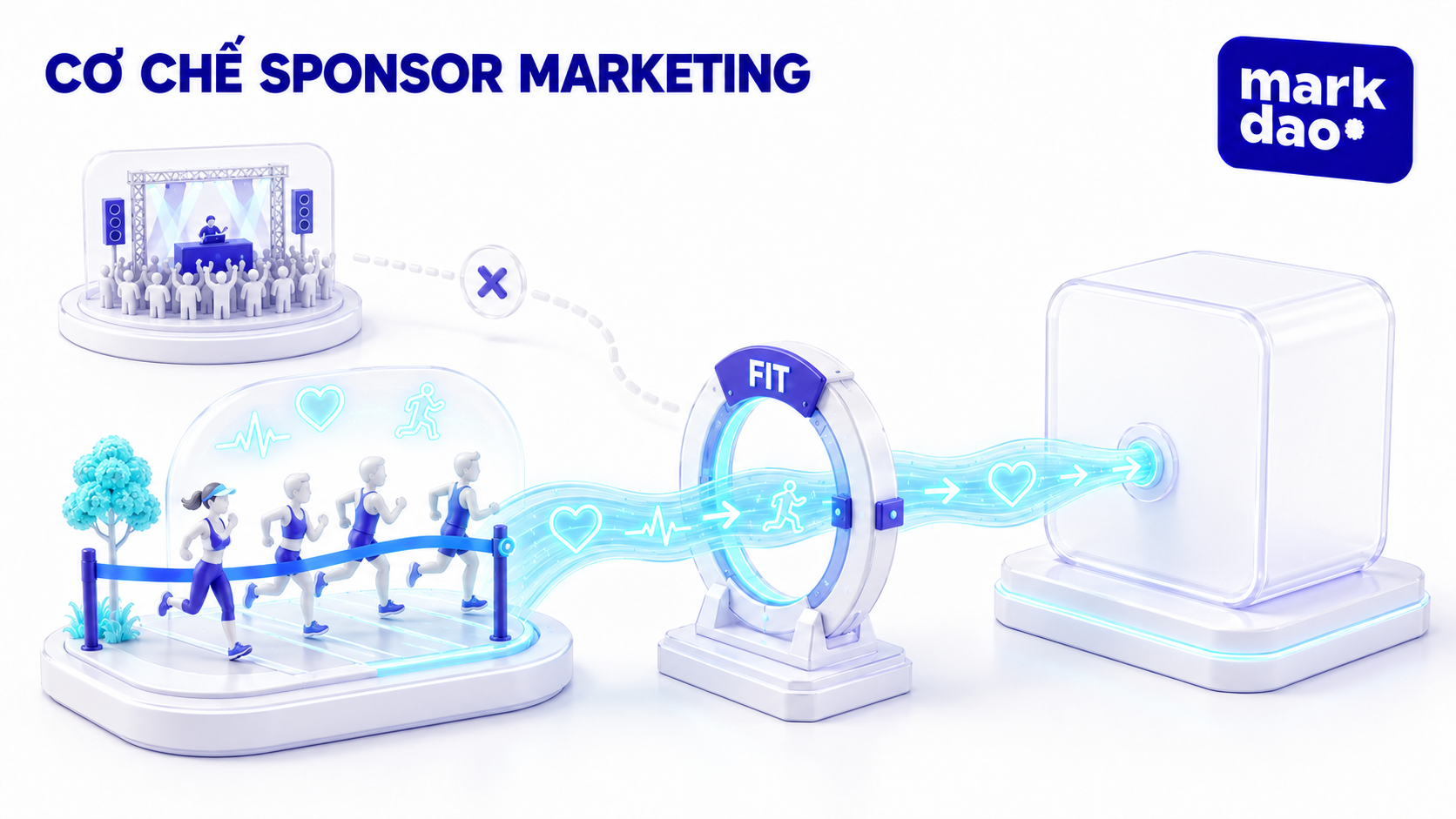
Therefore, the level of alignment between the brand and the sponsored entity is more important than the size of the crowd. A health supplement brand sponsoring a community fun run creates a logical association. If that same brand sponsors an electronic music festival, the association breaks down, even if the attendance is higher. Before choosing an event, compare it against your target customer persona you have built, rather than choosing based on the number of tickets sold.
This is also why sponsorship is not a channel for every business. Our perspective: if a brand does not yet have a clear positioning, sponsorship money will be wasted. Associative transfer needs a destination to latch onto. Without positioning, the public sees the logo, notes that "some brand is sponsoring this," and then forgets. With a budget below the threshold required to maintain sponsorship over multiple consecutive seasons, performance marketing usually yields more measurable results.
7 sponsorship tiers and their associated benefits
Events in Vietnam typically categorize packages into four metal-based tiers, plus three specific forms of sponsorship. Names may vary depending on the organizers, but the logic behind benefit stratification is quite consistent.
The last two tiers are often unfairly undervalued. In-kind sponsorship allows businesses to participate at a much lower marginal cost compared to cash, because you pay at cost price rather than retail price. A company providing 300 beverage units for an event is paying at cost, but the organizers record it at market value.
Pricing sponsorship packages: use a formula instead of asking for a rate card
There is no standard rate card for sponsorship, and for good reason. The price of a package depends on the specific audience profile, the level of exclusivity, and the actual number of touchpoints. Two events with 2,000 attendees can differ significantly in package value if their audience profiles are different.
The right approach is to set a price ceiling you are willing to pay, then compare it against the organizer's quote. Add up these four components:
1. Equivalent media value. Count the touchpoints featuring your logo or brand name: backdrops, standees, publications, social media posts, and press releases. Convert each type into the equivalent cost you would pay if purchasing standard advertising.
2. Direct engagement value. Booths, speaking slots, and sampling rights. Value these based on the cost you would otherwise incur to reach the same number of potential customers through other channels.
3. Exclusivity value. This only applies if the contract prevents direct competitors from participating. If the organizer does not provide a written commitment to industry exclusivity, this component is worth zero.
4. Reusable content value. The right to film, photograph, and use event imagery for your own channels for the following 12 months. This is the most overlooked component during negotiations.
Calculation example. The figures below are hypothetical and used only to illustrate the formula, not to represent market rates. Suppose you calculate 120 million in media value, 40 million in direct engagement value, 0 for exclusivity as the contract lacks this clause, and 25 million in reusable content value. Your price ceiling is 185 million. The organizer quotes 260 million. The 75-million gap is what you must either negotiate for additional benefits or use as a reason to decline the package.
Include all four of these components in your sponsorship proposal and budget allocation table before sitting down at the negotiation table.
How to measure sponsorship effectiveness using 3 tiers of metrics
Sponsorship is often considered difficult to measure, but most of the difficulty stems from measuring at the wrong tier. Setting revenue targets for a brand awareness package will always yield poor results, and vice versa.
Three things to do before the event day, not after:
- Establish baseline metrics. Without pre-sponsorship data, there is nothing to compare against afterward.
- Create unique promo codes and tracking links for each sponsorship package. This is the most cost-effective way to isolate the contribution of this channel.
- Agree in writing that the organizer will provide raw data, including a submission deadline. Many contracts overlook this, leaving the sponsor with nothing but a nice set of photos.
For multi-season packages, calculate ROI over a long-term cycle rather than event by event. The value added to brand equity only becomes apparent after several iterations.
A warning about market data
When gathering data to build a sponsorship budget, double-check your sources. We compared the global sports sponsorship market size for 2025 across four research firms and received four different figures: Statista reported $52 billion, Straits Research reported $65.71 billion, Market Report Analytics reported $70.44 billion, and Market Intelo reported $107 billion. The difference between the lowest and highest figures is more than double, for the same market and the same year.
The reason is that each firm defines the market scope differently, and since most of these reports sell their full versions, their methodologies are not public. The practical takeaway: do not use market size figures to justify your company's sponsorship budget. Use your own conversion data instead.
Due diligence checklist before signing a contract
Run through these eight questions before transferring any funds. Each question addresses a risk that has derailed someone's sponsorship campaign in the past.
- How many seasons has the organizer run this event, and how was the attendance data for the most recent season verified?
- Who else is on the list of sponsors, and are there any brands that conflict with your positioning?
- Does the contract commit to specific quantities for each touchpoint, or does it just vaguely state "appearance on media materials"?
- Do you have the right to approve designs before they are printed or published?
- How is the clause for event postponement or cancellation written, and what percentage of the fee is refundable?
- Does the contract include a morality clause that allows you to withdraw and revoke image usage rights if the sponsored party becomes involved in a scandal?
- How long do your rights to use event images and videos on your own channels last?
- Who covers the production costs for branded merchandise, you or the organizer?
Question 6 is most critical when sponsoring individuals. If you are working with a KOL or influencer, reputation risk is tied directly to a person, and it can arise even after the contract is signed.
5 mistakes that cause sponsorship budgets to go to waste
Choosing based on scale rather than audience fit. A large event with the wrong audience results in a much higher cost per lead than a smaller, industry-specific event.
Paying and then walking away. A sponsorship package only opens the door to access. Amplification through your own channels, post-event content, and nurturing the leads you acquire are what generate results. Activation budgets should be calculated separately from the start.
Not having an exclusivity clause but still paying the price of an exclusive package. Verify everything in writing; do not rely on verbal promises.
Measuring by intuition. No baseline metrics, no unique tracking codes, just a report at the end featuring nice photos and a few comments.
Sponsoring for one season and then stopping. Brand association requires repetition. Stopping after one season means you paid for the hardest part without reaping the benefits in subsequent seasons.
Conclusion
Sponsorship marketing is an investment in brand association rights, not just a purchase of logo placement. Three things determine the outcome: choosing a partner based on audience fit rather than scale, setting your own price ceiling using the four components before negotiating, and finalizing baseline metrics and unique tracking codes before the event date.
FAQ

The sponsor is the party providing money, goods, or services. The sponsee is the party receiving them and granting promotional rights in return. In a contract, these two roles have completely different obligations.
Yes, but opt for silver or bronze tiers, or in-kind sponsorship at industry-specific events, rather than trying to buy high-tier packages at major events. In-kind sponsorship allows you to participate with low marginal costs because you pay at cost price.
Sponsorship is a commercial transaction with promotional rights stipulated in a contract. Charity does not come with promotional conditions, and proactively leveraging charity work for media exposure is often counterproductive.
Exposure metrics are visible during the week of the event. Changes in perception should be measured after 4 to 8 weeks. The impact on purchasing behavior can usually only be isolated after several consecutive seasons of sponsorship.
Events are suitable when the goal is credibility and direct contact with a concentrated audience. KOLs are suitable when the goal is reach and reusable content. The reputational risk of a KOL is higher and requires stricter ethical clauses.