

Have you ever wondered why you see a product advertisement at the very top of your Google search results? That is the power of PPC (Pay-Per-Click) advertising – a strategy that helps businesses reach potential customers quickly and effectively.
With PPC, you only pay when someone clicks on your ad, which helps optimize your budget and increase conversion rates. But how do you run a successful PPC campaign without wasting money? In this article, Markdao will help you understand what PPC is, how it works, its benefits, and the best strategies to achieve maximum results.
What is PPC? Concepts and operating principles
PPC (Pay-Per-Click) is an online advertising model where advertisers only pay when someone clicks on their ad. It is one of the most popular methods for attracting potential customers and driving sales on digital platforms.
PPC is commonly used on search engines like Google and Bing, as well as on social media platforms such as Facebook, Instagram, TikTok, and LinkedIn. With PPC, businesses can quickly reach the right target audience, effectively control their budget, and accurately measure campaign performance.
%20l%C3%A0%20m%C3%B4%20h%C3%ACnh%20qu%E1%BA%A3ng%20c%C3%A1o%20tr%E1%BA%A3%20ph%C3%AD%20cho%20m%E1%BB%97i%20l%E1%BA%A7n%20nh%E1%BA%A5p%20chu%E1%BB%99t.avif)
How PPC works
PPC operates on an ad auction mechanism, where advertisers place bids on specific keywords or target audiences. When a user enters a search query or browses social media, the system conducts an auction to determine which ads will appear and in what position.
This mechanism consists of the following 4 key factors:
1. Keyword Bidding
- Each advertiser selects keywords relevant to their products or services.
- They then set the maximum price they are willing to pay for each click (CPC – Cost Per Click).
- When a user searches for that keyword, the system compares the bid amounts and other relevant factors to decide which ad is displayed.
2. Ad Quality Score
- Ad position is determined not only by your bid, but also by the quality of your ad.
- Google Ads, for instance, evaluates ads based on keyword relevance, expected click-through rate (CTR), landing page experience, and content optimization.
- A high quality score helps lower advertising costs and increases your chances of securing better ad placements.
3. Ad Display and Billing
- Once an ad wins the auction, it is displayed on search results pages, partner websites, or social media platforms.
- Advertisers are only charged when a user clicks on the ad, rather than for mere impressions without interaction.
4. Optimization and Performance Improvement
- Once a campaign is live, advertisers need to monitor data such as clicks, conversion rates, and cost-per-click to optimize performance.
- Adjusting keywords, ad copy, landing pages, and bidding strategies helps improve PPC performance and minimize wasted budget.
Thanks to its flexible mechanism, PPC not only helps businesses reach customers quickly but also provides clear, measurable results. However, to fully leverage the potential of PPC, businesses need a solid strategy and must continuously make adjustments to achieve the best outcomes.
6 Common Types of PPC Advertising
PPC is not limited to a single format; there are many different types depending on the platform and campaign goals. Below are the most common PPC advertising formats that businesses can leverage to optimize customer reach.
1. Search Ads
Search ads are the most common form of PPC, appearing on search engines like Google and Bing. When a user enters a specific keyword, the ad is displayed at the top or bottom of the search results page.
.avif)
- Pros:
- Target the right audience actively searching for your products or services.
- Easily measure performance through clicks and conversion rates.
- Suitable for almost any industry, from e-commerce to financial services.
- Cons:
- High competition, especially for popular keywords with expensive bids.
- Requires continuous optimization to maintain high quality scores and reduce costs.
2. Display Ads
These are image, banner, or video ads displayed on websites within the Google Display Network (GDN) or other platforms.
.avif)
- Pros:
- Reach users across millions of websites to increase brand awareness.
- Diverse formats, ranging from static and animated images to short videos.
- Targeting options based on user interests, behavior, or remarketing.
- Cons:
- Click-through rates (CTR) are generally lower compared to search ads.
- Easily ignored or blocked by ad-blocking software.
3. Social Media Ads
This type of PPC advertising appears on social media platforms such as Facebook, Instagram, TikTok, LinkedIn, Twitter, and Pinterest.
.avif)
- Pros:
- Precise targeting based on age, gender, location, interests, and behavior.
- Diverse display formats: posts, videos, stories, and carousels.
- High engagement, making it easy to generate viral marketing and attract potential customers.
- Cons:
- High competition, especially on Facebook and Instagram.
- Requires creative content to capture attention amidst a sea of posts.
4. Video Ads
PPC video ads typically appear on YouTube (YouTube Ads) or other video platforms like TikTok and Facebook Watch.
.avif)
- Pros:
- Visual format that makes it easy to convey brand messaging.
- Captures attention more effectively than static ads.
- Can be combined with remarketing strategies to re-engage potential customers.
- Cons:
- Video production costs are higher compared to images or text.
- Users can skip ads after a few seconds if they are not engaging.
5. Shopping Ads
This is a specialized type of PPC advertising for e-commerce businesses, displaying products directly on Google or Bing search results pages.
.avif)
- Pros:
- Displaying images, prices, and product information directly helps attract customers.
- Higher click-through rates because users have clear purchase intent.
- Suitable for businesses selling physical products.
- Cons:
- Requires a well-structured product feed.
- Requires continuous optimization to achieve the best results.
6. App Install Ads
This type of advertising aims to increase app downloads on the App Store or Google Play.
- Pros:
- Target the right audience interested in downloading your app.
- Optimize cost per download.
- Combine with remarketing campaigns to retain users.
- Cons:
- Requires a high-quality app experience to retain users after the download.
- High competition with millions of other apps in the app store.
Each type of PPC advertising has its own pros and cons, and businesses can choose the most suitable format based on their business goals. If you want to attract potential customers quickly, search or social media ads may be the optimal choice. If you want to build long-term brand awareness, display and video ads can be highly effective. The key is to continuously optimize your campaigns to achieve the best performance.
Benefits of PPC advertising
PPC advertising not only helps businesses reach customers quickly but also offers many advantages over traditional advertising methods. Here are the reasons why PPC has become a top choice for many businesses:
- Reach potential customers quickly: PPC helps businesses appear immediately in front of people with specific needs, rather than waiting for SEO results. This is especially useful when launching new products or needing to boost sales in a short period.
- Flexible budget control: Advertisers can set daily or total campaign budgets, ensuring spending does not exceed set limits. Additionally, costs can be adjusted based on ad performance to maximize ROI.
- Precise audience targeting: PPC allows for precise targeting based on keywords, location, device, age, interests, and user behavior. This ensures businesses only reach those most likely to be interested in their products or services.
- Easy to measure and optimize: PPC systems provide detailed data on clicks, conversion rates, and cost-per-click (CPC), helping businesses track performance and adjust campaigns for the best results.
- Increase competitiveness against rivals: Even if a business does not yet have a high organic search ranking, PPC helps the brand appear on the first page of Google or social media platforms, competing directly with major competitors.
- Build a strong brand identity: Even if users don't click on your ads, they still see your brand, product, or service. This helps build familiarity and can encourage them to return to search for or purchase from you later.
- Optimize ROI with the right strategy: When optimized correctly, PPC can deliver higher returns than many other advertising channels. By focusing on the most valuable keywords and target audiences, businesses can reduce wasted spend and effectively increase revenue.
PPC is not just a paid advertising channel; it is a powerful tool that helps businesses grow rapidly in the digital landscape. Implementing PPC effectively not only generates leads but also helps optimize costs and increase long-term profitability.
How to set up an effective PPC campaign
For a PPC campaign to be truly effective, it requires more than just placing ads on Google or Facebook and waiting for results; it demands a structured strategy. From keyword research to landing page optimization, every step impacts ad performance and business profitability.
Here are 6 essential steps to help you launch a successful PPC campaign:
Step 1: Define your PPC campaign goals
A PPC campaign can only be effective when you clearly understand your ultimate goal. Do you want to:
- Increase website traffic?
- Generate more leads?
- Boost sales?
- Increase brand awareness?

Defining the right goals from the start will help you choose the appropriate platform (Google Ads, Facebook Ads, LinkedIn Ads, etc.) and optimize your ad messaging to reach the right potential customers.
Step 2: Research and select strategic keywords
Keywords are the deciding factor in the success of a PPC campaign. Choosing the wrong keywords can cost you a lot of money without attracting the right customers. Use Google Keyword Planner, Ahrefs, SEMrush to:
- Identify keywords with high search volume but moderate competition.
- Avoid keywords that are too generic or have excessively high bids.
- Build a list of negative keywords to exclude irrelevant queries and save your budget.
Additionally, balance the use of Exact Match, Phrase Match, and Broad Match to optimize display performance.
Step 3: Write compelling and persuasive ad copy
A PPC ad is only displayed for a few seconds, so your headline and description must be engaging enough to grab attention immediately.
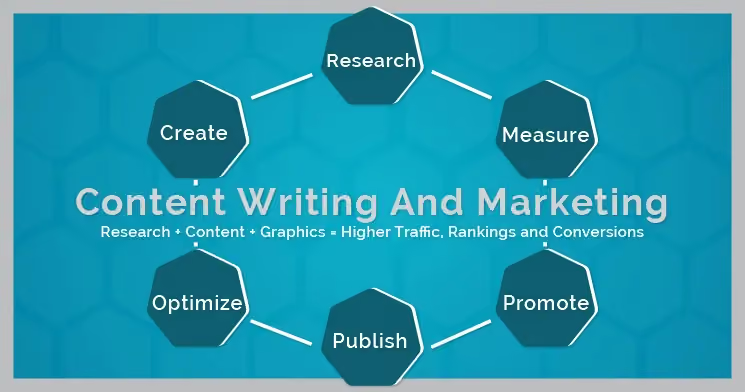
An effective PPC ad needs:
- An engaging headline: Address the customer's needs or pain points directly. For example: “50% off advertising fees – Get qualified leads now!”
- A concise, persuasive description: Clearly present the benefits of your product or service. Use specific numbers (7-day free trial, Only 199K/month…) to increase credibility.
- A strong CTA (Call To Action)Encourage customers to take immediate action, for example “Sign up now – Only 3 discounted spots left!”
Additionally, leverage ad extensions such as sitelinks, callout extensions, and phone numbers to increase the appeal and credibility of your ads.
Step 4: Optimize your landing page to increase conversion rates
Sending customers to an unappealing landing page is like "firing a gun without bullets." If the landing page does not match the ad content or lacks appeal, customers will bounce immediately, lowering your conversion rate and increasing costs.
A Landing Page optimized for PPC should include:
- A compelling headline: Synchronized with the ad content to ensure consistency.
- Concise, focused content: Avoid rambling; get straight to the solution.
- A lead form or clear CTA button: Limit the amount of information requested to increase completion rates.
- Fast loading speed and mobile-friendly display: Google prioritizes fast-loading pages, especially on mobile devices.
Step 5: Manage budget and optimize smart bidding
One of the most common mistakes for those new to PPC is failing to control the budget properly, leading to "burning money" without achieving results.

To manage your budget effectively, you need to:
- Determine your average Cost Per Lead (CPL) and the desired profit per customer.
- Use an appropriate bidding strategy: Google Ads offers various options such as Manual CPC, Maximize Conversions, or Target CPA. Test them to find the most effective strategy.
- Monitor and adjust bids based on performance: Focus your budget on high-conversion keywords and reduce spending on underperforming ones.
Additionally, if your PPC ads are geo-targeted, consider adjusting bids by region to optimize your budget and performance.
Step 6: Continuously monitor, analyze, and optimize your campaign
A PPC campaign is never a "set it and forget it" task. To achieve the best results, you need to closely track metrics and adjust your strategy in a timely manner.
Key factors to monitor include:
- CTR (Click-Through Rate): If your CTR is low, improve your ad copy.
- Conversion Rate: If many people click on your ad but do not convert, you need to optimize your landing page.
- Cost Per Acquisition (CPA): If your CPA is too high, review your keywords, bids, and ad quality.
- A/B Testing: Test multiple ad versions to determine which one performs best.
Continuously update and optimize your campaign to reduce advertising costs while maintaining high performance.
Common mistakes when running PPC ads
While PPC is a powerful tool for driving revenue growth, implementing it incorrectly can drain your budget without delivering the desired results. Here are common mistakes you should avoid:
- Running PPC without a clear understanding of your customers: Having a budget doesn't guarantee effective PPC. Without researching customer behavior, needs, and preferences, your ads will reach the wrong audience, leading to lower conversion rates.
- Focusing on traffic volume instead of lead quality: Many businesses focus solely on click counts while losing sight of the primary goal: conversion. High traffic without qualified leads only increases costs without generating profit.
- Lacking differentiation in PPC campaigns: If your ads are identical to your competitors' or lack a unique selling point, customers have no reason to choose you. Invest in creative content, strong calls to action, and compelling offers.
- Running ads while neglecting the landing page experience: Directing customers to an unappealing, slow-loading, or irrelevant landing page is a critical mistake. Your landing page must be optimized to retain visitors and drive action.
- Failing to test and optimize continuously: PPC is not a "set it and forget it" strategy. If you don't regularly monitor and adjust your keywords, bids, and ad copy, you will quickly fall behind your competitors.
- Running ads without a long-term strategy: PPC can deliver quick results, but without integrating it with SEO, content marketing, or email marketing, your business will become entirely dependent on ad spend rather than building a sustainable customer base.
Understanding these mistakes will not only help you avoid wasting your budget but also enable you to create more effective PPC campaigns that deliver real value to your business.
PPC Trends in 2026
The world of PPC advertising is changing rapidly, and 2026 will see new trends that help businesses optimize performance and achieve sustainable growth. Here are the key trends you cannot afford to miss:
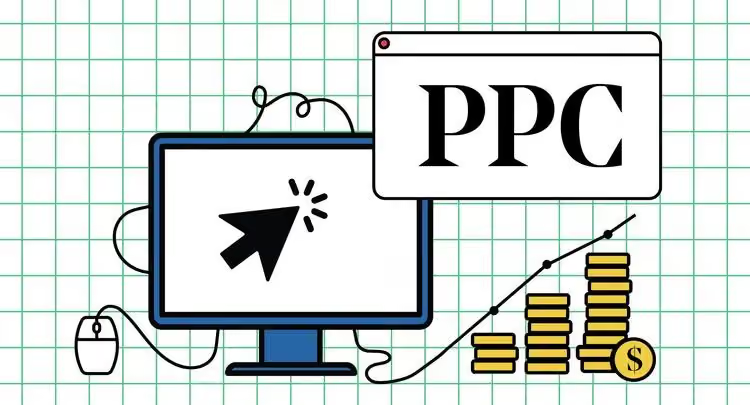
- Automation and AI taking over PPC: Advertising platforms are increasingly integrating AI to optimize campaigns, from smart bidding and keyword selection to content personalization. Advertisers need to leverage this technology to boost performance and reduce costs.
- The impact of Zero-Click Search on PPC: More and more users are finding answers directly on the search engine results page (SERP) without clicking on ads. Consequently, PPC strategies need to focus more on valuable content and user experience to drive conversions.
- Video advertising continues to reign supreme: Video content on YouTube, TikTok Ads, and Google Video Ads will remain highly effective PPC channels, thanks to their ability to engage viewers and drive action faster than traditional text ads.
- Voice and visual search optimization: The rise of virtual assistants (Google Assistant, Siri) has made voice search increasingly popular. Businesses need to optimize PPC content for natural language and use relevant imagery to keep up with this trend.
New privacy policies impacting PPC: The phase-out of third-party cookies and stricter privacy regulations are changing how user data is collected. Advertisers must find alternatives, such as first-party data strategies and contextual marketing. - Focus on omnichannel marketing strategies: Today's customers access information across various platforms. An effective PPC campaign must integrate advertising across Google, Facebook, TikTok, Instagram, and other platforms to create a seamless customer experience.
As we head into 2026, businesses must quickly adapt to these changes to maintain a competitive edge and maximize their advertising budgets.
Conclusion
PPC advertising is not just a powerful marketing tool but a strategic game where agility and continuous optimization determine success. As technology evolves and user behavior shifts, businesses must remain flexible—from choosing smart keywords and optimizing landing pages to leveraging AI and emerging trends.
If you know how to harness PPC correctly, you will not only increase revenue but also build a sustainable competitive advantage in a volatile digital landscape. Start today—optimize your PPC campaigns and turn every click into a real opportunity!