In the ever-changing landscape of SEO, auto generated content is becoming a powerful tool that helps save time and effort in content production. However, does using an auto content generator truly provide sustainable benefits, or does it carry the risk of getting your website penalized by Google? This article will help you understand the pros and cons of automated content, as well as how to use it effectively to optimize SEO without compromising website quality. Let's join Markdao to dive deeper!
What is Auto Generated Content?
Auto Generated Content (AGC) is content created automatically by programs, code, or algorithms with little to no human intervention. auto content generator tools are often used to create content quickly, especially on large websites such as blogs, news sites, or e-commerce platforms.
However, AGC often does not focus on content quality but is primarily aimed at manipulating search engine rankings. This can violate Google's guidelines, leading to the risk of ranking drops or even penalties.
Auto Content Generator for WordPress
Currently, many auto content generator plugins for WordPress support automated content creation, helping websites update posts without manual writing. Some popular plugins include:
- WP Automatic
- WP Robot
- AI Content Generator
While these tools offer convenience, overusing them without editing can result in low-quality content that fails to provide real value to users.

How Auto Content Generators work
Tools for auto generate content work by:
- Collecting data from various sources such as RSS feeds, APIs, or existing articles.
- Automatically creating new content by combining, translating, substituting synonyms, or using AI models.
- Publishing articles directly to the website without human review.
Many websites use free auto content generators to save costs, but if the content is not properly optimized, the site may be flagged by Google as "thin content" and suffer a drop in rankings.
Common types of Auto Generated Content
In the world of auto content generators, there are many methods for creating automated content. However, not all types of content provide real value to readers. Below are the types of auto generate content currently popular:
Automatically translated content
Some websites use translation tools like Google Translate, DeepL, Microsoft Translator to convert content from one language to another without review or editing.
- Automated translation often lacks accuracy and misses context, making the content difficult to understand.
- Google can identify low-quality automated content and classify it as thin content.
- Fails to create unique value and is difficult to optimize for SEO according to E-E-A-T (Experience, Expertise, Authoritativeness, Trustworthiness)

Example:
Original content (English): "The best SEO strategies focus on user experience and high-quality content."
Automatically translated content (Vietnamese): "The best SEO strategies focus on user experience and high-quality content."
Content created by patching
This is a method of collecting various content snippets from existing articles on the internet and stitching them together into a new post.
- The content lacks consistency and coherence.
- Easily flagged as "duplicate content" or "scraped content," with a high risk of being penalized by Google.
- Without unique value, it is difficult to attract readers.

Example:
Paragraph 1 from article A: "SEO is an important strategy for optimizing website rankings on Google."
Paragraph 2 from article B: "Quality content helps increase user retention."
Paragraph 3 from article C: "Tools like Google Search Console support SEO performance analysis."
→ Result: An article that lacks cohesion and flow, easily identified by Google as duplicate content or scraped content.
Content created by replacing words with synonyms
Some free auto content generator tools use "spinning" techniques to create new content by replacing words with synonyms.
- The content can become confusing or lose its original meaning.
- Google can identify and penalize spun content.
- Fails to provide real value to the reader.

Example:
Original: "Automated content creation tools can help save time on writing articles."
→ Spun: "Automated text generation software has the ability to reduce the time spent editing posts."
Content created using sentence templates
Some auto content generator for WordPress use pre-defined templates to generate content.
- Formulaic content that is easily identified as automated.
- Lacks personalization, making it difficult to engage readers.
Example:
"Today the weather in [city] is [weather]. It is a great day to [activity]."
"Top [number] most effective tools for [task] in [year]."
Methods for auto generate content save time but must be used correctly to avoid negatively impacting SEO. Below is a quick summary table:
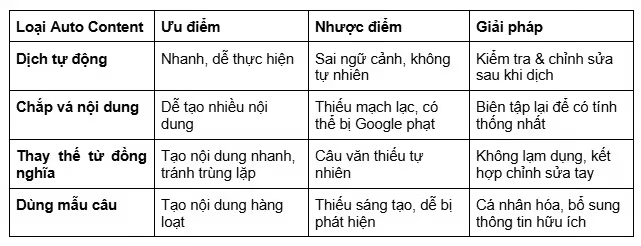
If you use an auto content generator For WordPress, ensure content is edited and optimized to avoid violating Google's guidelines. Automated content should only be a supporting tool, not the primary method for building your SEO strategy.
How can you mitigate the impact of auto-generated content on SEO?
Using auto content generators can offer certain benefits, such as saving time and effort in content creation. However, if misused or overused, it can have serious consequences for SEO. Below are the main negative impacts of auto-generated content on Google search rankings.
Negative impact on Google rankings
Google has clearly stated that automatically generated content, if it provides no real value to users, may violate their “Search Essentials”. This means that if a website uses an auto content generator for WordPress without editing or optimization, it is highly likely to be penalized by Google.
Consequences of automated content for SEO:
- Lower rankings on SERPs: Google can identify automatically generated content and classify it as thin content, leading to a drop in search rankings.
- The website may face manual or algorithmic penalties: Google has algorithms such as Panda, Helpful Content Update to address low-quality content. In severe cases, a website may receive a manual action and be removed from search results.
- Risk of de-indexing (removal from Google Index): If a website contains excessive automated content that provides no value to readers, Google may decide to remove it from its index entirely.
Real-world example:
Many websites previously used free auto content generator tools to mass-produce content without any real value. Following Google's algorithm updates, these sites saw their rankings drop or were even removed from search results.
How to fix it:
- If you use an auto content generator, ensure the content is edited and optimized before publication.
- Always check content quality to ensure it does not violate Google's policies.
- Combine automated content with in-depth research and analysis to ensure the articles provide genuine value.
Poor user experience
One of the key factors Google evaluates in SEO is user experience (UX). Automatically generated content often lacks creativity and personalization, leading to a poor reading experience.
The problem with automated content regarding UX:
- Lack of engagement: Automatically generated content is often formulaic and lacks an engaging writing style or relevance to the target audience.
- Failing to address user needs: Users are typically looking for valuable information; if they perceive the content as auto generate content, they may quickly leave the page.
- Increased Bounce Rate: When users visit a page with automated and unhelpful content, they leave immediately, causing the bounce rate to spike, which negatively impacts SEO.
Real-world example:
A blog uses an auto content generator for WordPress to automatically create articles on software tutorials. However, the content is not truly useful because it is merely a collection of paragraphs from various sources, lacking detailed instructions or illustrative images. As a result, users quickly leave the page, leading to a high bounce rate and a drop in SEO rankings.
How to fix it:
- If you use automated content, you need to add elements that enhance the user experience, such as images, videos, tables, and in-depth content.
- Edit the content to ensure it meets the actual needs of your users.
- Use auto generate content as a supporting tool, not as your primary source of content creation.
Loss of credibility and brand impact
A website with too much automated content may be perceived as unreliable, diminishing the brand's credibility in the eyes of both users and Google.
The problem with using automated content:
- Loss of customer trust: If customers realize that a website only contains cookie-cutter content with no real value, they may never return.
- Impact on backlinks and authority: Reputable websites generally do not want to link to pages with low-quality content. This hinders your ability to build natural backlinks and lowers your site's credibility.
- Negative impact on brand image: If your website provides unedited, auto-generated content, your brand may be perceived as unprofessional.
Real-world example:
An e-commerce website uses a free auto content generator to create automated product descriptions. However, these descriptions are inaccurate and contain grammatical errors, causing customers to lose trust in the products and leave the site without making a purchase.
How to fix it:
- Create content manually or combine AI with human editing to ensure quality.
- Ensure content provides real value, serving the user rather than just aiming for SEO.
- Maintain brand reputation by providing accurate and helpful information.

Advice:
- Auto content generator tools should only be used as a support mechanism and should not completely replace manual content writing.
- If you use an auto content generator for WordPress, always check and optimize your content before publishing.
- Google increasingly prioritizes high-quality, helpful content for users. Therefore, a sustainable content strategy remains creating valuable, well-researched content optimized according to E-E-A-T.
Conclusion
Auto content generator can offer certain benefits for rapid content production, especially when combined with modern AI tools. However, if overused or left unchecked, it can lead to serious consequences such as loss of Google rankings, negative impacts on user experience, and damage to brand reputation.
If you want to leverage auto content generator effectively, use it as a supporting tool rather than relying on it entirely. Combining automated content with manual editing, SEO optimization, and ensuring genuine value for readers will help your website grow sustainably without violating Google's policies.