

Cost Per Click (CPC) plays a crucial role in determining the cost you pay for each click on your ads. It is a core metric that helps businesses manage budgets, measure campaign effectiveness, and optimize customer outreach strategies. So, what is CPC, how is it calculated, and how can you optimize advertising costs while maintaining performance? Let's join Markdao to find out in this article!
Overview of Cost Per Click (CPC)
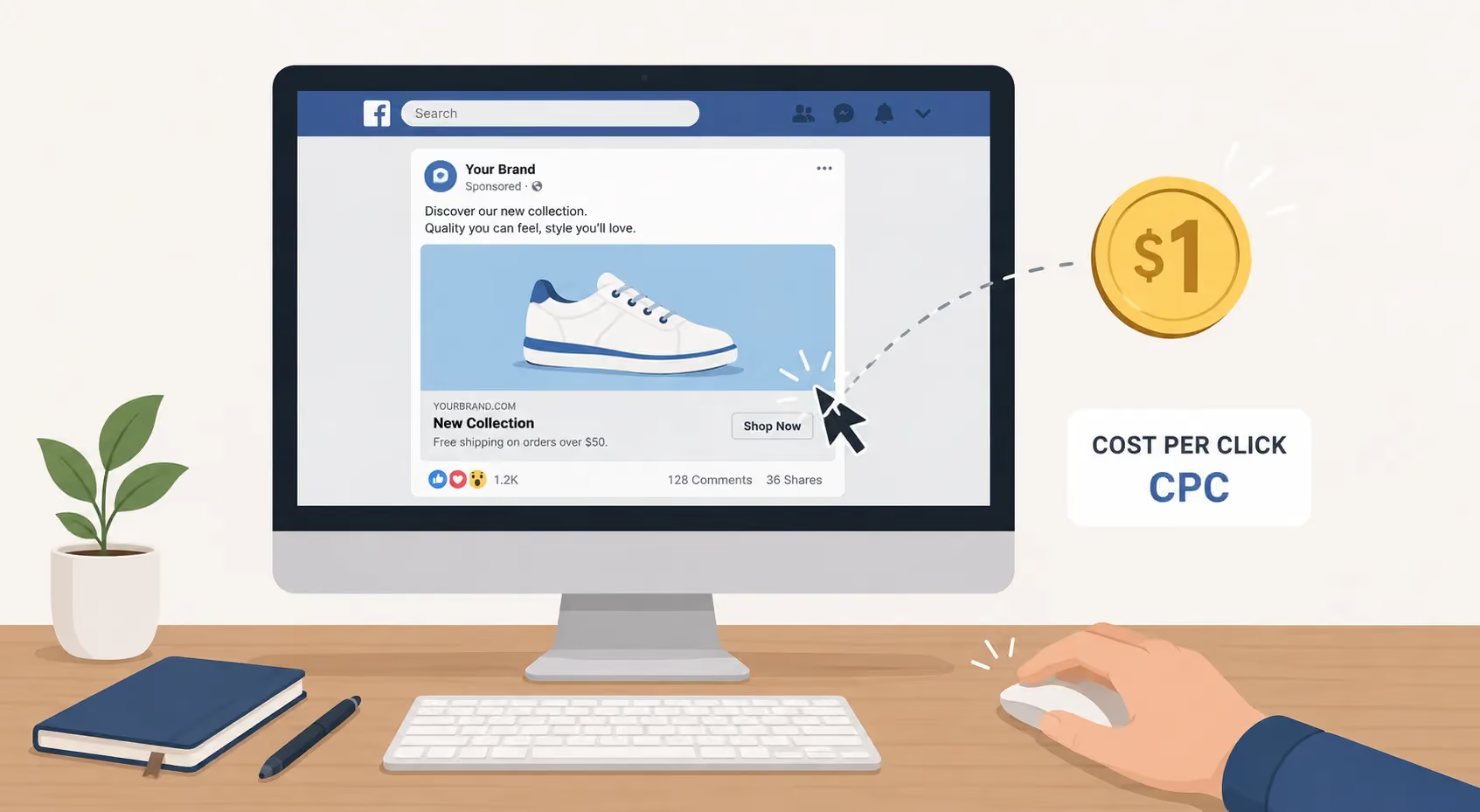
Cost Per Click (CPC) is an online advertising model where advertisers only pay when a user clicks on their ad. CPC is commonly used on advertising platforms such as Google Ads, Facebook Ads, and Bing Ads, helping businesses optimize their advertising budgets and focus on actual traffic.
This model is particularly useful as it helps advertisers measure campaign effectiveness and optimize Conversion Rates based on the budget spent.
Why is Cost Per Click important in online advertising?
- Effective budget control: Advertisers only pay when someone clicks, which helps optimize costs.
- Easy performance evaluation: Based on CPC data, businesses can track advertising effectiveness by campaign or keyword.
- Advertising strategy optimization: CPC helps businesses identify which keywords yield the highest ROI to optimize their budget.
- Focus on potential customers: People who click on ads usually have the intent to learn more or make a purchase, which increases the likelihood of conversion.
The difference between CPC and other advertising models
Besides CPC, there are many other online advertising models, including:
Cost Per Click is a popular choice for search advertising because it helps businesses reach the right potential customers at an optimized cost.
How to calculate Cost Per Click
The formula for calculating CPC is very simple:
Example:
A business spends 5,000,000 VND on a Google Ads campaign and receives 1,000 clicks. The average CPC will be:
Monitoring CPC helps businesses optimize their advertising budget and determine whether their spending is reasonable.
Common types of Cost Per Click
1. Max CPC
This is the highest bid amount an advertiser is willing to pay for a click on their ad. On Google Ads, Max CPC can be set manually or adjusted automatically by the system.
2. Avg CPC
This is the average cost that an advertiser actually pays for each click. Avg CPC is usually lower than Max CPC because advertising systems operate on an auction basis.
3. Manual CPC vs. Automated CPC
Depending on the campaign goals, businesses can choose the appropriate bidding method to optimize cost per click and improve advertising effectiveness.
5 factors affecting Cost Per Click (CPC)
Cost Per Click (CPC) is not fixed and changes based on various factors. Understanding these factors will help businesses optimize their advertising budgets more effectively. Below are the 5 most important factors affecting CPC in online advertising campaigns.
Keyword competition level
In search advertising (Google Ads, Bing Ads), high-competition keywords typically have a higher CPC. This occurs when multiple businesses bid on the same popular keyword, driving up the price due to the laws of supply and demand.
Examples of keyword competition levels:
Keywords in the finance and insurance sectors, such as "affordable life insurance" or "low-interest online loans" have very high CPCs because they offer significant conversion value.
Meanwhile, less competitive keywords like "how to care for houseplants at home" have lower CPCs because fewer businesses are running ads for them.
How to reduce CPC for high-competition keywords:
- Use long-tail keywords to reduce competition and reach potential customers more precisely.
- Run location-based ads to narrow the scope of your bidding.
- Optimize your landing page to increase your Quality Score, which in turn helps lower your CPC.
Quality Score on Google Ads
Quality Score is a metric used by Google Ads, rated on a scale of 1 to 10, based on the relevance between your ads and keywords. The higher your Quality Score, the lower your CPC and the better your chances of having your ads displayed.
3 key factors affecting Quality Score:
- Click-Through Rate (CTR): If an ad has a high CTR, Google considers the ad content engaging and lowers the CPC.
- Ad relevance to keywords: Ads should include primary keywords and align with user search intent.
- Landing Page Experience: A fast-loading, mobile-friendly landing page with clear content will help boost your Quality Score.
How to optimize Quality Score to reduce CPC:
- Write compelling ad headlines to increase CTR.
- Include primary keywords in your headlines, descriptions, and ad copy.
- Improve landing page speed by optimizing images and reducing load times.
- Use ad extensions such as sitelinks, call buttons, and location extensions to make your ads more engaging.
%20kh%C3%B4ng%20c%E1%BB%91%20%C4%91%E1%BB%8Bnh%20m%C3%A0%20thay%20%C4%91%E1%BB%95i%20theo%20nhi%E1%BB%81u%20y%E1%BA%BFu%20t%E1%BB%91%20kh%C3%A1c%20nhau.avif)
Ad Position
Google Ads operates on an auction system, where the ad's position on the search results page significantly impacts CPC.
How ad position affects CPC:
- Top 1 - 2 positions: Higher CPC but more clicks.
- Positions 3 - 5: Lower CPC but with a lower click-through rate.
- Bottom of the page or page 2 onwards: Cheap CPC but low effectiveness due to low click volume.
How to optimize ad placement to balance CPC and advertising effectiveness:
- It is not necessary to aim for the #1 spot, as positions 2-3 sometimes offer a better ROI at a lower CPC.
- Run A/B tests to determine which ad position delivers the best conversions at the lowest cost.
- Use smart bidding strategies like “Target Impression Share” to control ad placement without wasting your budget.
Industries and advertising sectors
Cost Per Click varies by industry. Some sectors have very high CPCs due to intense competition and high customer lifetime value.
Comparing average CPC across some industries (estimated on Google Ads):
How to reduce CPC in highly competitive industries:
- Focus on niche keywords instead of broad, generic ones.
- Optimize ads for specific target audiences (age, location, interests).
- Use Remarketing strategies to re-engage interested customers, thereby increasing conversion rates without raising CPC.
Device type (Mobile vs. Desktop)
Cost Per Click also changes depending on the device users search on.
Differences between Mobile and Desktop CPC:
- Mobile CPC is often higher because there are more mobile users and less ad space available.
- Desktop has a lower CPC, but conversion rates may be higher in certain sectors like B2B, software, and professional services.
How to optimize CPC by device:
- Adjust bids by device: If conversion rates are higher on mobile, you can increase your mobile CPC bids.
- Optimize the mobile experience: Landing pages must load quickly and be easy to read on mobile devices to avoid losing potential customers.
- Use Accelerated Mobile Pages (AMP) to improve page load speed and reduce mobile CPC.
Cost Per Click is not a fixed number; it is influenced by many factors such as keyword competition, quality score, ad placement, industry, and device. Understanding and optimizing these factors will help businesses lower their CPC, optimize their budget, and increase advertising effectiveness.
If you are running Google Ads or Facebook Ads and want to optimize your CPC, focus on improving your quality score, selecting relevant keywords, and enhancing the landing page experience. By doing so, you can achieve better ad performance without overspending your budget.
How to optimize Cost Per Click (CPC) for maximum effectiveness
Optimizing Cost Per Click (CPC) in online advertising helps businesses reduce costs while maintaining ad performance. Below are key strategies to help you optimize CPC effectively, save budget, and still achieve high conversion rates.
Research and select the right keywords
Choosing the right keywords directly impacts your CPC and campaign performance. If you select keywords that are too popular and highly competitive, your CPC may spike. Conversely, keywords with less competition but clear purchase intent can help lower costs.
How to conduct effective keyword research:
Use keyword research tools such as:
- Google Keyword Planner: Identify keywords with high search volume and reasonable CPC.
- Ahrefs, SEMrush: Analyze keyword competition, average CPC, and search trends.
- Google Trends: Identify search trends over time to select potential keywords.
Focus on long-tail keywords: Long-tail keywords typically have lower CPC and higher conversion rates.
Run A/B tests: with multiple keyword groups to find those with low CPC that deliver high performance.
Example: Instead of choosing highly competitive keywords like "buy gaming laptop", try "buy gaming laptop under 20 million", as it is less competitive and targets users with a genuine intent to purchase.
Optimize Quality Score to reduce CPC
Quality Score is a critical factor that directly impacts CPC. Google Ads prioritizes ads with high Quality Scores by lowering the bid required to achieve a good position.
Factors affecting Quality Score:
- Click-Through Rate (CTR): If many people click on your ad, Google will lower your CPC because it considers your ad to be valuable.
- Ad and keyword relevance: Ad content should include primary keywords to increase relevance.
- Landing page experience: The landing page must load quickly, display well on all devices, and provide useful content for users.
How to optimize Quality Score:
Write ad headlines and descriptions: engaging and containing primary keywords.
Improve the landing page:
- Reduce page load time (under 3 seconds).
- Ensure content matches the ad and avoid irrelevant information.
- Easy navigation and mobile-friendly interface.
Optimize CTR: Use ad extensions such as sitelinks, call, location, and review extensions to make your ads stand out.
Use a reasonable bidding strategy
Choosing the right bidding strategy helps control your advertising budget and effectively reduces CPC.
Common bidding methods:
Manual CPC:
- Control costs for each click.
- Suitable for experienced advertisers.
Enhanced CPC: Google will automatically adjust your bids to increase conversion rates.
Smart Bidding:
- Target CPA (Cost Per Acquisition): Automatically adjusts bids to achieve your desired CPA.
- Target ROAS (Return on Ad Spend): Google adjusts bids to achieve the best possible return on investment.
How to optimize bidding to lower CPC:
- Start with Manual CPC to understand the market, then switch to Smart Bidding to optimize performance.
- Lower bids for keywords with excessively high CPC that do not yield good returns.
- Increase bids for keywords with high conversion rates but low CPC.
Optimize ad content to increase CTR
A high CTR not only attracts more clicks but also helps Google rank your ads better, which in turn lowers your CPC.
How to optimize ad content:
Write compelling headlines:
- Use numbers (50% off, TOP 10 products).
- Ask questions to spark curiosity (Looking for a gaming laptop under 20 million?).
Add a strong call to action (CTA):
Example: Buy now – Only available today! or Get the offer now!
Use Ad Extensions:
- Sitelinks: Lead to important subpages.
- Callout Extensions: Add highlights such as Free shipping, 2-year warranty.
- Structured Snippets: Display a list of products/services.
Example:
Headline 1: Buy a Gaming Laptop - Get 20% off today!
Headline 2: High-Performance Laptops - Prices Starting From 15 Million!
Description: Powerful performance with a 2-year warranty. Buy now to receive attractive gifts!
Control budgets and track ad performance
Tracking ad performance helps you adjust campaigns flexibly, thereby optimizing CPC more effectively.
Tools for tracking performance:
- Google Ads Reports: Check CPC, CTR, and ROI metrics for each ad group.
- A/B Testing: Compare the effectiveness of two ad versions to select the best option.
- Google Analytics: Track user behavior on your website after they click on your ads.
How to control budgets to optimize CPC:
- Set daily budget limits to avoid wasteful spending.
- Remove ineffective keywords or those with high CPC and low conversion rates.
- Run tests with multiple ad groups to optimize the budget for the most effective campaign.
Conclusion
Understanding Cost Per Click (CPC) and how to optimize it is key to helping businesses reduce advertising costs while still achieving high results. By researching keywords, improving quality scores, choosing appropriate bidding strategies, and optimizing ad content, you can control CPC and increase your ROI (Return on Investment). Apply these strategies now to optimize your advertising campaigns most effectively!