Have you ever heard of Citation Flow (CF) but aren't quite sure about its role in SEO? It is a key metric that helps evaluate the strength of links pointing to your website, which directly impacts your Google rankings. But how can you effectively optimize and increase your CF score? In this article, Markdao will help you explore everything about Citation Flow, from its definition and significance to specific strategies to help your website climb the search rankings!
What is Citation Flow?
In the world of SEO, Citation Flow (CF) is one of the most important metrics for assessing the influence of backlinks pointing to a website. But what exactly is CF, and how does it affect your SEO strategy?
Defining Citation Flow
Citation Flow is a metric developed by Majestic used to measure the strength of a link based on the number of backlinks pointing to it. This score ranges from 0 to 100, with higher values indicating a website with many backlinks and significant potential influence.
However, CF focuses only on quantity rather than evaluating the quality of the backlinks. This means a website with many links from low-authority sources can still achieve a high CF, but that does not necessarily mean the website is trustworthy.
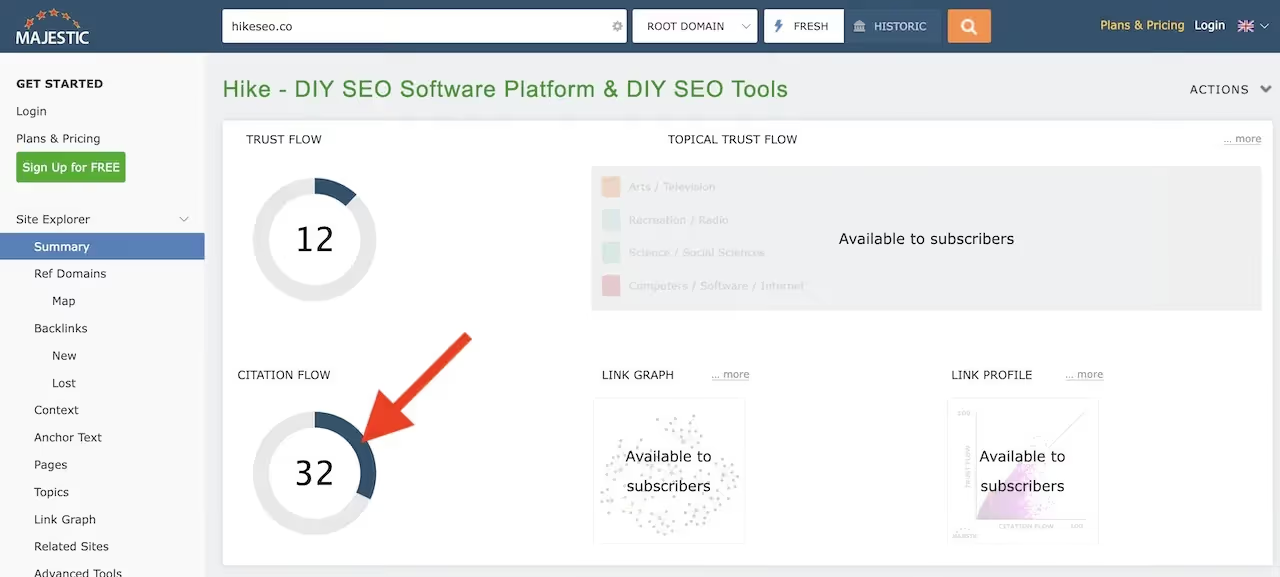
Example:
- A website with 500 links from obscure sources might have a high CF, but it may not necessarily provide real SEO benefits.
- Meanwhile, a website with fewer backlinks but from reputable sites will have a Trust Flow (TF) that is higher.
Citation Flow and Trust Flow
To accurately evaluate the strength of a website, you need to understand the relationship between Citation Flow (CF) and Trust Flow (TF).
1. What is Trust Flow?
- Trust Flow is a metric that measures the quality of backlinks based on the trustworthiness of the linking source.
- If a website has links from pages with high TF, it indicates that it is a reliable website.

2. How important is the CF/TF ratio?
- The ratio between CF and TF is known as the CF/TF RatioA website with a ratio close to 1 is generally considered balanced, indicating both good quantity and quality of backlinks.
- If the CF is too high while the TF is low, the website risks being flagged as spam by Google for focusing too much on link quantity while neglecting quality.
3. Summary:
- CF: Focuses on link quantity.
- TF: Evaluates link quality.
- Combining both will help you build a more effective backlink strategy.
The Significance of Citation Flow in SEO
Citation Flow is more than just a number; it is a key factor in shaping your SEO strategy. Below are the main reasons why CF is important for website optimization:
1. Assessing overall website authority: CF reflects a website's reach and popularity across the internet. A website with a high CF typically attracts more links, thereby improving its chances of ranking on the SERP (Search Engine Results Page).
2. Building an effective link-building strategy: By using CF, you can analyze and select appropriate link sources to boost your website's authority. Sites with high CF are usually prioritized when executing a link-building strategy.
3. Improving SEO rankings: Although CF is not a direct ranking factor, a website with a high CF combined with a strong TF is more likely to be prioritized by Google.
4. Analyzing competitors: CF is a useful tool for evaluating your competitors' link strategies. You can identify the backlink sources they are using and apply those insights to your own strategy.
Citation Flow is a key SEO metric that helps you understand link strength and optimize your backlink building strategy. Don't forget to combine it with Trust Flow to ensure your website is not only powerful but also authoritative in search rankings!
7 Effective Ways to Increase Citation Flow (CF) for Your Website
To increase Citation Flow (CF) effectively, you need to implement sound backlink building and management strategies. Beyond just focusing on quantity, maintaining link quality is a key factor in improving your SEO rankings. Below are detailed, practical methods to help you sustainably boost your CF score:
1. Build high-quality backlinks
Backlinks are the core factor influencing your Citation Flow score. However, not all backlinks are created equal. You need to:
- Prioritize reputable backlink sources: Create links from websites with high credibility (high TF) and good Citation Flow. These sites typically feature quality content, high traffic, and are highly regarded by Google.
Example: Links from reputable news outlets, industry-specific blogs, or well-known platforms like Medium or HubSpot.
- Link from relevant content: Backlinks from pages with content in the same field or topic as your website provide more value than irrelevant links.
Example: If you are in the tech business, seek links from tech blogs, forums, or IT-specialized websites.
- Focus on quality over quantity: Don't get caught up in chasing the number of backlinks while ignoring quality. A few links from sites with high CF and TF are more valuable than hundreds of links from untrustworthy sources.

2. Remove toxic backlinks
Bad links are one of the reasons why Citation Flow is negatively affected. These backlinks often come from:
- Websites with spammy or irrelevant content.
- Websites penalized by Google.
- Unreliable or hacked sources.
How to handle it:
- Use analysis tools: Use Majestic, Ahrefs, or Google Search Console to check your backlink profile and identify toxic links.
- Remove or Disavow:
- Send removal requests to the administrators of the sites containing the bad links.
- If removal is not possible, use Google's Disavow tool to reject these links.
3. Optimize website content to attract natural backlinks
One of the most effective ways to increase CF is to create high-value content that attracts natural backlinks from reputable sources.
- Create in-depth content: Detailed guides, exclusive research, or solution-oriented content often capture community attention and are shared more frequently.
- Diversify content formats:
- Infographics: Easily shared on social media and attract backlinks from articles that cite them.
- Video tutorials: Video content can be embedded or shared, generating natural backlinks.
- Ebook: Offer free ebooks in exchange for links from relevant sites.

4. Implement a Guest Posting strategy
Guest posting is an effective method for building links from reputable websites.
- Find relevant sites: Reach out to blogs, forums, or websites in your niche and offer to contribute content.
- Create high-quality content: Ensure the article provides genuine value to readers and includes backlinks to your website in a natural way.
- Prioritize sites with high CF and TF: Websites with high metrics will provide more value to your link-building strategy.
5. Promote content on social media
Social media is a powerful tool for boosting content and creating opportunities to earn natural backlinks.
- Share content on major platforms: Post on Facebook, Twitter, LinkedIn, or Pinterest to attract traffic and encourage sharing.
- Join community groups: Participate in industry-specific groups on Facebook or LinkedIn, where you can share valuable content and build useful links.
- Increase viral potential: Unique and trending content is more likely to be widely shared, generating more natural backlinks.

6. Use link analysis and optimization tools
Modern SEO tools will help you effectively track and optimize Citation Flow:
- Majestic SEO:
- Analyze the CF and TF of individual links.
- Evaluate opportunities for building new backlinks.
- Ahrefs:
- Check competitor backlinks to identify effective strategies.
- Track new and lost links.
7. Maintain and update links regularly
Backlink management is not a one-time task but requires continuous maintenance:
- Periodic checks: Monitor changes in CF, TF, and backlink status.
- Timely action: Remove or replace low-quality links to ensure CF is not negatively impacted.
5 Ways to check Citation Flow
Citation Flow (CF) is a key metric for evaluating the strength of links pointing to a website. Checking CF not only helps you understand your current "score" but also serves as a foundation for optimizing your SEO strategy. Below is a detailed guide on how to check CF:
1. Use the Majestic SEO tool
Majestic SEO is a leading tool for analyzing Citation Flow and Trust Flow. You can easily use this tool by following these steps:
- Access Majestic SEO:
- Website address: https://majestic.com
- Create an account if you don't have one (free and paid plans are available).
- Enter the URL to check:
- Enter the domain or specific URL you want to analyze into the search bar.
- View Citation Flow metrics:
- After the analysis, you will see the CF displayed as a score (from 0 to 100).
- The tool also provides a Backlink History chart for you to track trends.
- Compare CF and TF:
- Check the balance between Citation Flow and Trust Flow. If CF is significantly higher than TF, the website may have many low-quality links.

2. Use the Ahrefs tool
Ahrefs not only analyzes backlinks but also provides data regarding website credibility. Although it does not display CF directly, you can use related metrics:
- Access Ahrefs:
- Address: https://ahrefs.com.
- Register for an account (Ahrefs does not have a free plan, but offers a trial).
- Enter the URL or domain name:
- Analyze the quantity and quality of backlinks to estimate CF.
- View key metrics:
- UR (URL Rating): Equivalent to CF, reflecting the strength of links pointing to a specific URL.
- DR (Domain Rating): Equivalent to TF, representing the overall authority of the domain.
3. Using Moz Link Explorer
Moz is also a useful tool to help you evaluate link strength. Instead of CF and TF, Moz uses metrics such as DA (Domain Authority) and PA (Page Authority):
- Access Moz Link Explorer:
- Link: https://moz.com/link-explorer.
- Log in to your account to get started.
- Link analysis:
- Enter a URL to check the number of backlinks, link quality, and link sources.
- The number of backlinks can be used to estimate CF.
4. Free tools from SEO Review Tools
If you prefer not to use paid tools, SEO Review Tools offers a free solution for checking backlinks and getting a preliminary Citation Flow assessment:
- Access the tool:
- Select the link checking section:
- Search for “Backlink Checker” or “Citation Flow Tool”.
- Enter your URL and analyze:
- The data may be more limited compared to specialized tools like Majestic, but it is sufficient for a basic assessment.
5. Using Google Search Console for backlink checking
Google Search Console does not provide CF metrics directly, but it is a useful tool for checking the sources of backlinks pointing to your website.
- Access Google Search Console:
- Link: https://search.google.com/search-console.
- Check links:
- In the "Links" section, you can see the websites linking to your domain.
- Use this data to analyze backlink quality through specialized tools like Majestic or Ahrefs.
Conclusion
Increasing your Citation Flow score is a process that requires a combination of smart backlink building strategies and rigorous link quality management. Remember, CF is only truly effective when paired with Trust Flow to ensure your website is not just strong in terms of link quantity, but also credible in the eyes of Google. Start optimizing today to help your website go further on its SEO journey!