In SEO, Domain Authority (DA) is a familiar yet powerful term that helps you assess your website's "health" and its ability to compete in Google rankings. A DA score is not just a measure of credibility but also a compass for improving your SEO strategy. So, what is Domain Authority? How can you check this score and boost your website's DA? Join Markdao as we explore the answers and useful tools to help you lead the ranking race in the article below!
What is Domain Authority?
Domain Authority (DA) is a metric developed by Moz used to evaluate the strength and credibility of a domain in competing for search engine rankings. This metric is calculated on a scale from 1 to 100, where:
- The higher the score, the more likely the website is to rank well on Google.
- Large, reputable websites usually have high DA scores (such as Wikipedia, Google, Amazon), while new websites often have low DA scores because they lack sufficient "strength."

The DA score is built based on many factors, including the quality and quantity of links (backlinks), overall SEO performance, and how the website interacts with search engines. However, DA is not an official Google ranking factor but rather a tool for measuring a website's credibility and potential in the online environment.
4 The importance of Domain Authority in SEO
Domain Authority plays a crucial role in shaping the SEO strategies of businesses and individuals:
1. Measuring website strength: DA is a metric that reflects the quality and popularity of a website. If a website has a high DA score, it indicates that it has greater strength in competing for rankings.
2. Comparing with competitors: DA helps you understand your business's position relative to your competitors. A website with a higher DA generally has an advantage in attracting organic traffic from search engines.
3. Guiding your SEO strategy: The Domain Authority score is a metric that helps you determine what steps to take to strengthen your website. Activities such as building quality backlinks, optimizing content, and improving user experience all contribute to increasing your DA.
4. Increasing credibility with users and Google: A website with a high DA not only attracts search engines but also builds trust with users. A reputable domain typically receives more clicks and attention in search results.
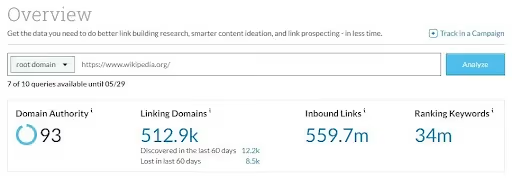
Domain Authority is more than just a number; it is a useful tool for measuring and improving the "health" of your website. Understanding and applying DA to your SEO strategy will help you increase your competitiveness, reach more customers, and achieve success in the digital world.
How is Domain Authority calculated?
Domain Authority (DA) is not a simple metric; it is calculated based on Moz's complex algorithm, which incorporates dozens of factors that influence a website's ranking potential. Some of the key factors Moz uses to calculate DA scores include:
Quality and quantity of links (Backlinks)
High-quality backlinks:
- Links from reputable websites with content relevant to your industry will have a significant impact on your DA score.
- For example: A backlink from a reputable news site like the BBC is worth much more than one from an untrustworthy personal blog.
Link diversity: A website with backlinks from a variety of sources (different industries, blogs, social media) is rated more highly than a website with links from only one fixed source.
Website structure and performance:
User Experience (UX): Fast page load speeds, mobile-friendly interfaces, and intuitive navigation are key factors that enhance user experience, which in turn indirectly improves your Domain Authority.
Logical URL structure: Clean, readable URLs that include relevant keywords help search engines easily analyze your website's content.
Domain Trust:
Domains with a long history of operation that have not violated search engine guidelines generally have an advantage.
Websites free of spammy links or malicious content are rated as more trustworthy.

Content update frequency
A website that consistently publishes high-quality, relevant new content is more likely to improve its Domain Authority score faster.
Content should be optimized for primary keywords without being overstuffed, ensuring it provides genuine value to readers.
Related SEO metrics:
Moz uses metrics such as MozRank, MozTrust, and Link Profile to provide a comprehensive assessment of a domain's strength:
- MozRank: Evaluates website popularity based on the quantity and quality of links.
- MozTrust: Evaluates website trustworthiness based on the link distance from reputable websites.
How DA scores are calculated (Scale of 1 to 100):
The Domain Authority score is designed on a logarithmic scale, which means:
- Increasing a DA score from 10 to 20 is much easier than increasing it from 70 to 80.
- Websites with high DA scores typically require a robust and sustainable SEO strategy to improve.
Domain Authority Checker Tools
To check the Domain Authority of a website, there are many useful tools on the market. Below are some popular and reliable tools to help you track and improve your DA score:
Moz Link Explorer
Moz Link Explorer is the official tool from Moz, widely used to check Domain Authority and related metrics. This is one of the most powerful tools for analyzing and evaluating a domain's authority on search engines.
Key features:
- DA Check: Moz Link Explorer provides a detailed DA score, helping you assess a website's authority. This DA score allows you to compare the strength of websites within your industry.
- Backlink analysis: Moz provides data on the quantity and quality of links pointing to a website. This tool allows you to track the growth of your backlink profile and identify opportunities to build more high-quality links.
- MozRank & MozTrust: In addition to Domain Authority, Moz Link Explorer also provides related metrics such as MozRank (measuring website popularity through backlinks) and MozTrust (measuring the trustworthiness of links). These metrics help you better understand website quality and the SEO factors that need improvement.
- Spam Score: This tool also provides information on a website's spam level, helping you avoid backlinks from untrustworthy sites that could negatively impact your DA.

Pros:
- High accuracy, especially in evaluating links and DA.
- Easy to use and provides detailed data on SEO factors.
- Provides additional metrics that give users a deeper insight into their SEO strategy.
Cons: To access advanced features, users must use the paid version.
Ahrefs
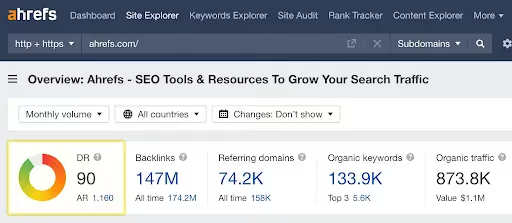
Ahrefs is one of the leading SEO tools, particularly renowned for its backlink analysis and website strength assessment. Although it does not provide a Domain Authority score directly, Ahrefs uses a metric called Domain Rating (DR), a similar metric that helps evaluate the strength of a domain.
Key features:
- Domain Rating (DR): Ahrefs' DR metric is similar to DA and is calculated based on the quantity and quality of backlinks pointing to a website. DR is measured on a scale from 0 to 100, and this metric is highly useful for benchmarking against competitors in the same industry.
- Backlink checker: Ahrefs excels at analyzing a website's backlinks. You can see exactly which websites are linking to you and the quality of those links.
- Competitor analysis: Ahrefs provides comparison reports between you and your competitors, helping you identify link-building opportunities and improve your SEO.
- Content Gap: This tool helps you find keywords that your competitors rank for but your website does not, allowing you to optimize your content and improve your Domain Authority.
Pros:
- A robust and reliable DR metric that helps you measure your website's strength.
- A very powerful backlink tool that can help you analyze competitor links.
- Detailed analysis of SEO metrics and effective competitor benchmarking.
Limitations:
- Does not provide DA scores directly; users must use the DR metric as an alternative.
- The paid version is quite expensive for beginners or small businesses.
SEMrush
SEMrush is a comprehensive SEO analysis tool that not only provides information on DA but also helps you optimize your entire online marketing strategy. SEMrush offers SEO-related metrics, ranging from backlink analysis and keyword performance tracking to suggestions for improving your Domain Authority.
Key features:
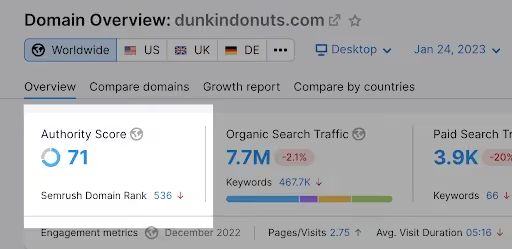
- Authority Score calculation: SEMrush uses Authority Score, a metric similar to DA, to evaluate website strength. This score is calculated based on factors such as backlinks, link quality, and other SEO elements.
- Backlink analysis: SEMrush allows you to track and analyze links from various sources, helping you identify high-quality links and disavow toxic ones.
- SEO Audit & Suggestions: SEMrush provides detailed reports on your website's SEO health and offers recommendations to improve your DA score through site optimization, link building, and page speed improvements.
- Competitor analysis: This tool helps you identify your competitors' SEO strategies and find opportunities to outperform them in search rankings.
Pros:
- Comprehensive features that help you check Authority Score and various other SEO metrics.
- Provides detailed backlink analysis and powerful SEO auditing capabilities.
- Easily track changes and progress in your SEO strategy.
Cons:
- SEMrush is priced quite high, making it suitable for professional SEOs or large enterprises.
- Free features are quite limited; a paid plan is required to unlock full functionality.
Other free tools
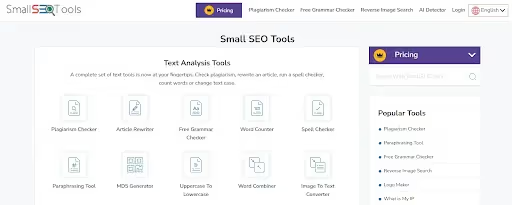
Small SEO Tools: One of the most popular free tools for checking Domain Authority and basic SEO factors. While it doesn't provide the depth of data found in Moz or Ahrefs, Small SEO Tools remains useful for beginners or those on a limited budget.
- Features: DA score checking, keyword analysis, and basic backlink analysis.
- Pros: Easy to use, no account required, and free.
- Cons: Data may be inaccurate or slow to update; does not provide advanced metrics.
Website SEO Checker: This tool also allows you to check your DA score along with other basic SEO metrics. It is suitable for beginners and provides a clear overview of your website's SEO health.
- Features: SEO auditing, page speed analysis, and basic DA assessment.
- Pros: Free, easy to use, and perfect for beginners.
- Cons: Does not provide in-depth analysis or advanced metrics like paid tools.
Steps to increase Domain Authority
Increasing your Domain Authority (DA) is a long-term process that requires a comprehensive SEO strategy. However, by following the specific steps below, you can improve your website's DA score and boost your search engine rankings.
1. Focus on content quality
Create high-quality, useful content: Content is the most critical factor in SEO. Providing valuable information that solves user problems will make your website more authoritative in the eyes of Google and other search engines. This also encourages repeat visits and increases organic traffic to your site.
Update content regularly: Articles should be updated frequently to maintain freshness and meet the evolving needs of searchers. Fresh content creates opportunities for higher rankings and makes it easier to attract backlinks from other sources.
>> See more: What is content? How to write content that engages readers

2. Build an effective backlink strategy
Create and maintain quality links: Links from reputable websites will help enhance Domain Authority . Focus on building backlinks from relevant and highly trustworthy sources. Avoid using black-hat SEO methods such as buying backlinks.
Optimize internal backlinks: Internal links are links that point between pages within your website. They help improve search engine crawlability and distribute link juice to important pages.
Earn natural backlinks: To get natural backlinks, you need to create valuable and engaging content that other websites want to share or link to. This may take time, but it is the most sustainable way to increase DA.
3. Improve page load speed
Optimize website speed: Page load speed is a key ranking factor for Google. A faster-loading website not only creates a better user experience but also helps improve Domain Authority and search rankings. Use tools like Google PageSpeed Insights to check and optimize your page load speed.

Optimize images: Large images can slow down your website's load speed. Make sure images are compressed and resized to reduce loading time.
4. Optimize for mobile devices
Mobile-friendly website design: The popularity of mobile devices requires websites to display and function smoothly on all devices. Google places great emphasis on mobile user experience, so optimizing for mobile devices not only improves user experience but can also positively impact Domain Authority.
Responsive Design: Ensure your website uses a responsive design that automatically adjusts its layout for users accessing it from different devices, such as smartphones, tablets, or desktop computers.
5. Regular Monitoring and Analysis
Use SEO analytics tools: To ensure you are on the right track, regularly check your DA, DR, and other SEO metrics using tools like Moz, Ahrefs, and SEMrush. Continuous monitoring will help you identify and resolve issues quickly, thereby improving your Domain Authority over time.
Competitor Analysis: Monitor your industry competitors to understand what they are doing to improve their DA. This will help you learn effective strategies that you can apply to your own website.
Conclusion
Increasing Domain Authority is not a simple task and requires patience. However, by optimizing content quality, building strong backlinks, improving page speed, and optimizing for mobile devices, you can improve your DA score and enhance your overall SEO performance. Most importantly, this process requires you to continuously monitor and adjust your SEO strategy to maintain sustainable growth for your website.