In the competitive world of SEO, understanding how Google works is the key to success. RankBrain – Google's groundbreaking artificial intelligence algorithm – is changing how websites are ranked. But what RankBrain actually is? And how can you optimize your website to "score points" with this powerful tool? Let's join Markdao in uncovering the secrets behind RankBrain and how to apply the most effective optimization strategies to boost your Google rankings!
What is Google RankBrain?
Google RankBrain is an artificial intelligence (AI) algorithm launched by Google in 2015 that plays a crucial role in ranking search results. It is part of the Hummingbird system, helping Google better understand the semantics of queries to provide the most accurate and relevant search results for user intent.

Unlike traditional algorithms that rely solely on keywords, RankBrain uses AI and machine learning to "learn" and understand how humans express meaning, thereby improving its ability to process complex search queries.
How RankBrain works within Google's algorithm
RankBrain acts as an intelligent filter that helps Google:
1. Understand the semantics of a query: Instead of just analyzing individual keywords, RankBrain focuses on the context and meaning of the entire sentence. This helps Google process queries that have never appeared before.
2. Prioritizing valuable results: RankBrain evaluates the relevance of websites based on signals such as content, user experience (UX), and dwell time.
3. Self-adjusting over time: RankBrain continuously learns from actual search data to improve results. If a result is chosen by many users and has a high interaction time, this algorithm will prioritize displaying it at a higher ranking in the future.
For example: When you search for “romantic dinner spots nearby”, RankBrain not only understands the main keywords but also analyzes your intent to display restaurants that match your needs.
Factors affecting RankBrain
RankBrain relies on many factors to evaluate and rank websites, including:
1. Click-through rate (CTR): A website with an engaging title and meta description will attract more users to click, helping RankBrain understands that the page is relevant to the query.
2. Dwell Time: The amount of time a user spends on a website reflects the quality of the content and how well the page meets their needs.
3. Bounce Rate: If a user leaves the page immediately after visiting, RankBrain may determine that the page is not useful.
4. High-quality content: RankBrain prioritizes pages that provide valuable information, use natural language, and have a readable structure.
5. Mobile compatibility: With the growing number of mobile users, a website that is well-optimized for mobile will be ranked higher.
How does RankBrain affect Google search results?
RankBrain plays a crucial role in improving the quality of Google search results, especially when handling complex, long-tail, or previously unseen queries. This algorithm impacts search results in the following ways:
1. Understanding user search intent
RankBrain does not just analyze keywords but also focuses on the context and the user's true intent.

- For example, when a user searches for "cool travel destinations in December", RankBrain understands that they are looking for places with a cool climate rather than just showing pages that contain the keyword "December".
- This helps Google provide more relevant search results, even for vague or ambiguous queries.
2. Ranking results based on user behavior
RankBrain uses signals from user behavior to determine the relevance of each website:
- Click-Through Rate (CTR): Results that receive more clicks from users are prioritized with higher rankings.
- Dwell Time: If a user stays on a website for a long time, RankBrain understands that the content is useful and valuable.
- Bounce Rate: Pages with a high bounce rate may be ranked lower because they do not meet the user's needs.
3. Handling new search queries
Before RankBrain, Google struggled to handle queries that had never appeared before. This algorithm changed that by:
- Applying machine learning to analyze and "guess" the meaning of new queries.
- Use data from previous similar queries to display more accurate results.
4. Optimize results based on context and location
RankBrain considers contextual factors such as geographic location, device used, and search history to provide the most relevant results.

- For example: If you search for "Italian restaurant" in Hanoi, RankBrain will prioritize displaying Italian restaurants near your area instead of those further away.
5. Enhance visibility for high-value content
RankBrain prioritizes content that is clear, easy to understand, and provides real value to users. Websites that offer well-structured content using natural language will be ranked higher.
In summary, RankBrain not only helps improve search rankings but also enhances the user experience by providing more relevant and useful results. This makes it a critical factor in modern SEO strategies.
How to optimize your website for RankBrain
RankBrain is a key part of Google's ranking algorithm, focusing on understanding user search intent and delivering the most relevant results. To make the most of this technology, website optimization must be approached comprehensively and strategically.
1. Optimize user experience (UX)
RankBrain values user satisfaction when visiting a website, making user experience a top priority.

Specific steps to improve UX:
- Increase page loading speed: A slow page will cause users to leave quickly, increasing the bounce rate, which negatively impacts rankings.
- How to implement: Compress images using tools like TinyPNG or ImageOptim; Use a Content Delivery Network (CDN) to reduce page load times; Minify HTML, CSS, and JavaScript code.
- Design an intuitive interface:
- Ensure the website is easy to navigate with clear menus and prominent call-to-action (CTA) buttons.
- Use whitespace effectively so the content is not cluttered.
- Improve readability:
- Break content into short paragraphs (2-3 sentences per paragraph).
- Use subheadings (H2, H3) to create a clear, easy-to-follow article structure.
2. Optimize for semantic keywords
RankBrain does not just look at primary keywords but analyzes the entire context to understand user intent.

Specific keyword strategy:
- Research long-tail keywords: For example: Instead of optimizing for the keyword "travel," use "summer travel destinations for families." This not only makes your content more specific but also improves your competitive edge.
- Natural semantic optimization:
- Use synonyms and related terms to broaden the context.
- For example: If you are writing about "weight loss," include terms like "dieting," "exercise," and "healthy meal plans."
- Use frequently asked questions: Create content that answers common questions users search for, such as: "RankBrain how does it work?"
3. Produce high-quality content optimized for readers
RankBrain prioritizes content that provides real value to users.
Content production principles:
- Address search intent: Analyze whether users are looking for information, wanting to make a purchase, or needing a solution, and create content accordingly.
- Appropriate article length: Articles should not be too short (under 500 words) as they lack depth, but they shouldn't be overly wordy either. Depending on the topic, the optimal length is usually between 1,000 and 2,000 words.
- Diversify content formats: Combine text, images, videos, and infographics to increase engagement.
- Update content regularly: Outdated information can damage your website's credibility. Schedule regular content updates to maintain accuracy and relevance.
4. Optimize for mobile devices
Google now prioritizes mobile-friendly websites through its Mobile-First Indexing policy.

Optimization steps:
- Responsive design: Ensure all content and images display perfectly across phones, tablets, and desktops.
- Reduce mobile load times: Use AMP (Accelerated Mobile Pages) to optimize page loading speeds on mobile devices.
- Check compatibility: Use Google's Mobile-Friendly Test tool to check and adjust your website.
5. Increase Click-Through Rate (CTR)
CTR is a key signal for RankBrain to evaluate the relevance of a webpage.
Strategies to improve CTR:
- Optimize titles:
- Titles should include primary keywords, spark curiosity, and promise value.
- Example: Instead of "Learn about RankBrain," try "What is RankBrain? Secrets to SEO optimization with RankBrain."
- Optimize meta description: Meta descriptions should be around 150–160 characters, clearly stating the benefits users will receive when visiting the page.
- Use Structured Data: Add schema markup to display highlights such as star ratings, FAQs, or videos in search results.
6. Continuous monitoring, analysis, and adjustment
RankBrain continuously learns and adapts to user behavior, so you need to regularly optimize based on real-world data.
How to do it:
- Use Google Analytics: Track traffic, bounce rates, and time on page.
- Optimize content based on Search Console: Analyze which keywords are performing well and adjust your content to better leverage those terms.
- Run A/B tests: Test titles, meta descriptions, or page layouts to find the most effective version.
By focusing on user experience, producing quality content, and improving elements like semantic keywords and page load speed, you will not only satisfy RankBrain but also enhance the overall effectiveness of your SEO strategy.
Comparing RankBrain with other algorithms
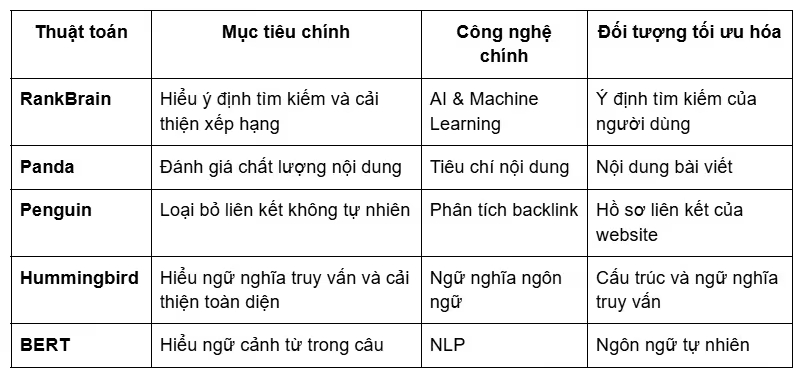
Each Google algorithm plays a unique role in improving the quality of search results. While Panda and Penguin focus on cleaning up content and links, RankBrain and BERT represent major advancements in understanding semantics and user search intent. The combination of these algorithms helps Google become an increasingly powerful and intelligent search engine.
How Google RankBrain measures user satisfaction
Google RankBrain measures user satisfaction through behavioral signals, including click-through rate (CTR), dwell time, and bounce rate.
When a user selects a result and stays on the page for a long time, RankBrain understands that the content is valuable and relevant to the query.
Conversely, if a user quickly leaves the page or selects a different result, RankBrain may consider the content irrelevant and adjust its ranking. This helps the algorithm continuously improve to better meet user needs.
Conclusion
Google RankBrain is not only a significant step forward in search algorithm optimization but also a key to enhancing the user experience on the internet. By using artificial intelligence and machine learning, RankBrain helps Google better understand search intent and provide more relevant, accurate results.
To make the most of this algorithm, content and website optimization should focus on quality, relevance, and meeting user experience needs. This is not just a way to improve rankings but also to build long-term credibility for your website in the eyes of both Google and users.