In the journey to conquer the heights of SEO, one of the "silent enemies" that many websites encounter is Keyword Cannibalization. This phenomenon not only wastes resources but also causes you to "compete" against yourself on Google rankings. So, what is Keyword Cannibalization really, and how can you detect and handle it effectively? Let's join Markdao in exploring the details to optimize your SEO strategy and bring your website closer to the top search positions!
What is Keyword Cannibalization?
Keyword Cannibalization, also known as "keyword self-competition," occurs when a website has multiple pages or articles targeting the same keyword or key phrase. Instead of helping the website optimize its search engine rankings, this creates internal competition between content pieces, causing them to unintentionally "cannibalize" each other's authority.
This phenomenon often appears when there is no clear keyword strategy or during content expansion when articles unintentionally overlap in keyword targeting. For example, if you have two articles both targeting the keyword "SEO guide," Google will struggle to determine which article is the most relevant to display to users.
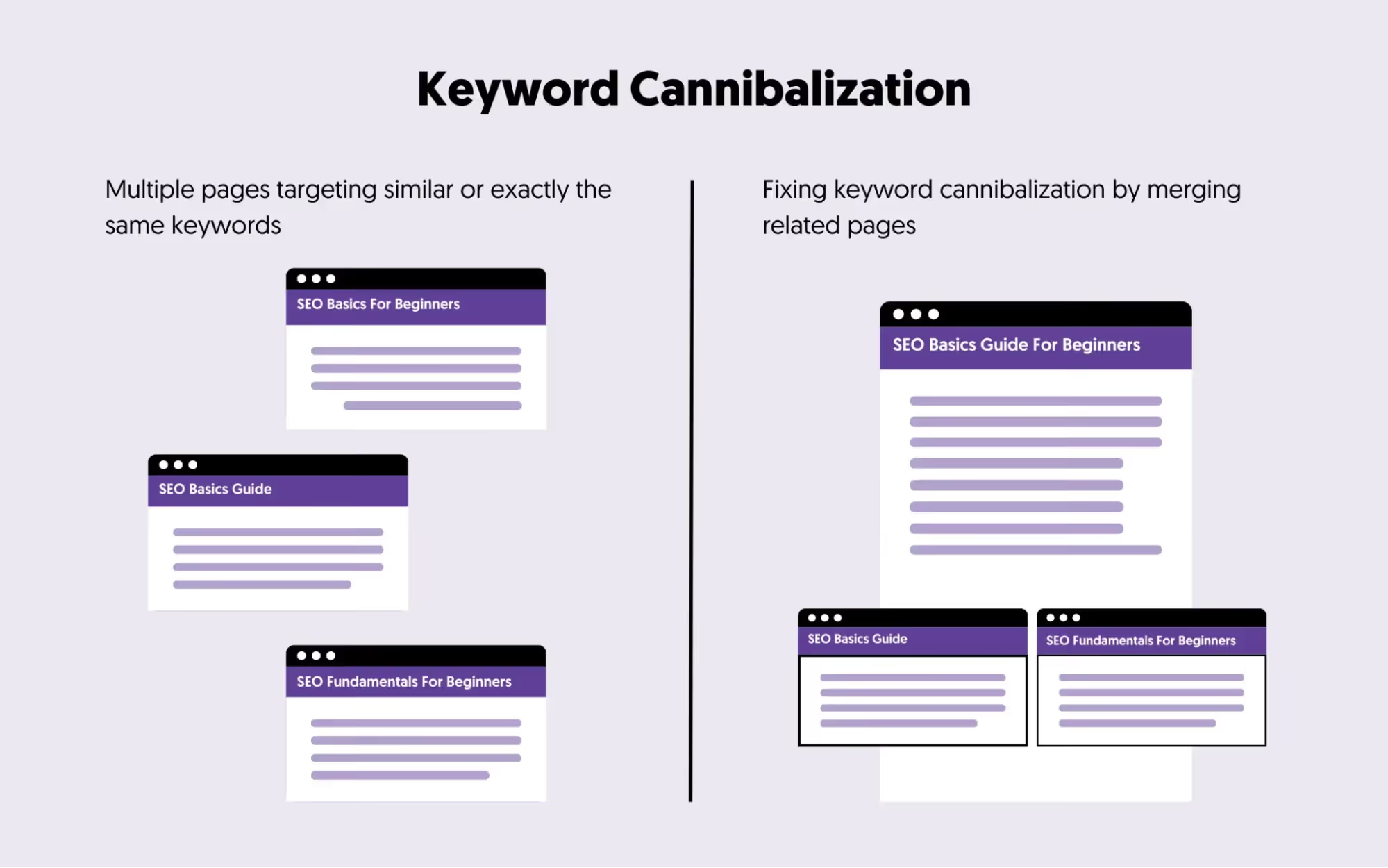
Signs of Keyword Cannibalization include:
- Multiple pages on the website competing for the same keyword ranking.
- Keyword rankings are unstable, constantly fluctuating between different articles.
- Traffic is diluted, reducing the overall effectiveness of the website.
Why does Keyword Cannibalization affect SEO?
Keyword Cannibalization can lead to several serious consequences for your SEO strategy, including:
- Decline in search engine rankings: When multiple pieces of content target the same keyword, Google has to split ranking signals between pages. This dilutes your SEO authority, reducing the chances of any single article achieving a high ranking.
- Reduced effectiveness of backlinks and internal links: Backlinks and internal links are crucial for improving Google rankings. However, when multiple pages target the same keyword, these links become dispersed instead of focused on one specific piece of content. This weakens the overall authority of your website.
- Negative impact on user experience: Users may feel confused when they find multiple articles with similar content on the same website. This not only makes for a poor user experience but also increases your bounce rate, which negatively affects your SEO.
- Difficulty in identifying priority content: When all your articles try to target the same keyword, you will struggle to determine which content should be prioritized for optimization or promotion. This hinders the development of a long-term SEO strategy.
Keyword Cannibalization not only weakens SEO performance but also acts as a major barrier to getting your website to the top of search results. Therefore, identifying and addressing this issue is essential to maintaining and improving your SEO performance.
5 Causes of Keyword Cannibalization
Keyword Cannibalization often occurs due to a lack of strategy and proper content management. Below are the common causes of this phenomenon:

1. Improper keyword optimization
Keyword Stuffing: When attempting to over-optimize, many articles are built around the same primary keyword, leading to unnecessary duplication.
Choosing keywords that are too broad: Keywords that are not specific enough cause multiple pieces of content to target the same phrases, especially when those keywords have high search volume.
For example: An e-commerce website has many articles all targeting the keyword "buy men's t-shirts" instead of clearly segmenting them by specific keywords like "men's crew neck t-shirts" or "Korean-style men's t-shirts."
2. Lack of a clear content strategy
No systematic keyword research plan: Without thorough keyword research and analysis, topics easily overlap, leading to "keyword cannibalization."
Aimless content development: Articles are created randomly without specific goals, causing multiple pieces of content to unintentionally target the same keyword.
3. Illogical website structure
Unscientific internal linking: Internal links that do not focus on core content lead to a dilution of SEO authority across pages.
Duplicate URLs and article titles: When URLs or article titles are not optimized to be clearly distinct, they can cause unnecessary competition.
Overuse of categories or tags: Using too many similar categories or tags can cause articles to overlap in keyword targeting.
4. Failure to update old content
Old articles not re-optimized: Older articles are often not optimized according to current keyword strategies. When new content is added, these older posts easily suffer from keyword overlap.
Failure to audit and consolidate content: Some websites create too many fragmented articles instead of consolidating them into comprehensive, in-depth content.
5. Mistakes when scaling the website
Focusing too much on quantity over quality: When scaling rapidly, many websites focus on mass-producing content while neglecting a sound keyword distribution strategy.
Failing to optimize content strategy over time: Businesses often fail to adjust their SEO strategy as their website grows, leading to content and keyword duplication.
In summary, Keyword Cannibalization often stems from a lack of diligence in content planning and SEO optimization. Identifying the root causes will help you easily find the right solutions to improve the effectiveness of your overall SEO strategy.
How to detect Keyword Cannibalization
Detecting Keyword Cannibalization in a timely manner is crucial for maintaining the effectiveness of your SEO strategy. Below are detailed and easy-to-follow methods to help you identify this issue:

1. Use Google Search Console
Google Search Console is a free and effective tool for checking your website's keyword performance.
How to do it:
- Log in to Google Search Console.
- Select the Performancetab.
- Check the list of keywords in the "Queries" tab.
- Click on each keyword to view the list of pages ranking for that specific term.
Signs to look for: If multiple pages are ranking for the same keyword, it is a clear sign of Keyword Cannibalization.
2. Search for keywords directly on Google
A manual but highly effective way to detect keyword cannibalization is to search for the keyword directly on Google.
How to do it:
- Type the keyword you want to check into the Google search bar.
- Use the syntax: site:yourdomain.com "keyword" to limit search results to your website.
Signs to look for: If multiple pages from your site appear in the search results for the same keyword, then Keyword Cannibalization may be occurring.
3. Use specialized SEO tools
Modern SEO tools can help you detect Keyword Cannibalization more quickly and accurately.
Some popular tools:
- Ahrefs:
- Use the “Site Audit” tool to check keyword performance.
- View the “Organic Keywords” section to detect pages with keyword cannibalization.
- SEMrush:
- Use “Position Tracking” to check keyword rankings.
- Check which keywords are being ranked for by multiple pages on your website.
- Screaming Frog:
- Crawl your entire website and analyze the content.
- Search for pages with duplicate titles, meta descriptions, or content.
4. Check internal links and backlinks
Internal links and backlinks are key indicators that help you identify Keyword Cannibalization.
How to do it:
- Analyze internal links: Use Google Search Console or tools like Screaming Frog to check for pages with duplicate internal links.
- Check backlinks: Use Ahrefs or SEMrush to see which pages your backlinks are pointing to. If multiple pages are receiving backlinks for the same keyword, your SEO authority may be diluted.
Detect Keyword Cannibalization not only helps you optimize your SEO strategy but also ensures your content performs at its best. Using a combination of SEO tools and manual methods will yield accurate and comprehensive results. Once detected, the next step is to address this issue to ensure your website achieves optimal performance.
How to effectively address Keyword Cannibalization
After detection of Keyword Cannibalization, the next step is to find the optimal solution to resolve the issue. It is crucial to apply appropriate strategies to improve your website's rankings and SEO performance. Below are effective and detailed ways to handle it:

1. Content Consolidation
When multiple pages target the same keyword, you should consider merging these pieces of content into a single, in-depth, and comprehensive article.
How to do it:
- Evaluate content quality: Review all related articles to determine which one performs best or provides the most valuable content.
- Combine information: Gather all key points and important details from the other articles into one single post.
- 301 Redirect: After merging, implement 301 redirects from the old URLs to the new article's URL to preserve backlinks and SEO value.
Benefits:
- Creates higher-quality content that better serves user needs.
- Boosts SEO authority by focusing on a single, authoritative piece of content.
2. Keyword Reassignment
If your existing articles have distinct content but share overlapping keywords, adjust your keyword strategy to avoid internal competition.
How to do it:
- Detailed keyword research: Use tools like Ahrefs, SEMrush, or Google Keyword Planner to find related secondary or long-tail keywords.
- Re-optimize content: Adjust titles, meta tags, and article content so that each page targets a unique keyword.
- Update internal links: Ensure internal links point to the correct pages and optimized keywords.
Example: If you have two articles targeting the keyword "buy men's t-shirts," change one to "buy premium men's t-shirts" to avoid duplication.
3. Use Canonical Tags
Canonical tags help Google understand which page is the official version of your content and that other pages are merely duplicates.
How to do it:
- Add the <link rel="canonical" href="primary-URL"> tag to the <head> section of your secondary pages.
- Specify a primary URL to consolidate rankings and backlinks to that page.
Note: Only use canonical tags when pages have similar or nearly identical content.
4. Implement 301 Redirects
A 301 redirect is a quick and effective way to handle unnecessary pages or duplicate content.
How to do it:
- Identify underperforming or unnecessary pages.
- Implement 301 redirects from these URLs to the most relevant or authoritative pages.
- Audit internal links to ensure they do not point to redirected URLs.
Benefits:
- Transfer SEO value from old pages to new ones.
- Reduce the number of pages flagged by Google as duplicate content.
5. Improve website structure
A logical website structure helps reduce the risk of Keyword Cannibalization from the start.
How to implement:
- Use keyword mapping: Plan content to clearly assign specific keywords to each page.
- Optimize internal linking: Create links from sub-pages to the main page to consolidate SEO authority.
- Manage categories and tags: Ensure each category or tag has a distinct purpose and is not redundant.
6. Content Pruning
If you identify articles with low-quality or outdated content, consider removing them.
How to do it:
- Check traffic and performance of your articles using Google Analytics.
- Delete pages that provide no value and implement 301 redirects if necessary.
Note: Only delete content when you are certain it no longer provides value to users or for SEO.
7. Monitor and optimize regularly
Keyword Cannibalization can recur if you do not manage your content strictly.
How to do it:
- Perform periodic audits using tools like Google Search Console, Ahrefs, or SEMrush.
- Adjust your content and keyword strategy over time.
Addressing Keyword Cannibalization not only helps improve keyword rankings but also optimizes user experience and enhances the effectiveness of your overall SEO strategy. By applying the methods above in a flexible and scientific manner, you can eliminate this issue and achieve better results on search engines.
Preventing Keyword Cannibalization
To prevent Keyword Cannibalization effectively, you need to build a clear content strategy from the start. Create a keyword map, ensuring each page focuses on only one primary keyword and a specific search intent. Use a logical website structure, categorizing content with categories and tags to avoid overlap.
Additionally, regularly check SEO performance using tools like Google Search Console or SEMrush to detect early signs of internal keyword competition. More importantly, create unique and valuable content for each article, and optimize internal links to guide users and search bots to the most relevant page. A well-planned strategy will help you avoid the risk of Keyword Cannibalization right from the planning stage.
Conclusion
Keyword Cannibalization is a common issue, but one that can be easily managed and prevented with the right SEO strategy. By detecting it early, optimizing your content, and building a logical website structure, you not only improve your keyword rankings but also enhance the user experience. Turn your content into a powerful competitive advantage instead of letting minor errors hinder your overall SEO performance.