In the world of SEO, keyword optimization is an essential factor for improving search rankings. However, using as many keywords as possible is not always a smart strategy. One common mistake many people make is "keyword stuffing"—cramming an excessive number of keywords into content, which makes the writing difficult to read and strips it of its true value.
So, what is keyword stuffing, and how can you avoid keyword "spam" while still optimizing effectively? Let's join Markdao in this article to better understand how to optimize keywords intelligently and safely for SEO.
What is keyword stuffing?
Keyword stuffing is an outdated SEO technique used when a writer attempts to optimize a webpage by cramming too many keywords into the content without regard for the natural flow of the writing. This is often done in elements such as headings, paragraphs, descriptions, or even meta tags.
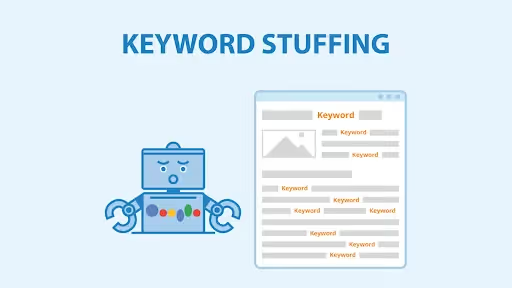
Initially, when search engines were not as advanced as they are today, this technique could provide some benefits in boosting search rankings. However, with the continuous improvement of algorithms like Google Panda and Penguin, keyword stuffing has become a prohibited practice that is harmful to SEO.
Illustrative example:
- A typical paragraph featuring keyword stuffing might look like this: "Buy a car on installment with the lowest interest rate in HCMC. Buy a car on installment quickly with low interest rates. You can choose to buy a car on installment with low interest rates today."
- Although the keywords "car on installment" and "low interest rate" are accurate, repeating them excessively makes the paragraph difficult to read and unnatural.
4 Negative effects of keyword stuffing on SEO
1. Reduced SEO effectiveness and Google penalties:
Google's algorithms are increasingly intelligent: Google no longer simply ranks websites based on keyword density. Current Google algorithms (such as Panda and Penguin) are designed to detect websites that use keyword stuffing and will lower the rankings of these pages.
Severe penalties for detected keyword spam: When Google detects keyword stuffing, the website may be "penalized" or even removed from search results. This not only affects rankings but also reduces traffic to the website.

2. Negative impact on user experience:
Increased bounce rate: Keyword-stuffed content is often difficult to read and fails to provide real value to users. When readers find an article unnatural or confusing, they will leave the site immediately, which increases your bounce rate. This not only hurts your SEO but also causes your website to lose opportunities to retain customers.
Reduced content utility: The goal of SEO is to provide useful information to users. If an article focuses solely on stuffing keywords without offering valuable content, users won't gain any helpful insights. This lowers the overall quality of your website and erodes user trust.

3. Loss of credibility and reduced trust from Google and users:
Google evaluates content quality: Google ranks websites based on content quality and the natural use of keywords. Sites that engage in keyword stuffing are viewed as untrustworthy, damaging their reputation with both search engines and users.
Creates a sense of deception: Users can tell when content is forced to fit an algorithm rather than providing genuine value. This leads to a feeling of being misled, which discourages them from returning to your website.
4. Impact on engagement and sharing:
Difficult to drive engagement: When an article is unnatural and hard to read, users are less likely to share it on social media platforms. This limits the reach of your content and reduces opportunities to increase traffic through various channels.
Limits community-building opportunities: A high-quality website with useful, readable content easily attracts and builds a loyal community of readers. Keyword stuffing hinders this potential.

How to identify keyword stuffing in your content
Identifying keyword stuffing in an article isn't always easy, but there are several clear signs you can look for. Here are the most common ways to spot keyword stuffing:
- Excessively high keyword density: Keywords appear too frequently in the article, with an unreasonable density (often exceeding 1-2%). This makes the content feel forced and difficult to read, lacking the natural flow of standard writing.
- Forced writing style: Repeating keywords or their variations unnaturally disrupts the coherence of the article. Sentences become rigid and difficult for the reader to follow.
- Repetition in titles and descriptions: When keywords are overused in titles, meta descriptions, or heading tags (H1, H2), it creates an imbalance and reduces the appeal of the article.
- Inappropriate keyword usage: Keywords are inserted into irrelevant contexts or do not support the main content, creating the impression that they were "forced" into the piece rather than developing naturally within the narrative.
7 Ways to avoid keyword stuffing and optimize keywords naturally
In the world of SEO, keyword optimization is not a numbers game but an art of balance. How can you insert keywords skillfully while keeping your content engaging and natural? Here are the "golden" rules to help you do it effectively.
1. Understand the reader's search intent
Keywords are not the destination; they are the bridge between your content and the reader. Take the time to research the search intent behind the keywords. What problem are users trying to solve? Are they looking for information, comparing options, or ready to make a purchase?
Once you understand this, keywords become natural tools to guide your content rather than "thorns" that disrupt the reading experience.

2. Focus on value rather than keyword density
Instead of "stuffing" keywords to hit an ideal density, ask yourself: Is my content truly valuable?
There is no absolute "standard" number for keyword density, but experts generally recommend keeping it at 1-2% of the total word count in the article. More important than the percentage is how you distribute the keywords:
- Do not repeat keywords in every paragraph. Instead, use your primary keyword in key locations such as the title, introduction, subheadings (H2, H3), and conclusion.
- Do not force keywords if they do not fit the context. If a sentence becomes awkward or difficult to read, prioritize natural flow.
3. Leverage synonyms and keyword variations
Rich and natural content depends not only on the primary keyword but also on related phrases and semantic variations.
Example of keyword variations:
- Primary keyword: "Keyword Stuffing"
- Variations: "stuffing keywords", "keyword spam", "over-optimization of keywords"
This not only makes the article reader-friendly but also expands its visibility in related searches (LSI keywords). Think of keywords as pieces that complete the overall picture of your content.

4. Place keywords in strategic positions
Search engines often prioritize keywords that appear in key areas of an article:
- Title (H1): Ensure the primary keyword appears naturally, without awkward phrasing or truncation.
- Meta description: This is the description that appears on search result pages, so the keyword must be clear and compelling.
- Subheadings (H2, H3): Insert keywords naturally to guide the content.
- Introduction and conclusion: Ensure the article begins and ends with content directly related to the keywords.
5. Write natural, readable sentences
Keywords are like spices in a dish – adding the right amount in the right place enhances the flavor, but overdoing it ruins the entire experience.
A well-optimized article is not just about search engines, but also about the reader's experience. If readers find the content forced or confusing, they will leave immediately.
- Read through each sentence and ask yourself: Does this sentence provide real value? Is it easy to read?
- Avoid writing sentences just to "stuff keywords," for example: "Keyword Stuffing is when Keyword Stuffing is repeated too many times in Keyword Stuffing." This sentence is not only meaningless but also annoying to the reader.
6. Invest in high-quality content
Modern search engines prioritize articles with genuine value rather than relying solely on keyword density. High-quality content typically features the following:
- Provides useful and insightful information.
- Addresses the questions or problems that readers care about.
- Written by someone with expertise or a deep understanding of the topic.
When you create content like this, keywords will naturally be integrated without any effort.
>> See more: What is content? How to write content that attracts readers

7. Measure and improve after publishing
Even after applying every keyword optimization technique, it is crucial to check performance after your article is published. Use tools like Google Analytics or Google Search Console to measure:
- Click-Through Rate (CTR): If your CTR is low, optimize your title and meta description.
- Time on page: If readers leave quickly, check whether your content is truly engaging.
Based on real data, you can continue to improve your article for better results.
Conclusion
Keyword optimization in SEO-friendly content is an art that requires a delicate balance. Do too little, and your content won't perform well in search. Do too much, and your writing will feel stiff and hurt your SEO rankings.
Avoiding keyword stuffing isn't just a technical trick; it's about how you tell your story to the reader—sincerely and naturally. Let your content speak to its true value, and use keywords only as a catalyst to connect with search engines. Ultimately, a memorable article is always one that touches the reader's heart.