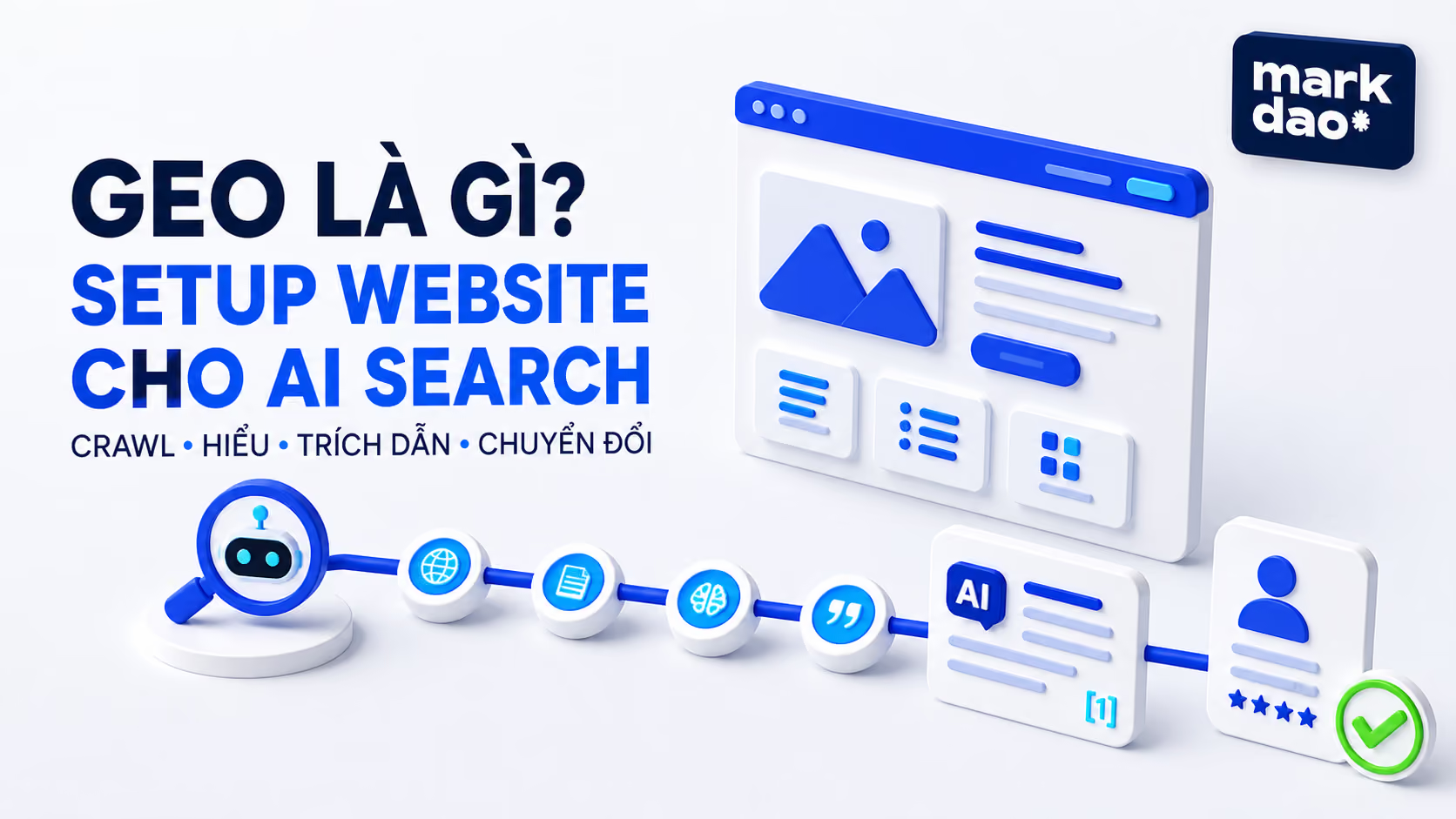



SEO is no longer an unfamiliar concept in the digital age, especially as businesses increasingly focus on e-commerce and digital media. SEO is the core factor that determines your website's ranking on Google search. So, how can you improve SEO, boost brand awareness, and increase revenue? This is currently the top priority for every business.

How does Google SEO work?
Search engines like Google have specific criteria for evaluating and ranking your website and its pages at the top of search results. In short, the two most important factors Google uses to determine your website's ranking are web design and the quality of the content you publish. If you want a high-standard website, don't hesitate to contact Markdao. With over 5 years of experience in the industry, we
are committed to providing you with a professional, modern, and especially Google-friendly website.
So, how a website is designed and how content is published are the two most important factors. But what exactly do we need to do? Let's continue exploring in the following sections:
Improve Google SEO to increase traffic to your website
First and foremost, we want to emphasize that if you intend to have a website that ranks well on search engines or meets high standards, the first step is to choose a quality agency.
Do your research, because this is not a simple task. It’s not enough to just have a beautiful, fast-loading website; you must remember that the purpose of creating a website is to promote your brand image to Internet users, sell products, and increase revenue.
It is worth noting that to achieve these goals, you need to increase traffic to your website, and there is no more effective or long-term way to do this than by appearing in the top positions of search results.
Sounds difficult, right?
How to improve Google SEO through web design?

what a website includes. Markdao will cover
factors such as the URLs of the pages on your website,
meta-description tags, headings and images, page load speed, issues regarding
netlinking, and finally, have you heard of the term responsive website, which means
From URLs
, especially for SEO, the URL plays a very
important role because it is the "house address" of the website for Internet users that
more importantly, Google's robots. These robots, also known as crawlers, will
visit your website to read and index it, which is the only way your website can
appear on search result pages.
The principles for creating a Google SEO-friendly URL are:
URLs should not contain special characters or numbers (0, 1, etc.): because Google
crawlers find numbers and special characters
like %$*#@ confusing, which can negatively impact your website's
ranking potential.
URLs should not contain accents: for languages with diacritics like Vietnamese or
French, URLs must not include them, as robots categorize these marks
the same way as special characters.
URLs should not be too long. Being "too long" refers not only to long keywords,
but also to having too many slugs; for example, www.markdao.com/fr/service/webdesign
is less optimized than www.markdao.com/service/webdesign. Furthermore, Google's
robots no longer favor URLs containing long keywords. An optimized URL is about
90 characters long for Webmaster Tools and 76 characters for Google blogs.
From
the meta-descriptions
The next important factor is meta descriptions. To optimize
standard meta descriptions
,
first, these tags must contain the website's keywords and provide a concise summary
that accurately reflects the page or website.
Meta descriptions appear on search engine results pages and serve as a summary
of a specific page or website. This means that when Internet
users perform a search on Google and receive a list of search
results, the first things that catch their eye are the title tags and, more importantly,
the meta descriptions. If the content within them is clearly presented, contains keywords,
and provides information that meets the user's search intent, the likelihood of your
page or website being visited is very high.
Choosing
appropriate titles and images
The titles here refer to H1, H2, H3 tags, etc., which are the first elements
read by Google bots when they crawl your pages; therefore,
you need to master the requirements for optimizing
Hn tags, such as the character count for each heading. Since Google's
algorithms are constantly changing, you need to regularly update these metrics. Next,
don't forget to include the main keyword in every title.
In terms of visuals, not only must they be high quality and accurately reflect the content
theme, but you should also remember that for images uploaded to a website, there is always
an ALT field, also known as alternative text. This is the part Google reads to understand
what your image is illustrating, thereby indexing that image on the search engine
image results.
Website
loading speed
Your page loading speed is directly proportional to your chances of being highly ranked by
Google. To achieve this, website creators need to know how to optimize the web code
used and limit the components within the site as much as possible, especially
images. You should design or select images with appropriate dimensions,
because image size is a key factor in determining page
loading speed.
Netlinking issues
well-known, inserting
internal and external links are the primary foundations from which search engines
evaluate the logical relevance of your content. This criterion is considered
one of the most important factors when improving
Regarding internal links, these are links that direct readers to other
pages within your website, such as service pages or product introductions
products,…
There are two types of external links: first, you insert links from your website to
other websites; second, also known as backlinks, you go to other
websites, forums, or blogs and insert links to your own website.
In reality, the quality and relevance of these links allow
Google to evaluate the popularity of your website and determine whether your content
is optimized or meets the needs of Internet users. Inserting
internal links, external links, or building backlinks are excellent methods
for improving
the
performance of your website.
Responsive web design
The final factor, which plays an increasingly indispensable role as users
today tend to use smartphones to browse the web, is a design that is friendly
to all screen interfaces, such as tablets, desktops,
smartphones, etc. Did you know that Google has penalized many websites that
could be opened on a desktop screen but not on mobile? If you are worried about
whether your website is responsive to all interfaces, or how
to make your website responsive, do not hesitate to let Markdao help
you.
Improve
your Google SEO directly through your content—it's an opportunity you shouldn't miss.

from content
will include the following elements: keyword selection, with a greater focus on long-tail
keywords, tips for writing SEO-friendly articles, and finally, regularly updating
content on your website.
Keyword
selection
A website consists of many pages, and each page should focus on a single
topic to meet the search intent of your visitors, customers,
or even potential leads. Therefore, your task is to choose
a primary keyword for each page, ensuring that these keywords
have a high search volume. Based on your chosen keywords, you will build
content for each page, and don't forget to include the keywords in the URL, titles, etc., as
we mentioned above; this really helps you "win over" Google crawlers.
keywords, or in other words, helping you find the
most searched keywords of the month in different countries, using tools
like Insight or Hubspot,…
Long-tail
keywords—why not?
Long-tail keywords provide more specific details about a topic than short-tail keywords
which are more general, helping Internet users immediately understand the subject matter, and if they have a need,
they will click right away. For example, the keyword “2018 toyota car price” will be extremely
competitive even if you rank in the top positions on the results page, and while traffic
may be high, it does not necessarily lead to effective revenue. So why not
be more specific by extending that keyword to “2018 toyota vios price”.
With this keyword phrase, you will have less traffic, but in return, although lower in volume, that
traffic will be of higher quality, thereby increasing your conversion rate.
Tips for writing Google SEO-friendly content
Once you have selected your keywords, you can proceed to write your content, and today
Markdao will introduce some tips for creating content that is
·
1 primary
keyword for each piece of content (article or webpage)
·
A minimum
of 300 words for a low-competition keyword, and up to 1500 words for a keyword with
high competition
·
Do not
repeating a keyword too many times in your content, as Google does not like
that
·
Absolutely
do not copy and paste content from other sources, otherwise you will be penalized by Google's
algorithms.
Continuously update your articles
which means constantly updating articles
on your website. These pieces of content must be relevant to your field of
operation, your products/services, etc. In short, imagine topics that
could be popular and useful to Internet users and write high-quality
articles. In
, especially SEO,
the more you strive to focus on Internet users, the more Google and other search
engines will highly value you.
In the future, what will we do to improve Google SEO for your website?

what else will there be? Today, Google is constantly introducing
new improvements to bring about a civilized, modern Internet world,
which includes the implementation of voice searches. In fact, you
can see that today's operating systems have further developed this area, specifically
like Siri on iOS or OK Google on Android, and performing searches,
voice queries will differ from those on screen interfaces. With this pace of
development, in the near future, you should consider and improve the
optimization methods
for your
website.
Markdao has introduced tips to
improve
it. We hope this article
will be useful for those looking to "revamp" the effectiveness of their website.
Good luck, and stay tuned for more interesting articles from
Markdao!