

Content is entering a rather "strange" phase: writing has never been easier, yet writing well and ranking at the top has never been harder. With just a few lines of prompts, AI can generate a complete blog post in minutes—fast, cheap, and virtually limitless. But precisely because of this, the internet is being "flooded" with generic content that is forgotten as soon as it's read.
So the question is no longer simply "should you use AI to write content?" but rather: does using AI actually help you create better content, or does it just make you a "faster" version of thousands of others? This article from Markdao will dive straight into practical experience, breaking down the pros and cons so you know where you stand in this game.
What is AI content writing?
If you have ever tried using AI to write, your first impression was likely one of surprise. Just enter a few lines of description, and seconds later, you have a relatively complete article that reads well and can even be used immediately in some cases. But because it is so easy, many people misunderstand the true nature of AI content.
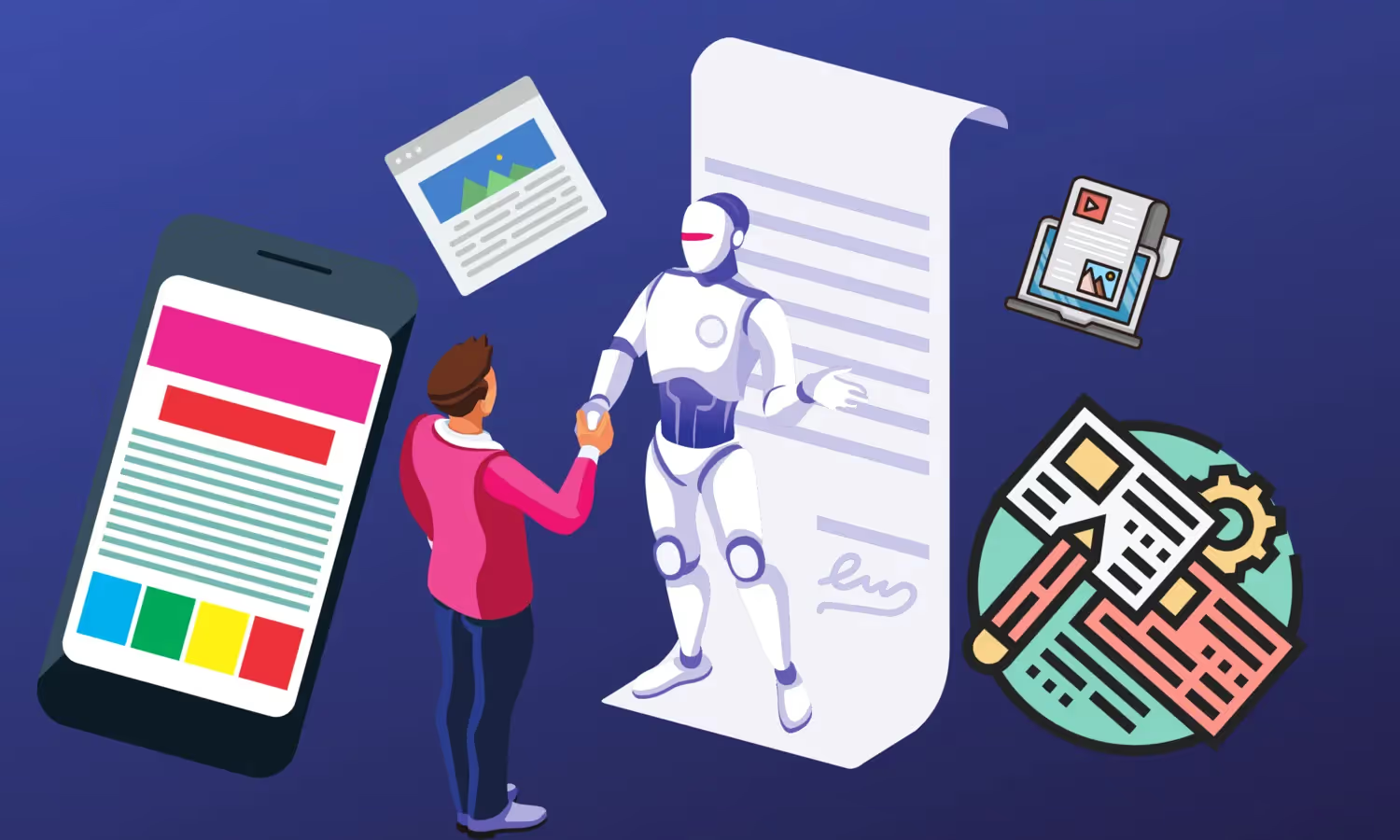
Simply put, AI content writing is the use of artificial intelligence tools to generate content on behalf of humans. You provide a topic, keywords, or specific requirements, and the AI relies on the data it has learned to produce a finished piece.
The problem is that AI doesn't actually understand what it is writing. It has no personal experience, no unique perspective, and no understanding of who your readers are. It only predicts which words should appear next in a given context to make the text look logical and smooth.
When placed alongside the true definition of content, you will see a clear difference. In our article on what is content on Markdao, we emphasize that content is not just about providing enough information; it must also deliver value, have a clear purpose, and most importantly, connect with the reader.
AI can help you create an article quickly and with the right structure, but it cannot yet provide the real value of content, such as insights, experiences, or unique perspectives. This is why many AI-generated articles read well but fail to leave an impression.
Looking at it more realistically, AI is like a very fast writing assistant. It can help you brainstorm ideas, write drafts, or handle basic tasks. But for content to truly have depth and effectiveness, you still need to edit, supplement, and provide direction.
Understanding this from the start will help you avoid a common mistake today: thinking that AI can completely replace a writer. In reality, AI only helps you work faster; whether the work is good or not still depends on how you use it.
Pros and cons of using AI for content writing
Pros of using AI for content writing
If you have used AI for a while, you will realize one thing quite clearly: it is not for nothing that everyone is getting "hooked" on it. AI is not perfect, but in some aspects, it truly makes content work significantly easier.
Here are the most significant benefits of using AI for content creation, from the perspective of an SEO and marketing professional:
- Significant time savings: Previously, completing an SEO-optimized blog post could take several hours, from research to final draft. With AI, you can cut this process in half, or even more, if you know how to use the right prompts.
- Reduced pressure when producing content at scale: Projects requiring dozens or even hundreds of articles—such as SEO blogs, landing pages, or satellite site networks—become much more manageable when AI handles the framework and basic content.
- Overcoming writer's block: When you don't know where to start, AI can suggest titles, outlines, or angles. Sometimes you don't even need to use the generated content itself; just getting a nudge in the right direction saves a lot of brainstorming time.
- Rapid production of repetitive content: Content types like product descriptions, meta descriptions, basic emails, or social posts with fixed formats are where AI truly shines. These tasks don't require much creativity, so AI handles them quite effectively.
- Basic SEO optimization support: AI can help you build article structures, suggest headings, distribute keywords, and ensure no critical sections are missing. For those new to SEO, this is a significant advantage.
- Easy A/B testing for content versions: You can quickly generate multiple versions of the same content to test different headlines, angles, or messaging without much extra effort.
- Lower content production costs: Instead of needing a large team for routine tasks, you can optimize your resources and focus your personnel on higher-value areas like strategy, insights, and conversion optimization.
Overall, AI doesn't automatically make content "better," but it helps you produce it faster, more consistently, and at a much larger scale. In an increasingly competitive content landscape, simply being faster is a major advantage if you know how to leverage it correctly.
The downsides of using AI content
AI can help you work faster, but after using it for a while, you will start to notice clear issues. In fact, most websites that use AI indiscriminately and fail to rank in SEO are struggling with the points below.
- Content tends to be generic and lacks personality: AI learns from existing data, so its writing style and approach are often very "safe." One article might seem fine, but reading several will reveal they all sound similar and lack a unique hook. For SEO, this makes it hard to compete because there is no reason for Google to prioritize your content over hundreds of similar ones.
- Lack of practical experience and user insights: This is the biggest weakness. AI lacks real-world experience and hands-on exposure, so its content often stops at merely synthesizing information. Elements like case studies, real-life lessons, and personal perspectives are almost non-existent, even though these are becoming increasingly important for SEO.
- Prone to creating "technically correct but useless" content: AI writes very smoothly and with perfect grammar, but many passages leave no lasting impression. The content sounds logical and comprehensive, yet it lacks depth and fails to solve the reader's specific problems.
- Risk of misinformation if not verified: AI can "hallucinate" data or provide inaccurate information while still sounding very convincing. If you publish posts without fact-checking, the risk of losing credibility is very high, especially in fields requiring precision like finance, healthcare, or law.
- Difficulty in creating high-conversion content: For sales-driven content like landing pages, ads, or emails, AI often writes in a generic way. Lacking emotion and a deep understanding of the customer, the content struggles to persuade readers to take action.
- Risk of being penalized by Google if overused: Google does not ban AI, but it prioritizes content with real value. Articles generated quickly by AI without editing or added insights rarely achieve sustainable rankings and may even drop in performance over time.
- Over-reliance can diminish writing skills: When you get used to letting AI do most of the work, you gradually lose the ability to develop ideas, write coherently, and delve deep into topics. In the long run, this is a significant disadvantage if you are a professional content creator.
To be blunt, AI is not the problem. The problem lies in how you use it. If you treat AI as a complete replacement, you will easily fall into a loop of bland, repetitive content that lacks real value. But if you understand these limitations from the start, you will know how to leverage AI without letting it drag down your content quality.
Should you use AI to write content?
If you are looking for a "yes" or "no" answer, it is a bit difficult. Because in reality, the question is no longer whether you should use AI, but rather to what extent you use it.

If you have been working in content for a while, you will clearly see that those who don't use AI are slow, while those who rely entirely on it produce content that isn't good enough to compete. Therefore, the most reasonable answer is that you should still use it, but you must use it the right way.
For tasks requiring speed, such as writing high-volume SEO blogs, creating outlines, conducting quick research, or handling basic content sections, AI is an almost indispensable tool. It helps you save a lot of time and offloads repetitive work. For projects that need to scale content, it is nearly impossible to manage without AI, or the costs would be prohibitively high.
However, there are things you should not hand over entirely to AI. For content that requires depth, a unique perspective, or is directly related to conversions—such as landing pages, sales copy, or brand-building articles—AI should only serve as a support tool. If you let AI write everything, the content will usually be safe and correct, but not persuasive enough.
The key lies in how you perceive AI. If you view it as a supporting tool, you will be able to leverage its speed while maintaining quality. Conversely, if you view it as a replacement, you will easily end up with a lot of content that lacks value.
Ultimately, a great content creator today isn't someone who writes everything by hand, but someone who knows how to combine AI with their own thinking. AI helps you move faster, but you are the one who decides whether you're heading in the right direction.
How to use AI to create content effectively
If you only use AI to write faster, you will soon hit its limits. You might produce more content, but that doesn't mean it's better. The difference between an average AI user and an effective one lies in how they control and leverage the tool.

1. Use AI to start, not to finish
Many people get stuck here without realizing it. They enter a simple prompt, take the entire output from the AI, and publish it immediately. In the short term, this saves time, but in the long run, it makes your content increasingly bland and difficult to compete with.
A more effective approach is to treat AI as a stepping stone. Use it to outline your post, brainstorm ideas, or generate an initial draft. Once you have a clear structure, developing the content becomes much easier and faster than starting from scratch.
More importantly, when you rewrite or edit based on that draft, you maintain control over the quality of the content instead of relying entirely on AI.
2. Always add your own perspective and experience to your content
This is the one element AI cannot replace, and it is what determines whether a piece of writing is truly valuable. If you pay attention, content that ranks well or keeps readers engaged usually shares a common trait: a unique perspective or real-world experience.
AI doesn't know what you've done, what problems you've faced, or what lessons you've learned in your work. Therefore, if you only use AI-generated content, your writing will easily fall into the trap of being "correct but forgettable."
After getting a draft from AI, take the time to add personal experiences, real-world examples, or your own observations. Just by adding these details, your writing will immediately stand out and gain much more depth.
3. Write prompts as clearly as you would brief a real person
Many people think AI is "smart" enough that a simple request is sufficient. In reality, the quality of the content depends heavily on how you craft your prompt.
If you only write a generic sentence, the AI will return generic content. Conversely, if you clearly describe your target audience, the goal of the post, the desired tone, and the required structure, the results will be much more accurate.
Think of writing a prompt like briefing a content writer. The more specific you are, the more accurate the output will be. This is a crucial skill if you want to leverage AI effectively, rather than just using it for the sake of it.
4. Always review and edit before publishing
One of the most dangerous mistakes is trusting AI-generated content completely. In reality, AI can write very fluently while still providing incorrect information or inappropriate phrasing.
There are cases where AI provides inaccurate data or writes passages that sound reasonable but lack real value. If you publish directly without checking, it not only affects the quality of your content but also damages your brand's reputation.
Therefore, proofreading and editing are mandatory. You need to verify the information, adjust the tone to make it sound more natural, and remove any fluff. This is the step that turns content from "usable" into "high-quality."
5. Combining AI with SEO mindset and specific goals
AI can help you write quickly, but it doesn't understand your SEO strategy. If you don't clearly define your keywords, search intent, or the article's purpose, the generated content is likely to be unfocused and fail to deliver real results.
Before you start, you should clearly define the goal of the article, the target audience, and the keywords you need to optimize for. Once you have a clear direction, you can use AI to develop content accordingly.
The difference lies in the fact that AI is just an execution tool, while the strategy must come from you. When combined correctly, you gain both speed and direction—this is the sustainable way to create content in the current landscape.
Overall, AI doesn't do the work for you; it helps you do what you already understand much faster. When you control the content, AI becomes a powerful assistant. But without direction, it only leads you to create more content, not better content.
The future of AI content and SEO
Looking at how AI is evolving, one thing is almost certain: AI isn't going anywhere; it will only become more deeply integrated into how we create content. The question isn't whether to use it or not, but how the game is changing.
In the past, simply writing with the right keywords and structure was enough to rank. But today, with AI capable of generating mass content in a very short time, the baseline for content has been raised. This means "good enough" content no longer cuts it. Google is also increasingly clear about prioritizing content that offers real value, experience, and uniqueness.
This leads to a clear trend: the future of content won't be a competition of quantity, but of quality and depth. Websites that rely solely on AI to mass-produce content without further investment will struggle to maintain stable rankings. Conversely, those who know how to combine AI with a strong content mindset will have a significant advantage.
Another notable point is that the concept of "good content" is changing. Previously, good content just needed to be accurate and sufficient. Now, it needs to incorporate elements of experience, personal perspective, and higher credibility. These are things AI cannot yet do well, which is why the human role remains crucial.
In this context, AI will gradually become a default part of the content creation process, much like how we transitioned from handwriting to using digital tools. Those who don't use AI may fall behind, but those who over-rely on it without quality control will also be weeded out.
Ultimately, the advantage will belong to those who understand both sides. They leverage the speed and processing power of AI while maintaining their content strategy, user insights, and human storytelling ability. This is no longer just about tools; it's about how you adapt to a rapidly changing content environment.
Conclusion
AI is not the "savior" of content, but it is also not the threat many people think it is. It is simply a tool, and like any other tool, its value depends entirely on the user.
If you use AI to quickly do things you don't truly understand, your content will likely end up accurate but bland—plentiful but valueless. But if you have a content mindset, understand your readers, and know what you are doing, AI will help you move much faster than before.
The reality is becoming quite clear. Those who ignore AI will gradually slow down. But those who rely entirely on AI won't get very far either. The real gap lies with those in the middle—people who know how to leverage AI as an advantage while still maintaining their own unique touch in content creation.