

While most marketers are still struggling to optimize chatbots or automation based on pre-set scripts, a "new wave" is quietly changing the game: AI Agents are systems that don't just respond, but also think, plan, and act like a real digital marketer. From keyword research and content creation to running ads and performance optimization, AI Agents can handle almost the entire marketing process that previously required an entire team. So, what exactly are AI Agents, how do they work, and why are they becoming a "strategic weapon" for businesses in the AI-first era? Let's join Markdao to explore this in today's article.
What is an AI Agent?
In the context of rapidly advancing artificial intelligence, the concept of AI Agents is becoming a major breakthrough, far exceeding what traditional chatbots or automation can achieve.
An AI Agent is an artificial intelligence system capable of perceiving its environment, making decisions, and taking actions to achieve a specific goal.
Simply put, if a chatbot only "responds when asked," an AI Agent can:
- Determine what needs to be done
- Plan the execution
- Take action to achieve the goal
For example:
- When given the goal of "increasing website traffic by 30%," an AI Agent doesn't just offer suggestions; it can also:
- Analyze current data
- Research keywords
- Plan content
- Create SEO articles
- Monitor and optimize performance
This makes an AI Agent a true "digital employee," rather than just a support tool.
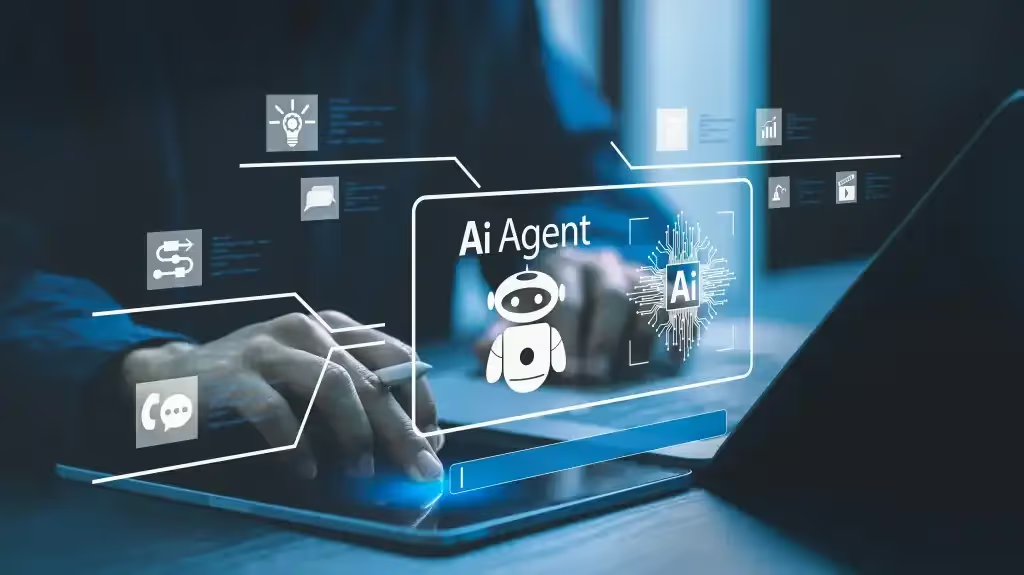
3 core elements of an AI Agent
A true AI Agent is typically composed of 3 key capabilities:
1. Perception: AI Agents have the ability to collect and understand data from multiple sources:
- User behavior
- Website data
- Market and trends
2. Decision-making: Based on the collected data, the AI Agent uses AI models (typically LLMs) to:
- Analyze problems
- Evaluate options
- Make decisions aligned with goals
3. Action: Not stopping at just "suggestions," an AI Agent can directly:
- Write content
- Send emails
- Create and optimize ads
- Connect with tools (CRM, Ads, Analytics, etc.)
This very ability to take action autonomously is the biggest differentiator compared to previous AI systems.
How do AI Agents differ from Chatbots and Automation?
To better understand the value of AI Agents, it is helpful to compare them with familiar technologies:
- Traditional Chatbots
- Operate based on scripts
- Respond based on input
- Lack the ability to make independent decisions
- Automation
- Run on fixed rules (if–else)
- Efficient but inflexible
- Do not "understand" context
- AI Agents
- Have clear goals
- Capable of reasoning and planning
- Capable of autonomous action and continuous optimization over time
You can think of an AI Agent as a combination of:
- AI intelligence (LLMs)
- Automation capabilities
- And human-like strategic thinking
The rise of AI Agents is no coincidence; it stems from real-world business needs:
- Increasingly heavy marketing workloads
- Growing demands for personalization
- The need for faster decision-making
Meanwhile, AI Agents can:
- Process massive volumes of data
- Operate 24/7
- Continuously learn and optimize
Because of this, AI Agents are shifting the role of AI from a "support tool" to a "strategic executor" in Digital Marketing.
How do AI Agents work?
At its core, an AI Agent functions as an "intelligent loop" consisting of continuous steps: receiving a goal → understanding data → reasoning → planning → acting → learning from results. The key difference is that it doesn't just process a single request; it can autonomously manage an entire workflow until the final goal is achieved.

At the start, an AI Agent is given a specific goal, such as "increase organic traffic" or "optimize landing page conversion rates." From there, instead of waiting for detailed instructions, it determines what needs to be done first and what follows. To do this, the AI Agent collects and "reads" data from various sources like Google Analytics, user behavior, website content, or even market trends. This is the perception phase, allowing it to understand the context just as a marketer would analyze data before making a decision.
Once it has sufficient data, the AI Agent uses AI models (typically Large Language Models) to perform reasoning. In this step, it doesn't just process information; it evaluates multiple options: should it focus on SEO or ads? Should it rewrite content or build a new landing page? This "deliberation" process gives the AI Agent the flexibility to make decisions rather than following a fixed script.
Next is the planning phase. The AI Agent breaks down the major goal into specific tasks, for example: keyword research → building content clusters → writing articles → on-page optimization → tracking rankings. Crucially, this plan is not fixed; it can change dynamically based on new data gathered during execution.
Once a plan is in place, the AI Agent begins taking action by connecting to external tools. It can call APIs, use a CMS to publish posts, run ads on Google or Facebook, send marketing emails, and even interact with a CRM to nurture leads. This is the step that makes AI Agents more "formidable" than chatbots, as they don't just suggest—they actually do the work.
After taking action, the AI Agent continuously monitors results and learns through a feedback loop. If an article doesn't achieve the desired ranking, it can automatically optimize the content. If an ad isn't performing well, it will adjust the targeting or budget. This loop runs continuously, helping the system become smarter and more effective over time.
In short, AI Agents don't operate on a "receive command, provide result" basis like traditional AI tools; they function like a real employee: they know how to set goals, think, act, and improve themselves. This is precisely why AI Agents are considered the core foundation for the next generation of automated Digital Marketing.
Common types of AI Agents today
Current AI Agents can be classified according to a logical progression, from simple reactive systems to agents capable of complex learning and optimization. Understanding each type will help businesses identify the level of application that best suits their needs and resources.

- Simple Reflex Agents: This is the most basic form, operating based on "if-else" rules. The agent responds directly to each input without storing information or considering previous context. In Digital Marketing, this type is commonly found in automated email systems or scripted chatbots. The advantage is ease of implementation, but the major limitation is a lack of flexibility and adaptability.
- Model-based Agents: Unlike the previous type, model-based agents have the ability to remember states and build an "internal model" of the environment. This helps them understand context and provide more appropriate responses. In practice, this is the foundation of content personalization systems, where AI adjusts messages based on a user's past behavior.
- Goal-based Agents: At this level, an AI Agent doesn't just react; it acts based on a specific goal. It has the ability to evaluate multiple options and choose the path that best achieves that goal. For example, in marketing, an agent might be tasked with increasing conversion rates and, from there, automatically suggest optimizations for content, CTAs, or user experience.
- Utility-based Agents: This is an advanced version of the goal-based agent. Instead of just achieving a goal, it also considers the efficiency of each option based on multiple criteria such as cost, profit, and risk. This type is particularly suitable for performance marketing tasks, where budget optimization and ROI play a key role.
- Learning Agents: This is the highest level, where an AI Agent can learn from data and continuously improve performance over time. It doesn't just execute; it self-adjusts its strategy based on actual results. In modern Digital Marketing, advanced AI systems often fall into this category, especially when combined with large language models to process content and make decisions.
Overall, these types of AI Agents do not exist in isolation but are often combined to form a complete system. The current trend is shifting from rule-based agents to learning agents, where AI doesn't just follow orders but has the ability to adapt, optimize, and play an increasingly important role in long-term marketing strategies.
Applications of AI Agents in Digital Marketing
The emergence of AI Agents is fundamentally changing how marketing operates. While AI previously only supported individual tasks, AI Agents can now coordinate, execute, and optimize entire marketing systems like a self-operating "digital team." This opens up a new era: marketing is no longer entirely dependent on human staff, but is accelerated by AI systems capable of self-learning and self-optimization.

Here are the most prominent and impactful applications of AI Agents in digital marketing today:
1. AI Agents in Content Marketing: From content production to full strategic operations
Content is no longer just about "writing articles"; it is a complex process involving research, production, and optimization. AI Agents can manage this entire chain automatically and continuously.
- Automated keyword research based on market data and search behavior
- Building content clusters and long-term SEO strategies
- Creating multi-format content: blogs, social posts, and landing pages
- On-page SEO optimization (headings, internal links, semantic keywords)
- Continuously updating and improving content based on actual performance
The key difference is that AI Agents don't just "write faster," they write with greater strategic alignment thanks to their ability to analyze data and optimize toward specific goals. This helps businesses shift from manual content production to operating content as a growth engine.
2. AI Agents in Performance Marketing: Real-time campaign automation and optimization
Performance marketing always demands speed and the ability to optimize continuously. This is the ideal environment for AI Agents to demonstrate their power.
- Automatically creating and testing multiple ad variations (A/B testing)
- Real-time campaign data analysis
- Adjusting budgets, target audiences, and bidding strategies
- Detecting and eliminating underperforming campaigns
- Optimizing ROI based on multiple variables simultaneously
Instead of marketers having to manually track and adjust every campaign, AI Agents can make decisions faster, more accurately, and continuously 24/7. This is especially critical in highly competitive environments, where every minute impacts costs and performance.
3. AI Agents in the Customer Journey: Personalizing experiences at scale
One of the biggest challenges in modern marketing is personalizing experiences for thousands, or even millions, of users. AI Agents help solve this problem effectively.
- Tracking and analyzing user behavior across multiple channels
- Automating customer segmentation
- Personalizing content, offers, and messaging for each user
- Automating lead nurturing via email, chatbots, and CRM
- Predicting future customer behavior
As a result, businesses can shift from a mass-market approach to “1-to-1 marketing at scale”, where every customer receives a unique experience while operations remain fully automated.
4. AI Agents in Data & Analytics: Turning data into strategic decisions
Data is the “fuel” of digital marketing, but its true value only emerges when it is analyzed and transformed into action. AI Agents act as a powerful “analytical brain.”
- Collecting and processing data from various sources
- Uncovering hidden insights that are difficult for humans to detect
- Predicting market trends and behaviors
- Providing data-driven strategic recommendations
- Automatically generating reports and dashboards
The key point is that AI Agents don't just "display data," they explain it and suggest actions,helping marketers make faster, more accurate decisions in a constantly changing environment.
5. AI Agents in SEO: Building a sustainable organic growth system
SEO is one of the fields that benefits most from AI Agents due to its systematic nature and high volume of tasks.
- Automate website audits and detect SEO errors
- Keyword research and silo structure development
- Create and optimize SEO-friendly content
- Suggest internal linking strategies
- Monitor rankings and continuously adjust strategies
Instead of executing SEO through disjointed campaigns, AI Agents help businesses build a continuously operating SEO system where content, technical aspects, and strategy are tightly integrated.
It is clear that AI Agents are not just a new tool, but a completely different approach to Digital Marketing, especially when combined with a vibe coding mindset to optimize creative and implementation processes. From content, ads, and customer journeys to data and SEO, AI Agents are gradually taking on the role of executing and optimizing the entire marketing system.
In the near future, the difference between businesses will no longer be about "whether they use AI or not," but who knows how to deploy AI Agents more effectively. Businesses that embrace this trend early will have a significant advantage in the race for digital growth.
Benefits of applying AI Agents in Marketing
Applying AI Agents in Marketing goes beyond just "automating tasks"; it is a major shift in how businesses operate and grow. When implemented correctly, AI Agents can deliver clear benefits in terms of performance, cost, and strategic quality.

- AI Agents significantly boost productivity by simultaneously handling multiple tasks that previously required an entire team. From market research and content production to campaign optimization, everything can run continuously without interruption. This allows marketers to shift their role from "doers" to "overseers and strategists."
- Another key benefit is the ability to reduce long-term operating costs. Instead of expanding the team to handle increasing workloads, businesses can leverage AI Agents to automate the majority of their processes. While initial implementation costs may be high, it is a highly effective investment in the long run.
- AI Agents enable personalized customer experiences at scale, something that is difficult for humans to achieve manually. The system can analyze the behavior, preferences, and interactions of each user to deliver relevant content, messaging, and recommendations. As a result, businesses not only increase conversion rates but also consistently enhance the customer experience.
- The ability to make fast, data-driven decisions is also a standout strength. AI Agents can process massive amounts of data in a short time, identify trends, and suggest actions in near real-time. This is especially critical in the Digital Marketing environment, where every minor change can significantly impact campaign performance.
- Furthermore, AI Agents have the capacity for continuous learning and improvement. By analyzing the results of past activities, the system can self-adjust its strategy to achieve better performance in the future. This is a key factor that helps businesses not only optimize in the short term but also build a sustainable competitive advantage.
Overall, AI Agents do not just help marketing become "faster" or "cheaper," but also help it become smarter, more precise, and highly scalable. This is the foundation for businesses to adapt and break through in an increasingly competitive digital landscape.
The Future of AI Agents in Digital Marketing
The future of AI Agents in Digital Marketing is not just about tool improvements, but a fundamental shift in how marketing is operated. As AI moves beyond supporting individual tasks to connecting, coordinating, and optimizing entire systems, the role of AI Agents will increasingly approach that of a "self-operating marketing engine."
In the coming period, AI Agents will evolve to become increasingly autonomous in decision-making. Instead of just providing recommendations, these systems will directly execute strategies, monitor results, and self-adjust in real-time. This means that many activities such as ad optimization, budget allocation, and content personalization will be handled almost entirely by AI, with speed and precision far exceeding human capabilities.
Another key trend is the formation of AI Agent ecosystems. Instead of a single agent, businesses will use multiple specialized AI Agents for functions like content, ads, CRM, and SEO, with these agents collaborating like a complete team. For example, an agent in charge of SEO services can provide insights to the content agent, while the ads agent uses data from the CRM to optimize targeting. The entire system operates as a unified "marketing engine."
Additionally, AI Agents will play an increasingly significant role in deep-level customer experience personalization. Beyond just suggesting relevant content, AI Agents can predict the needs, behaviors, and even the timing of individual user decisions. This opens up the possibility of building customer journeys that are virtually "tailor-made" for each individual, yet still deployable at scale.
However, the development of AI Agents also brings a major shift in the role of marketers. In the future, marketers will no longer focus on executing individual tasks, but will transition into the role of strategy, control, and optimization of AI systems. The most critical skills are no longer just writing content or running ads, but understanding how to set goals, train AI, and evaluate the performance of automated systems.
Looking ahead, the line between "human-led marketing" and "AI-led marketing" will increasingly blur. Businesses that effectively leverage AI Agents will be able to operate faster, optimize better, and scale more easily. Conversely, those slow to adapt risk being left behind in a game where speed and data are the deciding factors.
Conclusion
AI Agents are not merely an upgrade to chatbots or automation; they represent a fundamental shift from "human-operated" marketing to "intelligent system-led" marketing. As AI gains the ability to understand goals, plan, and execute actions autonomously, the marketer's role evolves—shifting from doing everything to designing and overseeing the entire process.
In this landscape, competitive advantage will no longer depend on who runs better ads or writes better content, but on who builds more effective AI Agent systems. The businesses that leverage AI to scale, continuously optimize, and make faster decisions will be the ones that lead the market.