


What are stop words? These are common words like "and," "is," "of," "the," "a," and "an" that search engines often ignore when indexing. In the world of SEO, there is ongoing debate about whether to keep or remove stop words. Some experts argue that removing them improves SEO efficiency and makes content more concise. However, in many cases, they play a crucial role in maintaining meaning and user experience. So, how should you handle stop words to optimize your content while keeping it reader-friendly? Let's join Markdao to find out!
What are Stop Words?
Definition and importance of Stop Words
What are stop words? Stop words is a term used in SEO, natural language processing (NLP), and search technology to refer to common words that search engines typically ignore when indexing or processing search queries. These words do not carry much semantic value and appear very frequently in sentences, such as prepositions, conjunctions, or connecting words.
Search engines, such as Google, often remove stop words to focus on more important keywords, which helps speed up data processing and improve search results. However, in some cases, stop words still play an important role, especially when they are part of a main keyword or contribute to the context of the content.

Examples of Stop Words
Below are some common stop words in languages like English and Vietnamese:
- Stop words in English
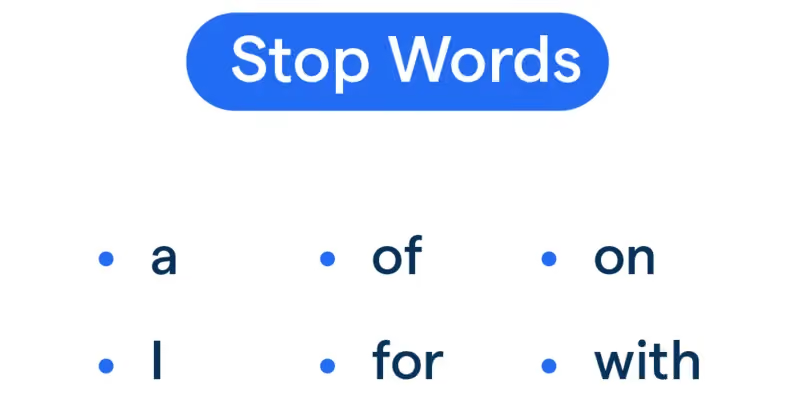
Words like “a,” “an,” “the,” “and,” “but,” “or,” “on,” “in,” and “with” are very common and generally do not carry specific meaning.
→ The phrase "The best SEO tips" might be shortened to "best SEO tips" during query processing.
- Stop words in Vietnamese:
Common stop words include “and,” “of,” “is,” “but,” “or,” “on,” and “at.”
→ The phrase "How to optimize your content" can be shortened to "optimize content you" during indexing.
What is the significance of stop words in SEO?
Stop words help search engines reduce the volume of data to be processed, allowing them to focus on important words to return more accurate results. However, with the development of modern search technologies like Google BERT, search engines have begun to better understand context and process stop words more flexibly. This means that, in some cases, retaining stop words can improve search results, especially for long-tail keywords or semantically rich questions.
For example: In the question "What is the best way to optimize a website?", the words "the" and "to" contribute to the overall meaning and help search engines clearly understand the context of the query.
Thus, although stop words are often removed, they still play a certain role in conveying meaning and optimizing content for both readers and search engines.
So why can stop words be controversial?
The debate surrounding stop words stems from the need to balance search engine optimization with a seamless user experience. While removing stop words can benefit SEO, overusing or misapplying this practice can negatively impact content quality.
Modern search engines like Google have evolved to handle stop words more intelligently, particularly through semantic search technology. Consequently, the decision to keep or remove stop words should be carefully considered based on your content goals and specific keywords.
Should you keep or remove stop words in your content?
What are stop words, and should you keep them in your writing? This is a key question for SEO professionals and content creators alike. Depending on your optimization goals and the context, you may choose to either keep or remove them. Let’s analyze each scenario in detail to help you make the right decision.
When to keep stop words
In certain situations, keeping stop words is not only necessary but highly beneficial, especially when you want to optimize content to match user search intent and improve the overall experience.
1. When optimizing for semantic search
Modern search technologies like Google BERT have significantly improved the ability to understand the context of queries. Although stop words may lack significant grammatical meaning, they play a crucial role in defining the overall context of a phrase.
Example: Search query "The best way to optimize content": Words like "the", "best", "to" help search engines understand that the user is looking for an optimal solution, rather than just a list of tips.

Google BERT improves the understanding of query context
2. For keywords containing stop words
If your main keyword contains stop words, you should keep them to avoid changing the meaning and to ensure the article aligns with user search intent.
For example: The keyword "the best tools for SEO" would become inaccurate if you removed the word "the".
Similarly, in Vietnamese, the keyword "best practices" would lose its full meaning if you removed the word "cách" or do .
3. Ensure a good user experience
Articles should remain natural and coherent to engage readers. Removing all stop words can make content difficult to read and unnatural.
For example: The "The best way to optimize your content" if stop words are removed, it could become "How to optimize your content", reducing its appeal and clarity.
When to remove stop words
Conversely, in some cases, removing stop words is more effective, especially when you want to optimize technical SEO elements.
1. In URLs to keep them clean
Stop words are usually unnecessary in URLs, and removing them can help make the path shorter and more search-engine friendly.
Example:
Full URL: example.com/the-best-seo-tips
→ URL after removing stop words: example.com/best-seo-tips
→ A concise URL is not only good for SEO but also easier to remember and share.
2. In subheadings or meta tags when character counts are limited
For subheadings or meta descriptions, where character counts are restricted, removing unnecessary stop words helps you focus on primary keywords without exceeding the allowed length.
Example: Meta tag: "How to optimize your website with helpful tips" can be shortened to "Website optimization: Helpful tips", saving characters while emphasizing the main point.
3. When you need to increase focus on primary keywords
Removing stop words from important sections like titles, H1 tags, or image ALT tags helps increase the weight of primary keywords and prevents content dilution.
Example: Title "Ways to optimize your website" can be optimized to "How to optimize your website", focusing more strongly on the primary keyword "website optimization".
Guide to handling stop words in articles
Handling stop words is a crucial part of content optimization, ensuring it is both search engine friendly and provides a great experience for readers. Below is a detailed 5-step guide to help you handle stop words effectively.
Step 1: Identify the primary keyword of the article
Before handling stop words, you need to identify the primary keyword to ensure that all content changes are aimed at optimizing the right focus.
Ask yourself: Does your primary keyword contain stop words?
Example:
- Keyword "the best SEO tools" contains stop words "the".
- Keyword "best way to do" contains stop words "way" and "do".
If your primary keyword contains stop words, you should keep them to avoid losing meaning or negatively impacting your search rankings.
Step 2: Consider the context and frequency of stop words in your content
Stop words don't always need to be removed. In many cases, they play a vital role in maintaining the context and flow of your writing.
- Context: If a stop word helps clarify the meaning of a sentence or phrase, keep it.
Example: The sentence "The best way to optimize content" includes stop words that help clarify the context.
- Frequency: Check if stop words appear too frequently and dilute your content. If so, adjust them to ensure the article is free of unnecessary repetition.
Step 3: Optimize URLs and titles: Remove unnecessary stop words
Stop words are often unnecessary in URLs or titles, as they can make them wordy and reduce the effectiveness of your SEO elements.
Optimize URLs: Remove stop words to create concise, search-engine-friendly URLs.
Example:
- Full URL: example.com/the-best-seo-tools
- Optimized URL: example.com/best-seo-tools
Optimize titles: If your article title is long, you can remove unnecessary stop words to focus on the primary keywords.
Example:
- Original title: "A guide on the best way to optimize SEO content"
- Optimized title: "Best SEO content optimization guide"
Step 4: Check the natural flow of the article
Even when optimizing for SEO, you must ensure the article remains readable and engaging for users. Removing too many stop words can make the content feel disjointed and incoherent.
Check for natural flow: Read through the article after removing stop words to ensure the sentences still make full sense and flow smoothly.
Example:
- Before: "This is the best way to optimize your content."
- After removing too many stop words: "Best way optimize content you."
- The second sentence is unnatural and harder to understand.
Step 5: Use stop word analysis tools
To handle stop words effectively, you can use content and keyword analysis tools. Some useful tools include:
1. Yoast SEO: This plugin provides suggestions for keywords, context, and content optimization, including how to handle stop words.
2. Google Search Console: This tool helps you analyze keyword performance and identify key phrases containing stop words for more effective optimization.
3. Other plugins or support tools:
- Ahrefs or Semrush: To analyze keywords and check if your keywords contain stop words.
- Grammarly or Hemingway: Helps check the grammar and flow of your content after processing stop words.

Benefits and limitations of handling stop words
1. Benefits of removing stop words
Removing stop words offers many benefits, especially in the context of content optimization for SEO.
- Reduce complexity in search data processing
Search engines like Google must process a massive amount of data every second. Removing stop words helps lighten the system's load, allowing it to focus on keywords that are truly important and meaningful.
Example: When a user searches for the phrase "how to optimize your website", the search engine can ignore words like "how", "to", and "your" to process the query faster and focus on the core phrase "optimize website".
- Create cleaner, more SEO-friendly URLs
Removing stop words from URLs not only shortens the path but also makes the URL easier to remember and read for both users and search engines.
Example:
- Full URL: example.com/the-best-seo-tips
- Shortened URL: example.com/best-seo-tips
This not only improves the user experience but also helps search engines prioritize indexing for better-structured content.
2. Disadvantages of removing stop words
Despite the many benefits, removing stop words also comes with some drawbacks that can affect context and content quality.
- Loss of meaning in certain key phrases
Stop words sometimes play a crucial role in conveying the meaning of a phrase. If they are removed, the phrase may lose its clarity and precision.
Example:
- Main keyword: "The Best SEO Tips"
- If you remove the stop words, it becomes "Best SEO Tips", which may lead to misunderstandings or fail to align with the user's search intent.
- It can confuse readers if removed entirely from the content
In articles or long-form content, removing all stop words can reduce natural flow and make the text difficult for readers to understand.
For example: A sentence like "The best way to optimize content" if all stop words are removed, becomes "Best way optimize content", making the sentence unnatural and less engaging.
Stop words are a double-edged sword in SEO. In some cases, removing them helps optimize content better, but there are also situations where they should be kept to maintain meaning and the reader's experience. To make the most of stop words, consider the context and target audience when writing your content.
Conclusion
After learning what stop words are, it is clear that stop words are not necessarily a hindrance to SEO if you know how to handle them correctly. Whether to keep or remove stop words should be based on the context, content goals, and the primary keywords of the article. Remember that the ultimate goal of SEO is not just to achieve high rankings on search engines, but also to provide the best value and experience for your readers. Therefore, optimize stop words flexibly so that your content is both SEO-friendly and engaging for users!