

In the world of SEO, thin content is a term used to describe content that lacks quality, provides little information, or is not detailed enough to solve a searcher's problem. Websites with thin content not only frustrate users but also make it difficult for your website to rank on Google. Let's join Markdao to explore why Google dislikes thin content and how to improve the quality of your website's content to boost SEO performance.
What is Thin Content?
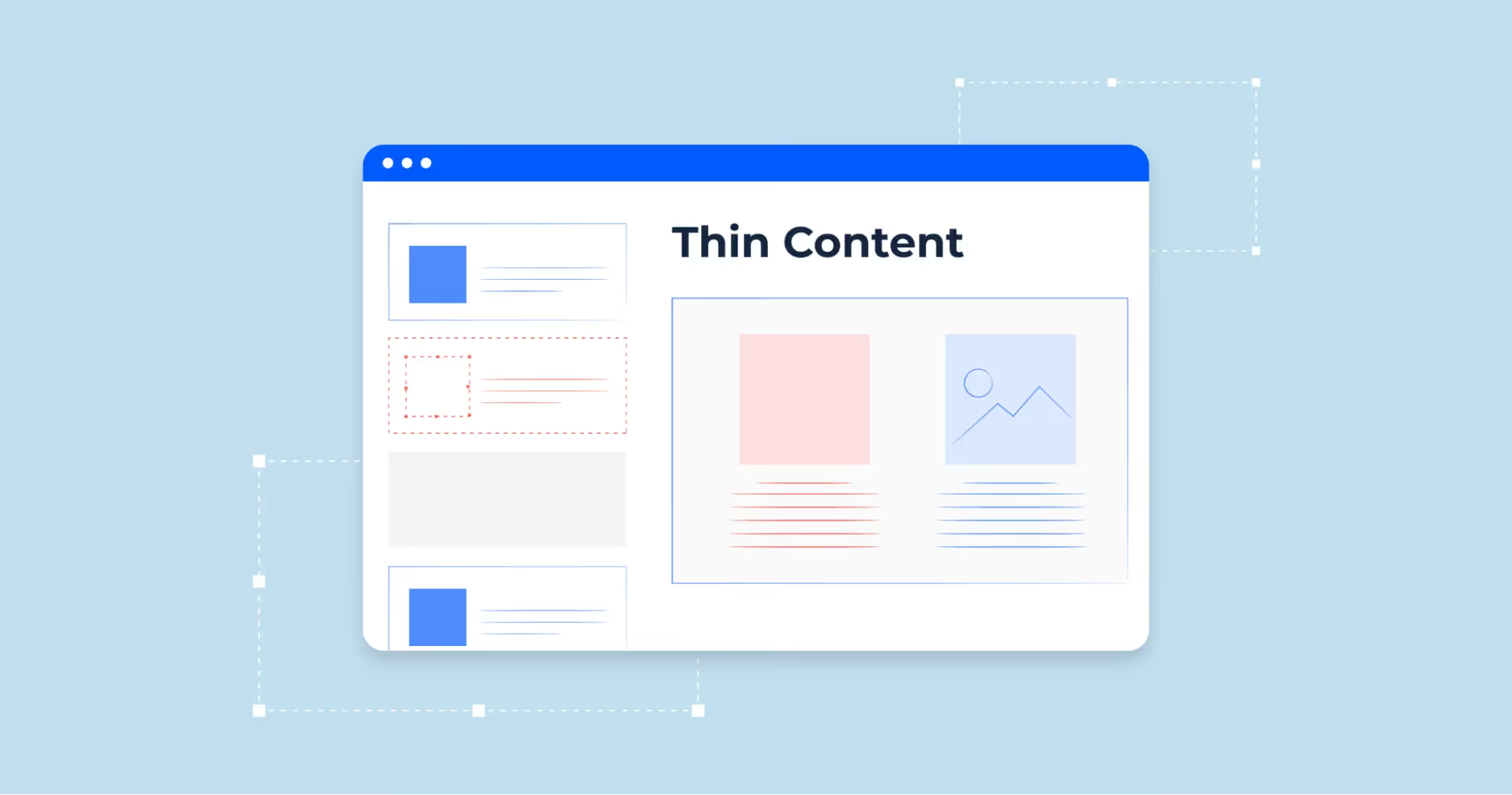
Thin Content is an SEO term referring to web pages or articles with low-quality content that fails to meet the needs of searchers. This type of content often provides no real value to users, leading to a poor experience and potentially negatively impacting your site's search engine rankings, especially on Google.
Thin Content is content that is incomplete, lacks depth, or fails to provide genuine value to the user. The characteristics of thin content include pages or articles that contain little information, are of poor quality, or do not address the problem the user is searching for. This prevents readers from getting the information they need, causing them to quickly leave and seek information from other sources.
Websites with thin content are not only unhelpful to users but also harmful to your SEO, as Google will rank those pages lower compared to sites that provide rich, valuable content.
Types of Thin Content
1. Pages with thin content
Pages that lack depth or fail to provide useful information are considered thin content. For example, a product page with only a few short sentences that does not explain the features, functions, or benefits of the product in detail will not provide value to searchers. These pages are unlikely to rank highly on Google.
2. 404 error pages or empty pages
These are pages that do not provide any information or do not exist, such as pages displaying a 404 error (page not found). These pages not only frustrate users but also negatively impact the SEO of your entire website.
3. Duplicate Content
Duplicate content occurs when you copy content verbatim from other websites without adding new value. Google can easily detect duplicate content and will penalize your website for violating quality guidelines.
4. Ad-heavy or Auto-generated Content
Auto-generated content is content created automatically without any editing or processing. These are often short, unoriginal posts lacking useful information, designed solely to display ads or drive users to irrelevant links.
Examples of Thin Content
A product page with a brief description that lacks informational value
Example: A product page that only contains a title and a few short lines like "This product is very good" without providing details on features, functions, or benefits. Users cannot understand how the product solves their problems, leading to a poor experience.
An article with only 100 words that fails to address the searcher's intent
Example: An article titled "How to take care of your skin" that is only 100 words long and fails to provide tips, techniques, or useful information on the topic. Searchers will not gain any value from this article, causing them to leave and look for other sources with higher-quality content.
Why does Google dislike Thin Content?
Thin Content is a major SEO issue, especially since it can negatively impact a website's search engine rankings, particularly on Google. The reason Google dislikes thin content can be explained by the following reasons:
Google always prioritizes user experience
Google focuses on providing the best, most accurate, and most useful search results for users. This is why Google consistently ranks websites with high-quality content that provides comprehensive and valuable information higher. Thin content does not provide real value to users, so Google prefers not to display these pages in its search results.
When a website has thin content, the content is often sparse, lacks detail, and fails to meet the user's search intent. This diminishes their experience, making them more likely to leave the site and seek information from other sources. With the goal of improving user experience, Google will lower the rankings of pages with thin content to ensure users find valuable and useful results.
Impact on search rankings
Google's Panda algorithm was designed to address websites with low-quality content, including thin content. When Google detects pages containing excessive thin content, these pages will be demoted in rankings or even removed from Google's search index. This reduces organic traffic and negatively affects the website's SEO performance.
SEO thin content is a critical issue in your SEO strategy. If your website contains a significant amount of thin content, you will struggle to achieve high rankings on search engine results pages (SERPs). Google prioritizes websites with comprehensive, detailed content that effectively meets user search intent, causing pages containing thin content to be ranked lower.

Low-quality content can lead to an increased bounce rate
When users visit a website and fail to find useful information or content that meets their needs, they leave quickly. This leads to a higher bounce rate. A high bounce rate is a signal that a website does not provide real value to users. Google places great importance on user behavior signals like bounce rate to evaluate the quality of a website.
If your page has thin content, users will not stay long and will quickly move to other sites with higher-quality content. This causes Google to perceive your page as having little value, leading to a drop in its search rankings. Google will prioritize websites with more comprehensive and useful content, reducing the visibility of thin content on the SERP.
Competing with high-quality pages
Google always prioritizes websites with rich, detailed content that effectively meets user needs. When a website contains only thin content, it will struggle to compete with other sites that offer more comprehensive, detailed, and valuable content. Pages that provide more in-depth and useful information will dominate Google's search results.
Google wants to ensure that users find search results that comprehensively address their queries. Websites with thin content cannot provide full value, making it difficult for them to compete with rivals that have higher-quality content. Consequently, Google will not prioritize thin content in search results, as these websites do not provide a good user experience.
Thin content not only affects the user experience but can also cause your website's Google rankings to drop. When creating content for your website, it is essential to provide valuable, detailed, and useful information to users. SEO thin content is an important factor to pay attention to in order to maintain and improve search engine rankings. To avoid being penalized by Google and to minimize the impact of thin content, ensure that every page on your website provides real value to searchers.
SEO thin content is a key element in an SEO strategy, and improving content quality will help you achieve better results in your overall SEO efforts.
How to identify thin content on your website
Identifying thin content on your website is a crucial step in improving content quality and optimizing SEO. Once you detect and address pages with thin content, your website will more easily achieve higher rankings on search engines like Google. Below are methods to identify thin content on your website.
Use SEO tools to check content
One of the most effective ways to detect thin content is to use specialized SEO tools. These tools help you analyze and evaluate the quality of your website content, allowing you to identify pages with thin or poor-quality content.
1. Google Search Console: This is a free tool provided by Google that allows you to monitor your website's performance on search engines. With Google Search Console, you can identify pages with no traffic or low SEO performance, which may be a sign of thin content.
2. Ahrefs: Ahrefs is a powerful SEO tool that helps you analyze backlinks, keywords, and content quality. By using the Site Audit feature in Ahrefs, you can check for pages that are thin or lack value. Ahrefs provides detailed information on word counts and internal linking ratios, helping you detect pages that lack useful content.
3. SEMrush: SEMrush is another SEO tool that helps you analyze your website and check for pages with thin content. SEMrush features the ability to analyze pages with low keyword rankings, high bounce rates, and low user engagement, all of which are indicators of thin content.
4. Screaming Frog: Screaming Frog is an SEO tool that crawls your entire website and analyzes each page. This tool will point out pages with little content, unclear structures, or a lack of detailed information. Screaming Frog can help you detect thin content so you can make adjustments and improvements.

Evaluating content quality
To identify thin content, you need to assess the quality of the pages on your website yourself. Below are the factors you should consider when evaluating a webpage:
- Few words and lack of detail: One of the most obvious signs of thin content is content that is brief and lacks depth. For example, an article with only a few sentences that fails to clearly explain concepts or provide comprehensive information will not offer value to the reader. If a page has an extremely low word count, it may be thin content.
- Lack of logical structure: Pages with thin content often lack structure or are not organized logically. The content may lack subheadings, clear paragraph breaks, or detailed explanatory sections. This makes it difficult for readers to consume information and find the details they need.
- Failing to fully answer searcher queries: When users search for information on Google, they expect to find an article or webpage that answers all of their questions. If your page does not address the problem or question the searcher is interested in, it is thin content. Pages that do not provide sufficient information, lack illustrative examples, or fail to offer detailed explanations will not be useful to users.
Consider the bounce rate
Bounce rate is one of the user behavior signals that Google uses to evaluate the quality of a webpage. Thin content often leads to high bounce rates, as users fail to find useful information and leave quickly. This directly impacts your website's Google rankings.
- Increased bounce rate: When users land on a page with thin content, they often fail to find the information they are looking for and leave the page immediately. This results in a high bounce rate, a metric Google uses to determine page quality. Pages with high bounce rates may be ranked lower by Google, which can negatively affect their search visibility.
- Short time on page: Along with a high bounce rate, another key metric is the time users spend on your page. If the average time spent on your website is very short, it may be a sign of thin content. Unengaging content that provides no value will cause users to bounce and look for other sites.
How to improve Thin Content
Create longer and more detailed content
To improve thin content, creating longer and more detailed content is a crucial step. Articles that are too brief, lack depth, or fail to fully answer a user's query are often classified as thin content. To avoid this, you should:
- Provide comprehensive information: Your content needs to be thorough and insightful, including all the details necessary to address the issues searchers care about. For example, if you are writing about a product, you should clearly describe its features, benefits, how to use it, and its pros and cons.
- Address searcher intent: Identify the questions users might ask when searching for information related to your topic. Ensure your article addresses every aspect of the issue and provides detailed solutions.
Long-form, detailed content will not only help improve your Google rankings but also provide value to users, thereby reducing bounce rates and increasing time on page.
Edit and update old content
One effective way to improve thin content is to edit and update older articles. Old content may be outdated or lack detail, leading to lower search result rankings. To improve this:
- Update old articles: Regularly review and update older posts to include new information, recent statistics, the latest research, or industry changes. This helps keep your content useful and relevant to users.
- Add images and videos: Incorporating images, videos, or graphics into your articles not only enriches the content but also makes information more accessible. Visuals can illustrate complex concepts, making your content more engaging and easier to understand.
Create pages with a clear purpose
One of the causes of thin content is when pages lack a clear goal or fail to meet the specific needs of searchers. To avoid this, ensure that every page on your website has a clear, easily identifiable purpose:
- Guides and in-depth articles: If you provide a guide, ensure it is detailed and easy to follow. In-depth articles allow searchers to find all the information they need in a single post.
- Product reviews and comparisons: For product reviews or comparisons, ensure you provide detailed information about each product, including pros and cons, features, pricing, and alternatives.
Creating pages with clear objectives helps users easily find the information they need and increases the likelihood of retaining them on your website.
Enhance content diversity
A key factor in improving thin content is diversifying the types of content on your website. Rich and varied content not only makes it easier for users to access information but also increases the value of your site in the eyes of Google:
- Combine text, images, and video: Content should not consist of text alone; it needs images, videos, and graphics to clarify concepts. For example, in how-to articles, you can add videos to illustrate steps or insert graphics to explain data more easily.
- Use infographics: Infographics are excellent tools for conveying information in an understandable and engaging way. They help users grasp complex information quickly and increase engagement with your content.
Diversifying content not only helps improve thin content but also keeps users on the page longer, thereby improving conversion rates and SEO.
Optimize On-page SEO
On-page SEO is a crucial part of improving thin content. Optimizing SEO improves your site's visibility on Google and makes it easier for users to find relevant information. Key factors to focus on include:
- Ensure content is readable: Content should be broken into short paragraphs with clear, easy-to-follow subheadings. Try to use short sentences, avoid excessive jargon, and always make your content accessible to the reader.
- Use appropriate keywords: Ensure your content uses keywords accurately and naturally throughout the article. However, avoid keyword stuffing; let them appear naturally and logically.
- Effective internal linking: Building internal links helps users easily find related articles and increases the authority of important pages. Ensure that articles link internally to other relevant content to help increase the time users spend on your site.
Conclusion
Thin content is a factor that requires attention in every website's SEO strategy. Google always prioritizes websites with rich, detailed, and useful content for users. Pages with thin content not only diminish the user experience but also negatively impact a website's search engine rankings. To improve this, providing high-quality, long-form, and detailed content, while optimizing On-page SEO, will help your website increase its value and improve its competitiveness on Google.