Have you ever wondered why some websites always appear at the top of Google search results despite having unremarkable content? The secret lies in "invisible" words—Anchor Text! These are more than just linked words; they are the key to rapidly boosting your website's rankings.
In this article, Markdao will help you answer the question of what Anchor Text is and explore how to turn it into the "lifeblood" that guides users and search engines, helping you achieve sustainable and effective ranking growth.
What is Anchor Text?
Anchor Text is the clickable text within a hyperlink that helps users navigate from one page to another or from one website to another.
Anchor Text acts like a "signpost" for both users and Google, helping to define the content of the destination page. By using relevant words or keywords in your Anchor Text, you provide Google with additional context to understand the content of the page you are linking to.
1. Defining Anchor Text
Anchor Text, also known as "link label," refers to the words or phrases that, when clicked, lead you to another page. These are the words or phrases you see highlighted or underlined, usually in a different color (commonly blue) to signal that they are clickable.
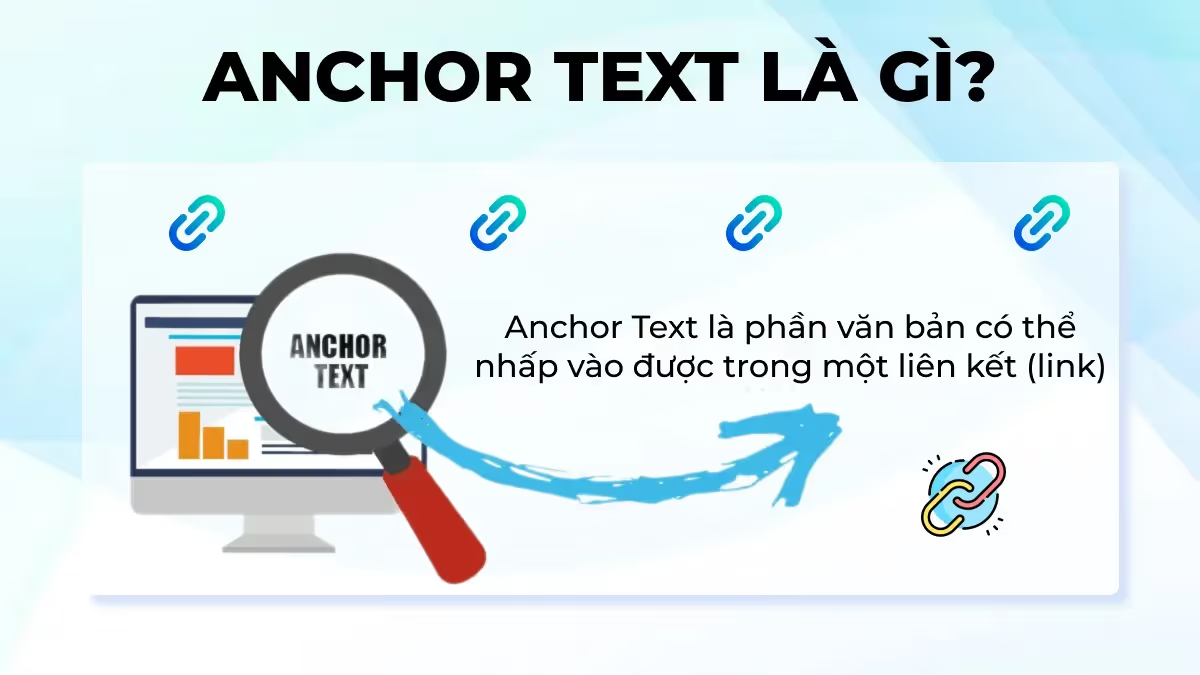
For example, if an article contains the phrase "Read more about how to write SEO-friendly content", and this phrase is in a different color or underlined, that is the Anchor Text. In this case, when readers click on "how to write SEO-friendly content," they will be taken to a page with content related to that topic.
Google examines the content within Anchor Text to better understand the linked page. Therefore, using accurate and logical Anchor Text will help your page rank better for the keywords you are targeting.
2. Common types of Anchor Text
Below are the common types of Anchor Text you will often see in articles or on websites:
Brand Anchor Text
This type of Anchor Text uses the brand name itself as the link text.
For example, with "Markdao," you would use the name in links such as: “See more of Markdao's services”Brand anchor text is often used to build trust and credibility for a brand name across various websites.
Exact Match Anchor Text
Exact match anchor text is when you use the specific keyword you want to rank for within the link text.
For example, if you want your page to rank for the keyword "SEO basics," you could use the anchor text "SEO basics" to link to a specific article on that topic. However, you should use this type of anchor text judiciously, as overusing it can be flagged by Google as an attempt to manipulate rankings.
Partial Match Anchor Text
This type of anchor text contains a portion of the main keyword combined with other relevant words.
For instance, if your main keyword is "how to write SEO-friendly content," you could use the phrase "tips for writing effective SEO-friendly content" as your anchor text. Partial match anchor text helps make your content more diverse and natural, avoiding excessive keyword stuffing.
So, how do you know what constitutes excessive keyword stuffing? You can read more in the article What is the ideal keyword density for website SEO? by Markdao to learn more!
Generic Anchor Text
Generic anchor text is when you use common phrases such as "click here", "read more", or learn more.
This type of anchor text is not directly related to specific keywords or content, but instead focuses on a call to action. While it does not have a strong impact on SEO, this type of anchor text still helps guide users effectively throughout the website.
URL-based Anchor Text (Naked Link Anchor)
URL-based anchor text, also known as a naked link, is when you use the website URL directly as the anchor text instead of a specific word or phrase.
Example: “https://www.markdao.com.vn”. This type of anchor text generally has less impact on SEO compared to others, but it still helps increase the credibility of the destination page.
Why is anchor text important for SEO?

Here is why anchor text plays a crucial role in SEO, especially when looking to optimize rankings on search engines:
1. Increase visibility and keyword rankings
Anchor text is one of the factors that Google and other search engines rely on to understand the content of a destination page. When you use relevant keywords in your anchor text, Google recognizes that the destination page may be relevant to those keywords, helping your website rank higher for target terms.
For example, if you want your page to rank for the keyword “SEO guide,” you can use anchor text like “detailed SEO guide” to increase the likelihood of appearing in search results when someone searches for that phrase.
2. Improve user experience
Anchor text helps readers easily grasp the content of a link and determine whether it meets their needs.
Clear and focused anchor text phrases make navigation more convenient for readers, thereby improving user experience and reducing bounce rates. A good user experience is also an indirect factor that helps improve a website's search engine rankings.
3. Build and strengthen website credibility
Anchor text not only improves user experience but also helps build website credibility in the eyes of search engines.
When another website links to your page using keyword-rich anchor text, Google views this as a signal that your page is valuable and authoritative in that field. This not only boosts the credibility of the destination page but also contributes to improving the overall trustworthiness of the entire website.
4. Optimize internal linking structure
Anchor text is a crucial component of internal linking, helping to build a solid link structure within a website. Internal links with appropriate anchor text make it easier for Google to understand the relationship between pages on your site, while also helping users conveniently find related content.

For example, if you have an article about "how to optimize images for SEO" and another about "SEO basics," linking them with relevant anchor text helps both users and search engines clearly identify the relationship between these posts.
You can read more in our article on what SEO is through these two concepts: Internal & External Links by Markdao to better understand these two important SEO terms!
5. Avoid Google penalties for over-optimization
Using anchor text correctly also helps you avoid Google penalties caused by keyword stuffing or over-optimization.
If you overuse exact-match anchor text or use it out of context, Google may view this as an attempt to manipulate rankings, which can lead to your site being penalized and losing its position. Using anchor text naturally and diversely will help you avoid this risk while keeping your website growing steadily and sustainably.
Principles for effective anchor text usage in SEO
Anchor text is an indispensable part of navigation and SEO optimization, but not everyone knows how to use it effectively. Below are the principles to help you maximize the power of your anchor text:
- Ensure relevance and clarity: Anchor text should link directly to the content of the destination page. This not only helps readers understand immediately but also helps Google correctly interpret the context and topic of the destination page. For example, using "guide to writing SEO-friendly blogs" for a page that provides exactly that content is clearer and more effective than just writing "read more."
- Use keywords naturally and avoid over-optimization: To avoid Google penalties, prioritize natural-sounding anchor text rather than stuffing keywords. Do not use exact-match keywords for every anchor text; instead, vary your phrasing and use synonyms or related keywords to make the content flow more smoothly.
- Diversify your anchor text: Do not rely on a single type of anchor text, as Google may view this as a sign of over-optimization. Combine different types, such as exact-match keywords, related keywords, branded keywords, and generic phrases, to make your links appear natural.
How to create and optimize anchor text for your SEO strategy
How to create anchor text
To create and optimize anchor text for SEO effectively, building a set of related keywords is crucial. This set helps generate diverse anchor text that aligns with your content while avoiding over-optimization of your primary keyword. Here is how to build a set of related keywords to use for your anchor text:
1. Identify your primary keyword
First, identify the primary keyword you want to focus on. For example, if your primary keyword is “SEO services,” you will use that as a base to find related keywords. Keyword research tools such as Ahrefs, GKP, or Google Search Console will also be very helpful during this process.
2. Research related keywords
Use keyword research tools like Google Keyword Planner, Ahrefs, SEMrush, or free tools like Ubersuggest to find secondary and related keywords for your primary keyword. Related keywords can include:
- Synonyms or phrases with similar meanings (e.g., “SEO optimization,” “search optimization services”).
- Long-tail variations of the primary keyword (e.g., “professional SEO services,” “comprehensive SEO services for businesses”).
3. Choose appropriate anchor text types
From the set of keywords you have built, you can create a wider variety of anchor text types:
- Exact Match : For example, “SEO services.”
- Partial Match : For example, “SEO optimization,” “search optimization services.”
- Long-tail Anchor Text : For example, “comprehensive SEO services for small businesses.”
- Generic Anchor Text: "learn more about SEO", "view details".
4. Strategic distribution within content
With a diverse set of keywords, you can distribute various Anchor Texts throughout your content without it feeling repetitive. This not only makes the article feel more natural but also helps search engines better understand the structure and topic of your content.
How to optimize Anchor Text
To build a sustainable SEO strategy with Anchor Text, try applying the following methods:
- Distribute Anchor Text ratios reasonably across internal and external links: Internal links with primary keywords help optimize target pages, while external links often use secondary keywords to avoid losing traffic from your main site. A harmonious combination helps Google understand your website structure and rank your content higher.
- Appropriate Anchor Text length: Concise Anchor Text (aim for 2–5 words) helps readers immediately grasp the linked content. An Anchor Text that is too long dilutes the meaning and makes it difficult for Google to identify the primary keyword. Keep your Anchor Text simple, yet meaningful enough for readers to understand the destination page immediately.

- Focus on user experience: Google doesn't just look at keywords; it also evaluates user experience. Put yourself in the reader's shoes and create natural, coherent Anchor Text to guide users to helpful pages. This is not just an SEO strategy, but a strategy for building trust with your readers.
Common mistakes when using Anchor Text
When implementing Anchor Text, many people still make common mistakes that negatively impact SEO. Here are the errors to avoid:
- Keyword stuffing: Using the same keyword repeatedly across many Anchor Texts is a sign of over-optimization. Google views this as "manipulative" behavior, which can lead to penalties or a drop in search rankings.
- Anchor Text that does not accurately reflect content: When readers click a link and don't find the content they expected, it increases your bounce rate. Ensure your Anchor Text always matches the destination page content to retain readers, improve user experience, and help your website maintain better rankings.
- Too many Anchor Texts on one page: Using too many Anchor Texts on a single page can be distracting and confusing for readers. Focus only on links that provide real value and select Anchor Text for important pages, avoiding content dilution or a poor user experience.
Conclusion
We hope that Markdao’s "short and concise" explanation has helped you better understand the concept of "Anchor Text."
In SEO, Anchor Text acts as a bridge between your readers and the content you want to share. Understanding how to properly use and optimize Anchor Text not only helps boost your search rankings but also improves the user experience. Remember, keeping your Anchor Text natural and diverse is key to building a sustainable and effective SEO strategy.