


In SEO, Text links are a double-edged sword – used correctly, they can help your website skyrocket in Google rankings, but if abused, the consequences can cause your site to plummet. So, what are text links? How can you leverage their power without worrying about Google penalties? Let’s join Markdao to explore how to use text links safely for sustainable SEO optimization, helping your website achieve high rankings naturally and effectively!
What are text links?
A text link is a type of hyperlink embedded directly into a piece of text, allowing users to click through to another webpage. Unlike image or button links, they appear as text and are often placed in key areas of a website such as the header, sidebar, footer, or content sections.
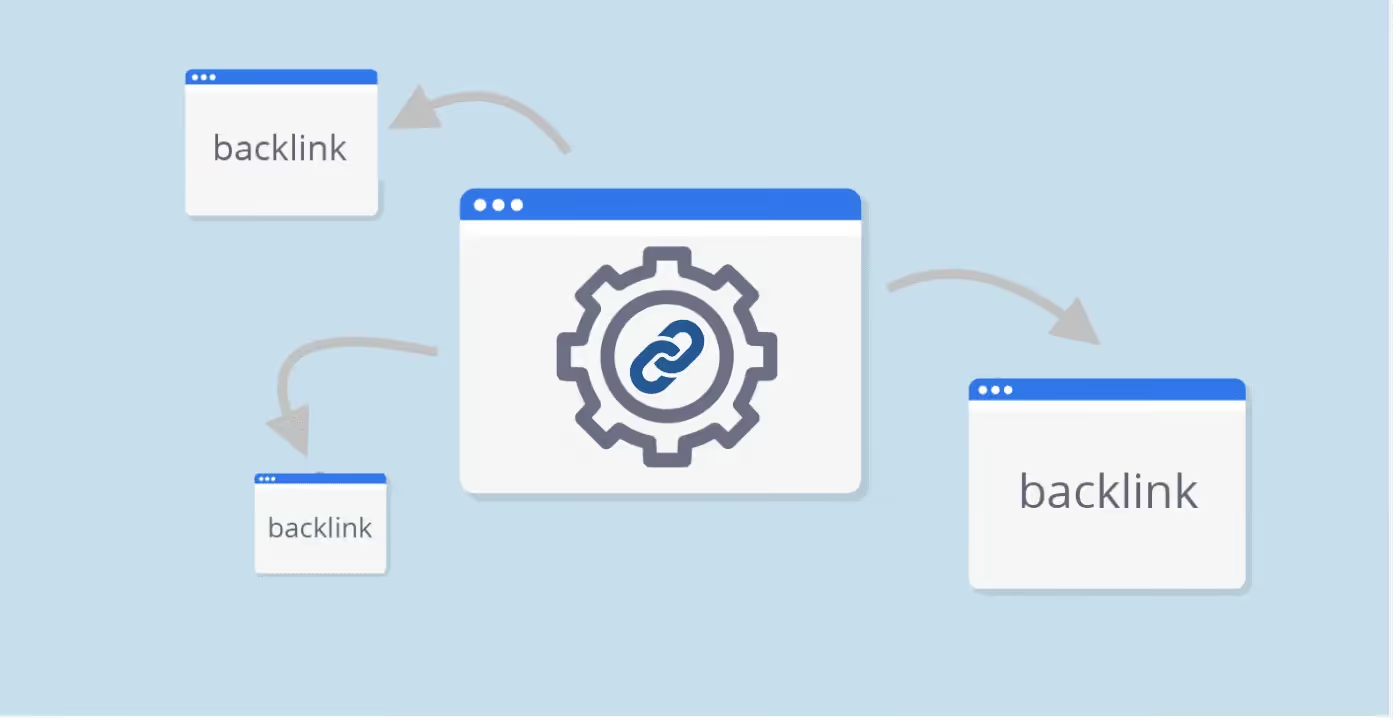
Basically, text links and backlinks are closely related. A backlink is any link pointing to a website from an external source, while a text link is a specific type of backlink presented as text rather than an image or button.
A common form of these in SEO is the sitewide link – links that appear on multiple pages of a website, such as in the footer or sidebar, which help increase link coverage but can also pose a risk if flagged as spam by Google.
.avif)
Text links play an important role in SEO, helping to improve search rankings when used appropriately. However, if overused or placed unnaturally, they can lead to Google penalties. In the next section, we will explore their benefits for SEO and how to use them safely.
The Impact of Textlinks in SEO
Regardless of the strategy you use to build textlinks, the factor of relevance remains the most important.
For example, if Markdao.com.vn is a website specializing in SEO, placing links on pages with content related to SEO or Digital Marketing is completely natural. Even if the textlink is placed in the menu, sidebar, footer, or anywhere else, it still holds high value and will not be flagged as spam by Google.
Conversely, if you place a textlink for Markdao on a coffee shop website or a tech site about smartphones, it is an unnatural signal. Google will easily detect this and may penalize your website.
So, if Google dislikes irrelevant links, why do many websites still use them and successfully reach the top?
Do websites using textlinks still successfully reach the top?
There are two main reasons for this:
1. They already have a solid foundation of quality backlinks
Suppose a website has 60 quality backlinks and then adds 3 irrelevant textlinks. In this case, these links have almost no impact because the site already has a strong, authoritative foundation.
However, if a website only has a few backlinks but is spamming irrelevant links everywhere, Google will "reward" it with a penalty.

2. They already ranked at the top and have high traffic volume
Websites that previously used text links to rank (2014 – 2015) may still maintain their rankings thanks to:
- Massive traffic volume from Google
- Natural backlinks generated by users
These factors help them build a protective shield against Google's algorithm updates.
However, if you are just starting with SEO and still abuse these methods, you are very likely to be penalized by Google.
Are text links still important in SEO?
The answer is YES, but they must not be used incorrectly.
No matter how you use them, always remember the principle:
- Text links must be placed on websites with relevant content
- Do not spam footers or sidebars indiscriminately
- Focus on building quality backlinks before using them
If done correctly, text links remains a powerful SEO tool. But if you do it wrong, Google won't hesitate to penalize you heavily.
5 Ways to use text links safely for website SEO
Google doesn't ban text links, but if abused or used incorrectly, your website can easily be penalized. To use them safely and effectively, you need to follow these principles:
1. Place them on pages with relevant content
Relevance is the key factor in determining whether a text link is natural or not.
If your website specializes in SEO, place links on pages about Digital Marketing, Content, or Website Design. Conversely, if you place an SEO text link on a clothing store or coffee shop website, Google will consider it an unnatural link.

2. Avoid sitewide links on irrelevant websites
Sitewide links are links that appear on every page of a website, usually located in the menu, sidebar, or footer.
If you place a text link sitewide on a website in the same niche, it may still be acceptable. However, if it appears on an irrelevant website, Google will easily detect it and flag it as link manipulation.
3. Use anchor text naturally and diversely
Anchor text should not be over-optimized by using only exact-match keywords. Instead, diversify your anchor text with types such as:
- Branded anchor text (e.g., Markdao)
- Generic anchor text (e.g., here, read more, check it out)
- Long-tail anchor text that includes keywords naturally (e.g., learn how to use Text links effectively)
Overusing one type of anchor text will raise red flags with Google and may trigger the Penguin algorithm.
4. Prioritize text links from reputable websites
Text links from high-authority websites provide more value than links from numerous low-quality sites. Focus on getting links from pages with high Domain Authority (DA), good traffic, and quality content.
5. Control the quantity and velocity of text link building
A sudden spike in links pointing to your website in a short period can make Google suspicious. Build links naturally and avoid a massive surge in backlinks over just a few days.
Text links remain an important SEO strategy, but they must be used correctly. To leverage their power, ensure your links are natural, relevant, and not over-optimized. Otherwise, Google may target your website and apply penalties at any time.
5 common mistakes when using text links and how to avoid them
Text links are a key factor in SEO, but if used incorrectly, they can lead to severe Google penalties. Below are common mistakes to avoid to ensure your SEO strategy remains effective and safe.
1. Placing text links on irrelevant pages
Many people place links on websites that are not topically related in hopes of gaining more backlinks. For example, a site about SEO placing a text link on a website for home appliances or a restaurant. Google will view this as an unnatural link, which diminishes the value of the backlink and may cause the website to be penalized.
How to avoid: Only place links on pages with content relevant to your website's topic. If you must place a link on a less relevant page, ensure the surrounding content text link is tight enough to create a logical connection.
2. Overusing sitewide text links (placing them on every page of another website)
Some people try to place text links in the footer, sidebar, or menu of many different websites to quickly gain a large number of links. Abusing sitewide links can be seen by Google as link manipulation. If these websites are irrelevant, the risk of being penalized is even higher.
How to avoid: Limit the use of sitewide links and only place them on websites with truly relevant content. If you do use them, place them naturally and avoid over-optimizing the anchor text.
3. Using only exact-match keyword anchor text
Many people only use the exact keyword they want to rank for as the anchor text, such as "professional SEO services." Google may view this as over-optimization, leading to a drop in rankings or a penalty from the Penguin algorithm.
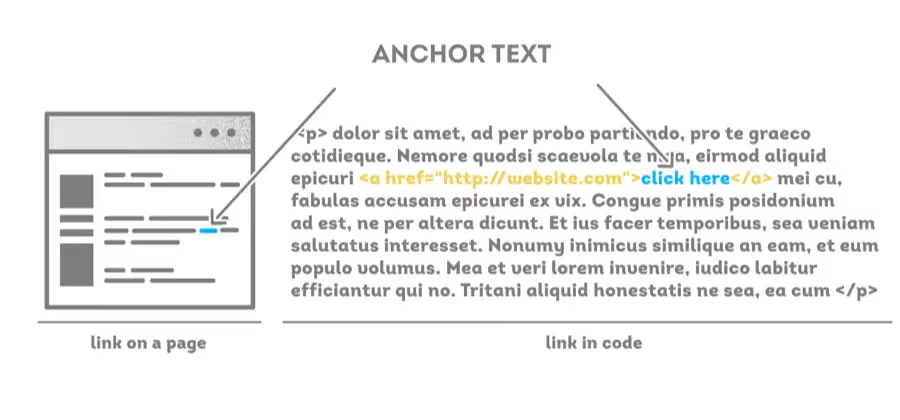
How to avoid: Diversify your anchor text by using:
- Long-tail keywords, for example: "how to optimize SEO effectively with text links."
- Branded anchor text, for example: “learn more at Markdao”.
- Natural anchor text such as: “see more here”, “refer to details”.
4. Buying and selling text links openly and aggressively
Purchasing links in bulk from various websites in the hope of quickly boosting rankings. Consequently, Google may detect unnatural link patterns and apply penalties, or even remove the website from search results.
How to avoid: Focus on building natural links through quality content and collaborating with websites in the same industry to gain truly valuable backlinks.
5. Building too many text links in a short period
Some SEOers try to create hundreds or thousands of backlinks in a short time to rapidly increase rankings. Google will become suspicious and may apply penalties if it detects an unusual spike in the number of links pointing to a website.
How to avoid: Build text links naturally, distributing them evenly over time to avoid unusual, sudden spikes.
Conclusion
Text links remain a powerful tool in SEO, but they are only truly effective when used correctly. Do not chase quantity or look for shortcuts—relevance and naturalness are the deciding factors. Build your link system sustainably, because SEO is not a sprint, but a long-term strategy to secure solid rankings on Google.