

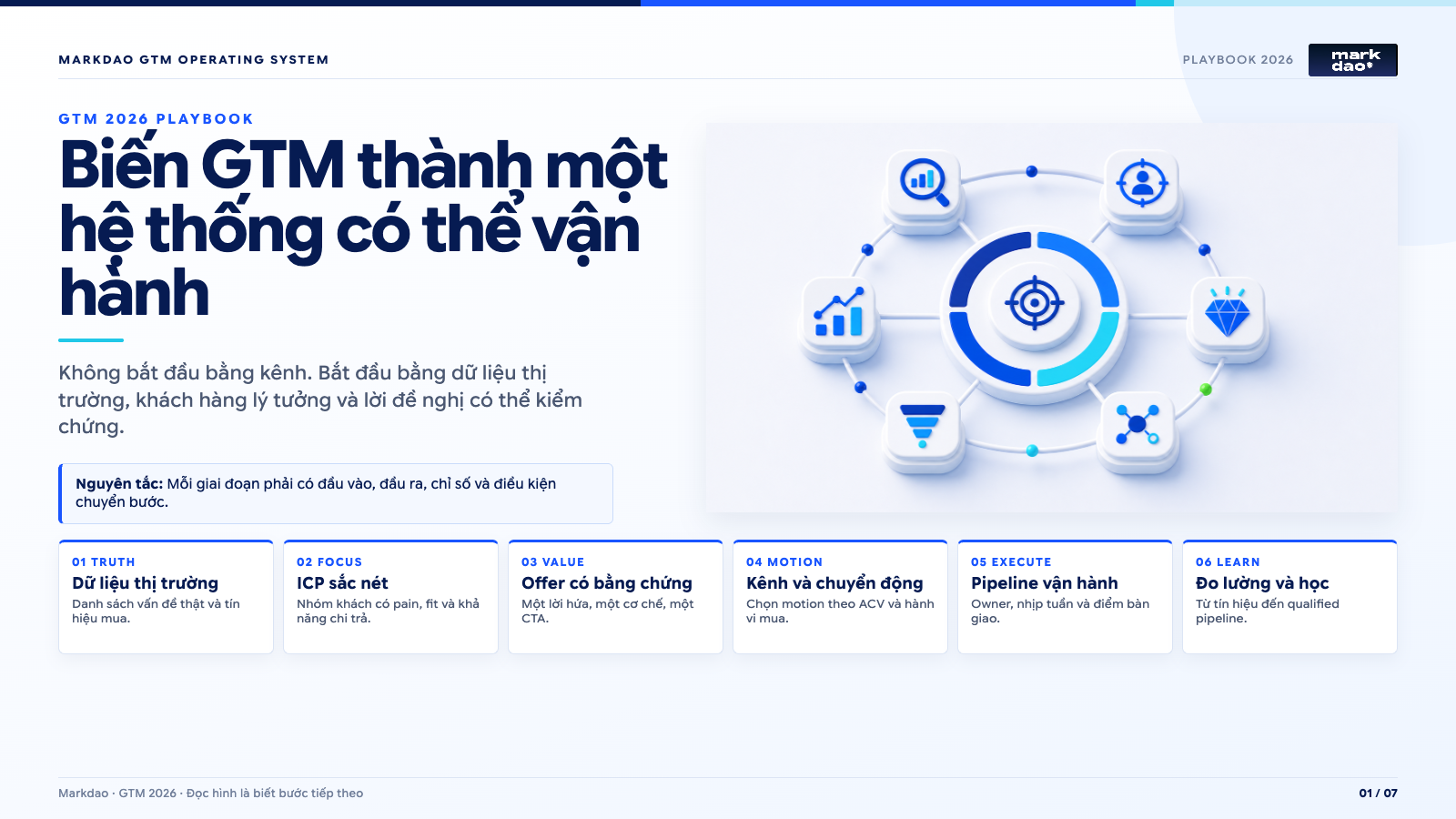

A new website can launch on time. Ads can start driving traffic. The sales team can send hundreds of emails every week. But if these three activities target three different customer groups, tell three different stories, and measure three different sets of metrics, the business does not have a Go-to-Market Strategy. It just has a lot of activities happening at once.
Go-to-Market Strategy, often abbreviated as GTM, is a framework that determines how a product reaches the right market, convinces the right buyers, and generates revenue in a repeatable way. It connects market research, ideal customer profiles, positioning, pricing, sales channels, websites, sales processes, customer success, data, and execution resources.
The novelty of GTM in 2026 does not lie in adding more AI tools. The advantage comes from the ability to shorten the learning loop: detecting signals earlier, testing messages faster, responding at the right time, and feeding results back into the system to improve the next iteration. AI only works when foundational decisions like market, ICP, offer, and sales approach are already clear.
This article builds a practical seven-step GTM framework. Each step includes inputs, key decisions to finalize, outputs, and indicators that the business is ready to move forward.
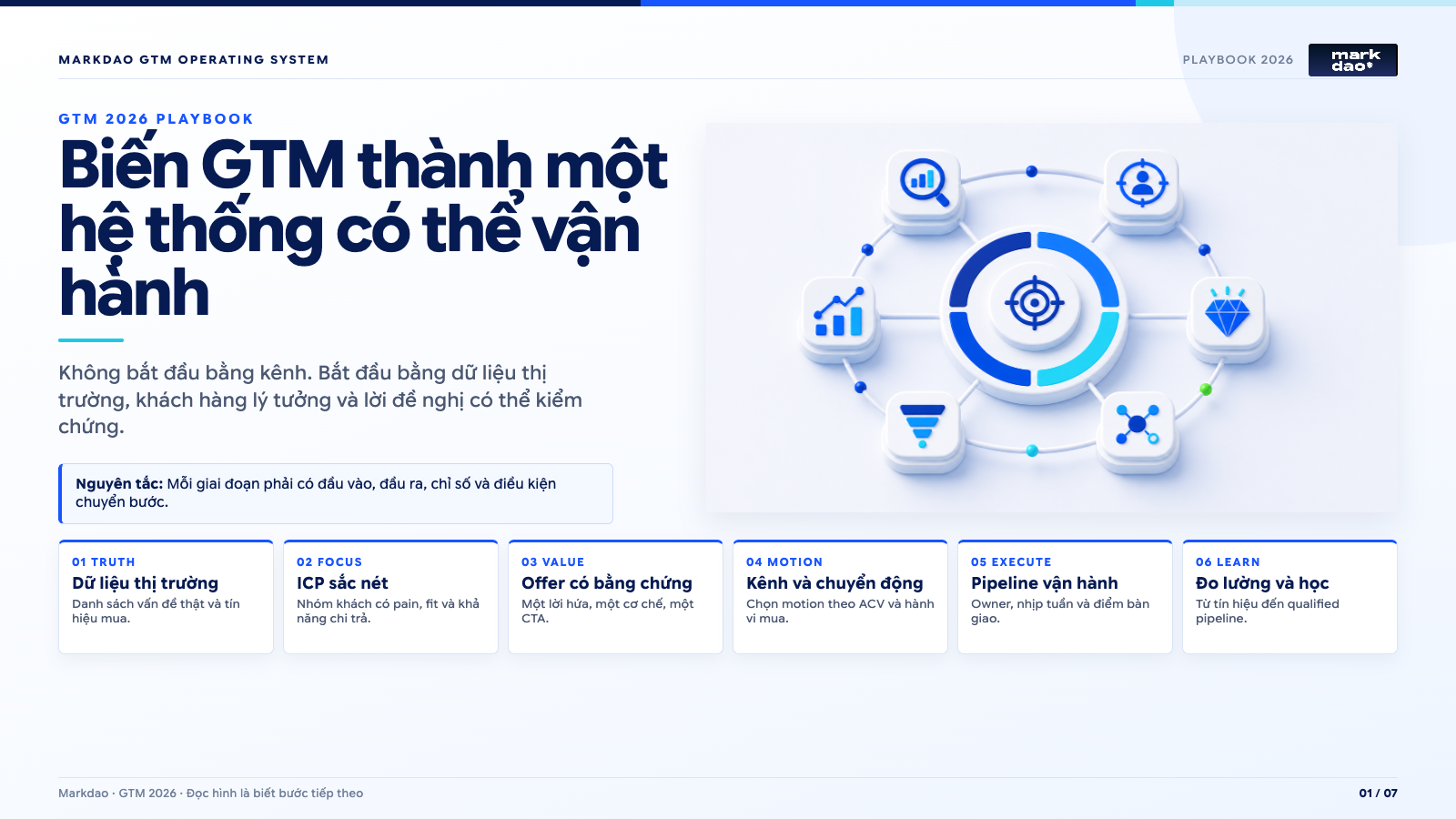
Quick summary: what must a complete GTM Strategy answer?
- Which market is attractive enough and aligns with current capabilities?
- Which group of businesses or customers has the highest probability of buying, using the product successfully, and staying?
- Which problem is urgent enough for them to allocate a budget to solve immediately?
- How is the product positioned, packaged, and priced?
- Will the business sell via product-led, inbound, outbound, sales-led, partner-led, or a combination?
- What is the role of the website and each channel in the buying journey?
- Which tasks should be automated, and which require human judgment?
- Which metrics prove that the GTM is creating good customers, rather than just generating more activity?
If a question does not yet have a data-backed answer, it is a hypothesis that needs testing. Do not turn a hypothesis into an expensive scaling plan.
What is a Go-to-Market Strategy?
A Go-to-Market Strategy is a cross-functional plan to bring a product or service to the right customer group, through the right channels, with the appropriate messaging, pricing, and sales approach. Salesforce describes GTM as a step-by-step plan, including market research, customers, channels, pricing, and competition, aimed at turning a product into revenue. See Salesforce's Go-to-Market Strategy framework to compare the foundational components.
GTM is not synonymous with a marketing plan. Marketing is responsible for creating awareness, demand, and access opportunities. Sales converts qualified opportunities into deals. Product ensures the product delivers value. Customer success helps customers realize that value, continue using the product, and expand. GTM connects these departments into a unified revenue logic.
GTM is also not just for launch day. Businesses need to build or update their GTM strategy when one of the following changes occurs:
- Launching a new product or service.
- Targeting a different customer segment.
- Entering a new market or region.
- Changing pricing, packaging, or revenue models.
- Transitioning from relationship-based sales to a scalable system.
- Adding product-led, partner-led, or a new demand generation channel.
- Investing in AI to change how you research, reach, or serve customers.
- Pipeline is growing, but win rates, customer quality, or retention rates are declining.
Key insight: GTM is not a static document. It is a set of hypotheses that are continuously tested. A beautifully crafted GTM plan that does not specify which data points will trigger a change in business decisions is not yet an operational tool.
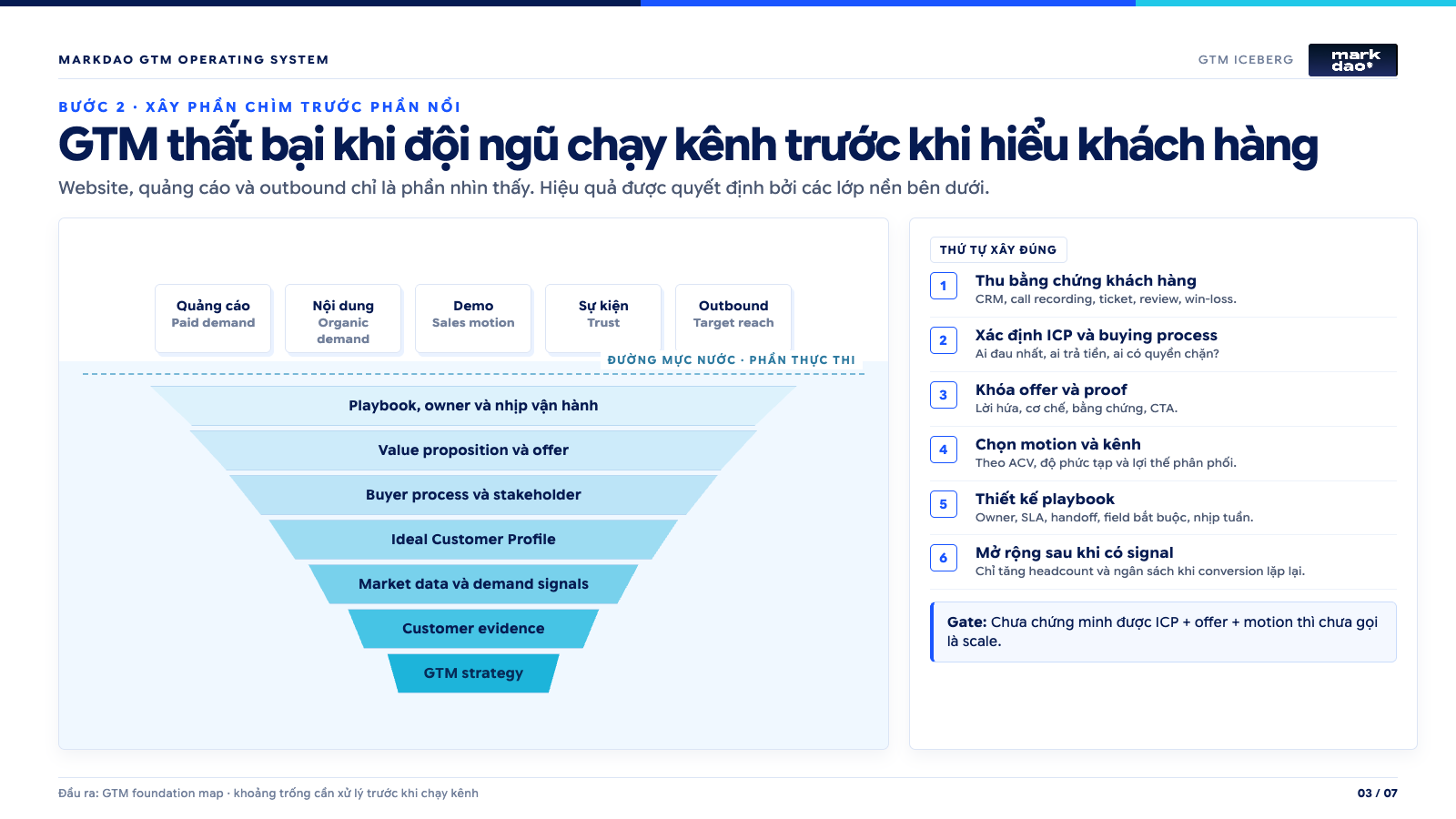
The GTM Iceberg: what businesses see is often not the root cause.
Websites, ads, SEO articles, webinars, outbound emails, demos, and LinkedIn content are the most visible parts. Therefore, when the pipeline is weak, businesses often demand more posts, higher budgets, or increased reach.
But the effectiveness of the visible part depends on several layers beneath the surface:
- Is the market and customer data reliable enough?
- Is the ICP narrow enough to filter out unqualified groups?
- Does the business understand the buying committee and the approval process?
- Is the customer's problem urgent enough?
- Does the value proposition clearly state the results, timeframe, and evidence?
- Does the offer reduce risk for the initial decision-making process?
- Is the pricing model aligned with how your customers typically buy?
- Do marketing, sales, and customer success teams share the same definition of a qualified lead?
- Does your CRM accurately capture lead sources, statuses, and win/loss reasons?
An outbound campaign might generate plenty of responses but still fail if the respondents aren't accounts with actual buying power. A landing page might achieve a high form-fill rate but produce leads without the budget. A product might see many trial sign-ups but few users reaching the core value. Individual channels may look effective on their own dashboards, while the overall GTM strategy fails to generate healthy revenue.
Key insight: before increasing volume at the surface, check what lies beneath. Scaling only amplifies the system you already have. If the underlying logic is flawed, the business will simply generate errors faster and at a higher cost.
Step 1: Validate the market and the problem before choosing channels
GTM doesn't start with the question, "Which channels should we run?" It starts with, "Which customer segment has a problem significant enough to solve, and why are we uniquely positioned to win there?"
Define the boundaries of your addressable market
The three concepts of TAM, SAM, and SOM help teams avoid confusing a large market with a winnable opportunity.
- TAM is the total theoretical demand for your type of solution.
- SAM is the portion of the market that your current product and business model can serve.
- SOM is the portion you can realistically reach and capture within a specific timeframe, given your current budget, channels, and capabilities.
SOM is the only number that matters for GTM decisions. If your sales team has only two people, no industry brand recognition, and a six-month sales cycle, your plan cannot be based on the assumption of rapid market share capture just because the TAM is large.
Research the problem instead of just customer demographics
A customer segment might fit your industry and size criteria but lack the motivation to buy. Your team needs to understand four layers:
- What context triggers the problem?
- What are the consequences of not solving it?
- What alternative solutions are they currently using?
- What event causes them to move from interest to action?
Trigger events can include opening a new branch, a leadership change, receiving funding, regulatory shifts, the current system reaching its scalability limit, or a new revenue goal. Within the same ICP, an account that has just experienced a trigger event is far more valuable than an account that fits the profile but has no reason to act.
Minimum dataset required before market validation
- CRM data for won, lost, and churned customers.
- Interviews with current customers and those who declined.
- Recordings of sales calls, support tickets, and pre-purchase inquiries.
- Product usage data or website behavior.
- Pricing, messaging, offers, and channels of direct competitors and alternative solutions.
- Search keywords, community discussions, and the language customers use to describe their problems.
The output of step 1 is not a lengthy market report. It is a concise market thesis: “We believe group X is facing problem Y in context Z; current solutions are inadequate because of A; signals indicating they are ready to buy are B; we have advantage C to reach and serve this group.”
Conditions for proceeding: the team must be able to clearly state who is not in the priority market and what data would invalidate the market thesis.
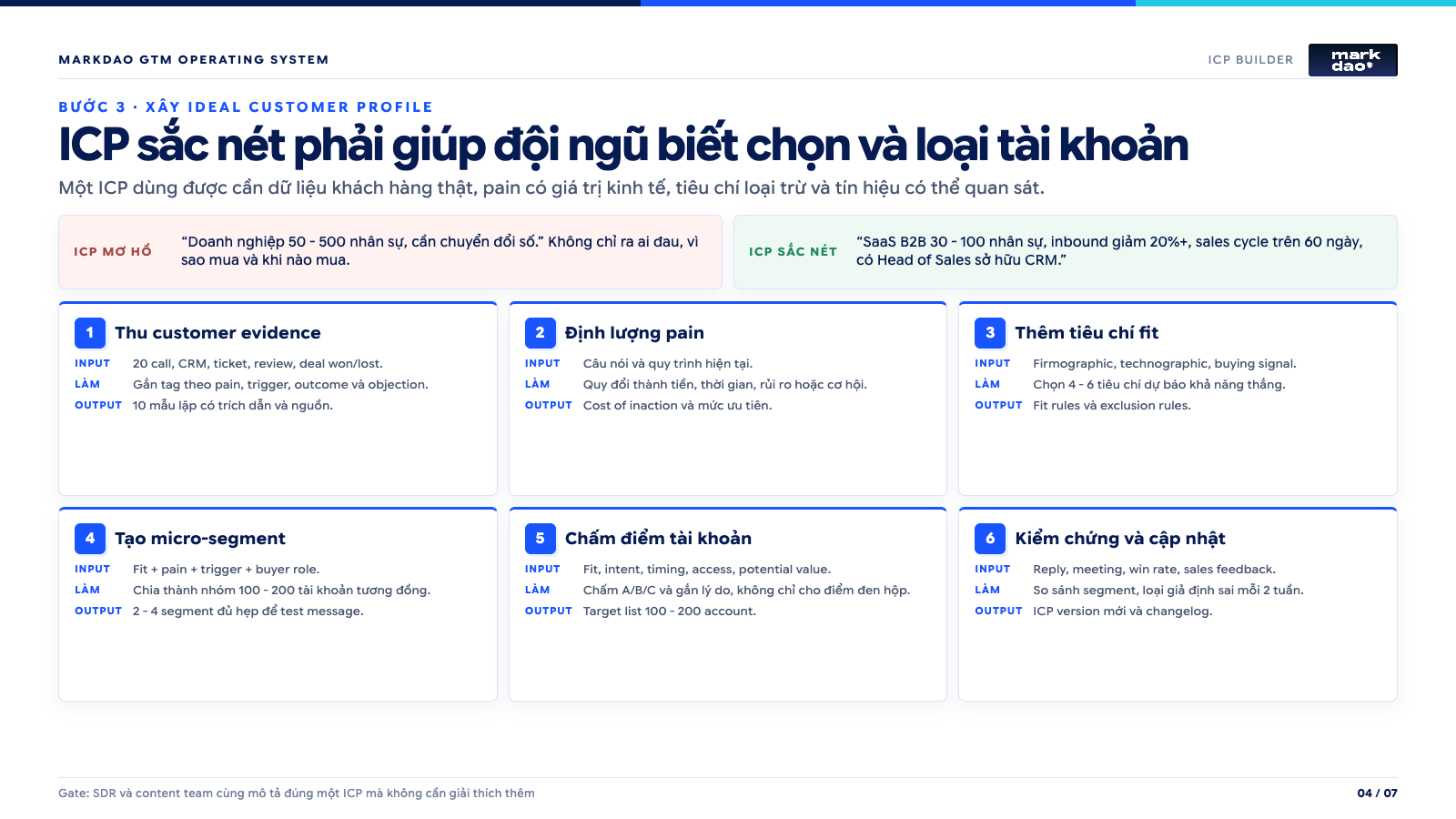
Step 2: Build an ICP clear enough to prioritize and reject
ICP, short for Ideal Customer Profile, describes the type of account or customer that is the best fit for the product. In B2B, the ICP is typically at the company level. Buyer persona describes the individuals involved in the decision-making process within that company.
A company might be a perfect fit for the ICP, but the sales team may still fail by reaching out to the wrong person. Conversely, an interested individual will not generate a deal if their company lacks the budget, does not have a significant enough need, or cannot implement the product.
HubSpot recommends building an ICP from CRM data, characteristics of customer segments with high revenue, usage levels, and retention, then supplementing it with direct interviews. See HubSpot's guide to building an ICP to clearly distinguish between ICP and buyer persona.
Six layers of data for an actionable ICP
- Firmographic: industry, headcount, revenue, geography, and stage of development.
- Technographic: technology stack, connectivity capabilities, and data maturity level.
- Operational: current processes, workload, bottlenecks, and implementation resources.
- Economic: budget, cost of the problem, and the ability to demonstrate ROI.
- Behavioral: research channels, level of proactivity, content interacted with, and response to offers.
- Trigger: the event that makes the need urgent right now.
12-Point ICP Scoring Framework
This is a practical framework, not a universal benchmark for every industry. Each account is scored from 0 to 3 across four criteria:
- Fit: is the account in the right industry, size, tech stack, and geography?
- Pain: is the problem clear, costly, and impacting key objectives?
- Timing: is there a trigger event, deadline, or active project?
- Ability to win: does the business have proof, implementation capability, and access to decision-makers?
Scores of 10 to 12 can be classified as Tier A for deep research and personalization. Scores of 7 to 9 are Tier B for group-based nurturing. Below 7, accounts should be monitored or removed from current priorities. These thresholds should be calibrated based on your own win rate and retention data.
Mapping the buying committee
A B2B deal rarely involves a single "customer." You need to identify at least these roles:
- End users care about convenience and work efficiency.
- Project leads care about progress, coordination, and results.
- Budget holders care about ROI and risk.
- Technical or legal departments care about security, integration, and compliance.
- Executive approvers care about strategic impact.
Each role requires a different message and evidence, but all must lead to the same value story. If your website talks about creativity, your sales deck talks about cost savings, and your demo only shows features, the buying committee will have to piece the story together themselves. Most of the time, they won't do that for you.
Key insight: a good ICP doesn't just help you find who to approach. It also helps you say "no" to leads that waste your time, generate short-term revenue but are difficult to implement, prone to churn, or fail to serve as strong case studies for your segment.
Prerequisites for moving forward: Sales and marketing must share the same scorecard, the same definition of Tier A, and the same reasons for disqualifying an account.
Step 3: Turn problems into positioning, value propositions, and buyable offers
The ICP determines where the business should focus. Positioning explains how the business wants to be perceived in the customer's mind. The value proposition translates that position into specific value. The offer turns that value into a decision the customer can make.
Positioning must be based on the actual competitive landscape
Customers do not compare products against a void. They compare them against direct competitors, manual processes, current tools, hiring more staff, or simply continuing to live with the problem.
Effective positioning must answer:
- Who is the product for?
- What job are they trying to get done?
- What are the common alternatives?
- What distinct results does the product deliver?
- What evidence makes the claim credible?
Value propositions should be based on outcomes, not feature lists
The practical framework consists of five parts:
- Problem: the specific situation costing the customer time, revenue, or opportunities.
- Cost of delay: what continues to happen if nothing changes?
- Outcome: the improved state the customer wants to achieve.
- Mechanism: how does the product deliver the result?
- Evidence: what data, case studies, demos, expertise, or processes reduce skepticism?
Weak example: “AI platform helps automate sales.” Stronger example: “Helps sales teams prioritize accounts with buying signals, prepare call briefs, and update CRM after meetings, so staff can spend more time on high-probability opportunities.”
The offer must reduce the risk of the first step
Customers rarely buy into the entire vision on the first try. The offer should be designed as a valuable, low-risk starting point:
- A current-state assessment with concrete deliverables.
- A pilot limited to a specific user group or process.
- A demo using data that closely mirrors the customer's reality.
- A phased implementation package with clear criteria for scaling.
- Commitments regarding response times, scope of support, or acceptance criteria.
Pricing and packaging must align with your motion. A low-priced product that requires multiple meetings and customization will have unsustainable sales costs. A high-ticket solution with only a “sign up now” button on the website won't provide enough evidence for a buying committee.
Key insight: Businesses don't have a single message for everyone. You need a unified narrative with multiple versions of proof tailored to roles, buying stages, and levels of awareness.
Readiness criteria: The team can present the offer in one sentence, clearly stating the outcome, target audience, scope, proof, and next steps.
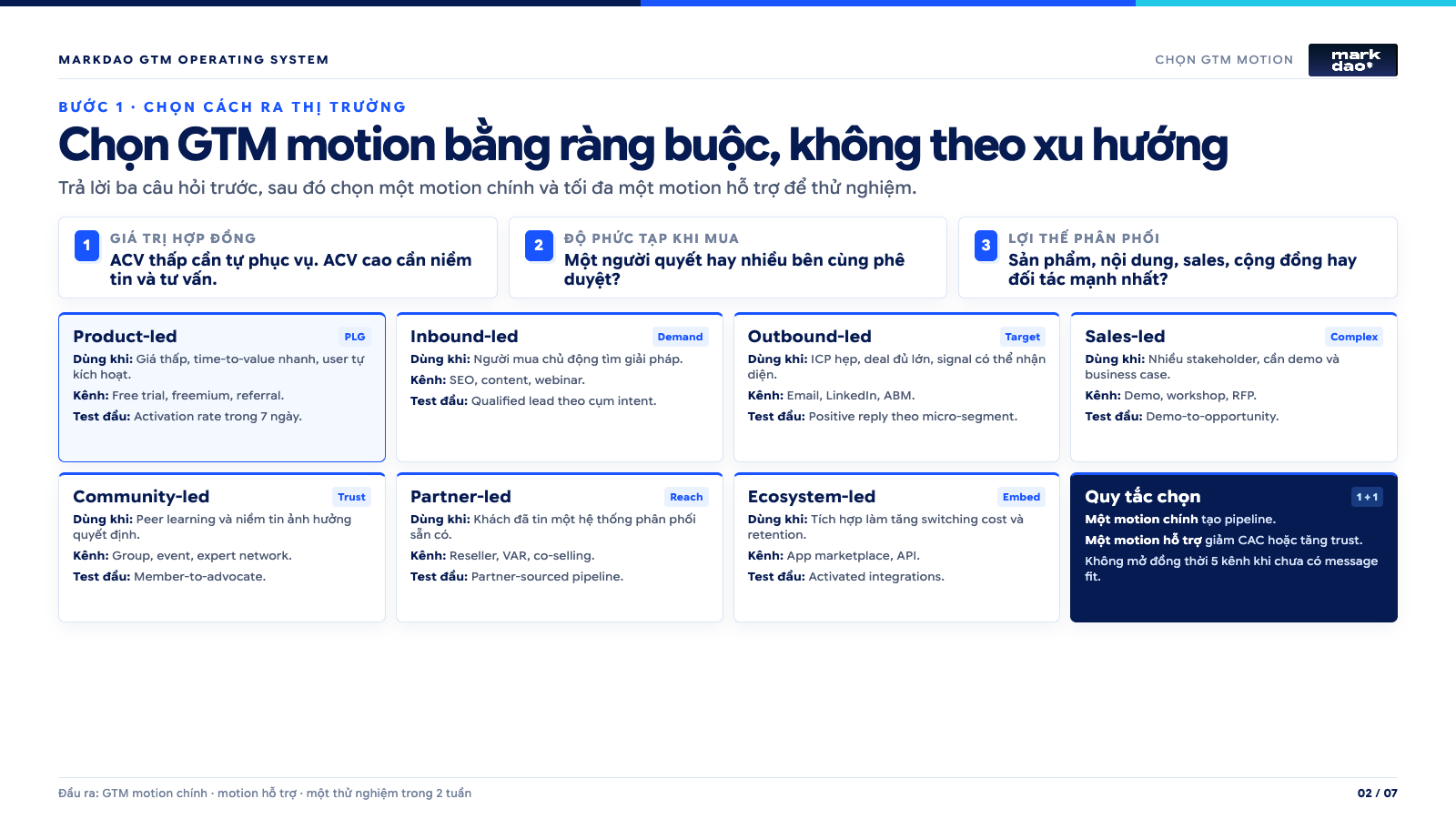
Step 4: Choose a GTM motion that aligns with how customers buy
A GTM motion is the primary mechanism that moves customers from awareness to purchase and value realization. A motion is more than just a channel; it dictates the level of involvement from product, marketing, sales, community, and partners in the revenue generation process.
Product-led
Customers experience value through the product before speaking with sales. This is suitable when the product is easy to try, has a short time-to-value, allows users to get started on their own, and has a low cost-to-serve per account.
A common bottleneck is high sign-up volume but low completion of core actions. In this case, the problem isn't acquisition, but activation, onboarding, or the gap between the end-user and the budget holder.
Inbound-led
Customers find you through content, search, webinars, free tools, or professional resources. This is suitable when the market has a need for education, customers are actively researching, and your business has the expertise to explain the problem better than competitors.
Inbound is not just about increasing traffic. Content must guide readers from their initial question to an evaluation, comparison, or relevant contact point. If you need to build a keyword system, content clusters, and service pages that are aligned, you can refer to comprehensive SEO services by Markdao.
Outbound-led
Businesses proactively reach out to target accounts via email, LinkedIn, cold calls, or events. This is suitable when the target market is clearly defined, the deal size is significant, and there are signals to help identify the right timing.
Effective outbound doesn't start with the number of emails sent. It starts with list quality, buying triggers, messaging hypotheses, and the ability to provide contextual responses. AI can assist with research and personalization, but it cannot save a broad ICP or a weak offer.
Sales-led
Sales teams are deeply involved in discovering needs, building solutions, persuading the buying committee, and managing the procurement process. This is suitable for complex products, high-value contracts, or scenarios with significant integration requirements or implementation risks.
In a sales-led model, the website does not replace the sales team in closing deals. Instead, it helps sales reduce time spent on repetitive explanations, provides social proof, and allows members of the buying committee to verify information between meetings.
Community-led
Growth stems from a community sharing common problems, professions, or goals. A community is effective when it creates value independent of the product and helps members learn from one another. If the community is used merely as a channel for advertising, trust will quickly erode.
Partner-led
Partners assist with distribution, referrals, implementation, or value-added services. This is suitable when customers already trust a specific vendor ecosystem, reseller, or consultant. This motion requires clear rules regarding customer ownership, revenue sharing, lead standards, sales collateral, and support mechanisms.
Ecosystem-led
The product gains value when connected to other platforms, data sources, or marketplaces. Integrations become part of the reason to buy and the reason to stay. An ecosystem is only meaningful when these connections create genuine use cases, rather than just a list of logos.
How to choose a motion instead of chasing popular trends
The team should score each motion based on six questions:
- How much guidance do customers need before realizing value?
- How many people are involved in the decision-making process?
- Is the contract value sufficient to cover the costs of sales and service?
- Can you identify target accounts and buying signals?
- Do customers prefer to buy directly, via self-service, or through partners?
- Is the product simple enough for a self-guided experience?
Most B2B businesses require a hybrid approach. For example, inbound generates demand, outbound activates the right accounts, sales manages the buying committee, and customer success provides proof for the next cycle. The goal isn't to decide "which motion we belong to," but rather which motion takes the lead and how the others support it.
Key insight: a motion is an economic choice. If your sales process requires too many human hours relative to the contract value and retention rate, faster growth will only increase your cost pressure.
Prerequisites for moving forward: every motion must have a clear role, owner, cost, KPIs, and exit criteria.
Step 5: Designing your website as GTM execution infrastructure
A website is not a brochure separate from your strategy. It is where positioning, content, social proof, data, and conversion actions converge. Your website structure must evolve alongside your GTM motion and maturity level.
If your business is rebuilding its entire platform, Markdao's professional website design service starts with business goals, user research, sitemaps, content, UX/UI, technical architecture, and SEO foundations, rather than starting with a template.
Website for product-led motion
- The homepage explains the value proposition in seconds and leads directly to the product experience.
- Feature pages map each function to the specific job the user needs to accomplish.
- Pricing and packaging are clear enough for customers to self-select.
- Signup, onboarding, and empty states are designed to drive the first "aha!" moment.
- Help centers, templates, and instructional content reduce reliance on manual support.
- Product analytics track activation, time-to-value, and drop-off points in the user journey.
Website for inbound-led motion
- Pillar pages address broad topics and navigate users to in-depth, specialized content.
- Content clusters cover problems, selection criteria, comparisons, and implementation methods.
- Service pages bridge knowledge with solutions, social proof, and CTAs.
- Lead magnets should only collect information when the asset genuinely helps the reader accomplish a specific task.
- Forms and CRM systems track the source, topics of interest, and next steps.
- Internal links guide readers from informational queries to high-value business pages without pushing for a sale too early.
Websites for outbound and sales-led motions
- Landing pages tailored by industry, use case, or key account segments.
- Solution pages focused on pain points and outcomes, rather than just product names.
- Case studies detailing the context, methodology, results, and conditions for application.
- Pages for security, integrations, implementation processes, and procurement FAQs.
- Demo booking forms with just enough qualification to help sales teams prepare effectively.
- Sales rooms or resource kits to help buying committees share information internally.
Websites for partner-led and ecosystem-led motions
- Partner program pages explaining the target audience, benefits, requirements, and how to apply.
- Partner directories or marketplaces to help customers find the right expertise.
- Integration pages showcasing use cases, data exchange, and connection guides.
- Co-marketing kits to help partners tell a consistent value story.
- Lead attribution and distribution mechanisms to prevent channel conflict.
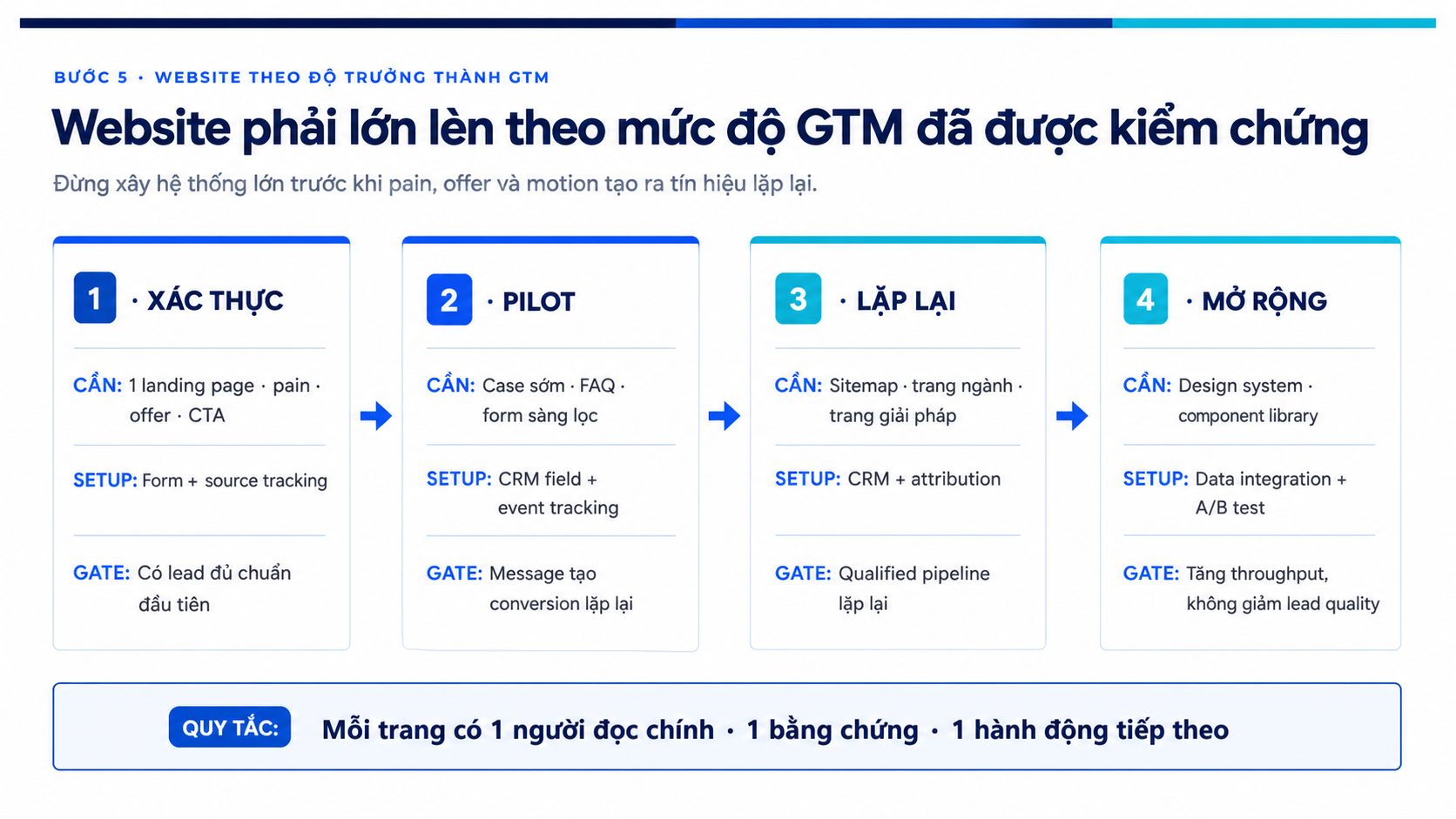
What does a website need at each GTM stage?
The validation stage does not require a large website. Businesses need a landing page clear enough to test the pain point, offer, and CTA. The pilot phase requires adding case studies, FAQs, a screening form, tracking, and objection-handling content. The iteration phase needs a sitemap based on the buyer's journey, a system of industry pages, solution pages, CRM, and attribution. The scaling phase requires a design system, component library, content management, data integration, and testing process.
The team can use the end-to-end SEO-standard website design process to translate GTM goals into a sitemap, content flow, wireframes, features, and a measurement plan.
When considering new technologies or styles, evaluate their impact on brand identity, usability, performance, and conversion rather than just chasing trends. The article 2026 website design trends provides a scoring framework to decide which trends are worth testing.
Key insight: a good website doesn't try to be everything to everyone. Each page type must have a specific role in the GTM strategy, a primary target audience, evidence to provide, and a clear next step.
Prerequisite for moving forward: the team can map every key page to a specific stage of the buying journey, an owner, and a metric.
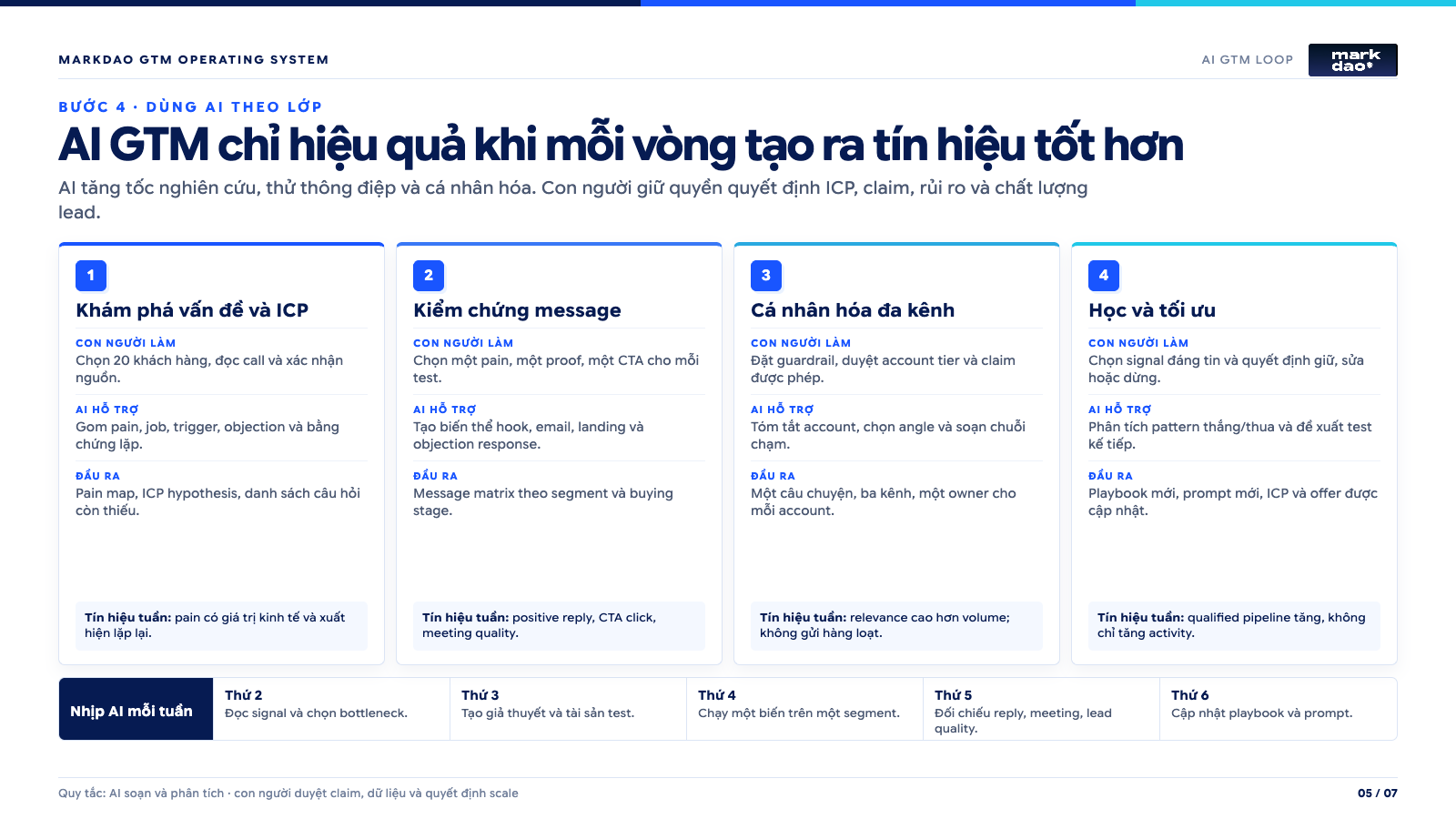
Step 6: Build an AI GTM Strategy from workflows, not tool lists
AI GTM Strategy is not about buying more chatbots, email writing tools, or lead scoring software. It is about redesigning the revenue generation process so that data flows to the right place, AI handles the appropriate tasks, humans control critical decisions, and results are measured over multiple cycles.
OpenAI distinguishes between rule-based automation and agents capable of handling context and multi-step workflows. Agents require models, tools, instructions, and guardrails; they must also know when to stop or hand off to a human when necessary. See the OpenAI guide to building AI agents to understand the foundational components.
Select AI use cases based on four criteria
- Frequency: is the task repeated often enough to be worth standardizing?
- Ambiguity: Does the task require context and judgment, or just a fixed set of rules?
- Data: Does the AI have access to reliable, up-to-date, and sufficiently structured sources?
- Risk: If the output is incorrect, what is the impact on brand, data, legal, or revenue?
Repetitive, low-ambiguity tasks should be automated. Tasks requiring synthesis of multiple sources and contextual adaptation are suitable for agents. High-risk decisions require human oversight, regardless of how well the automated system performs.
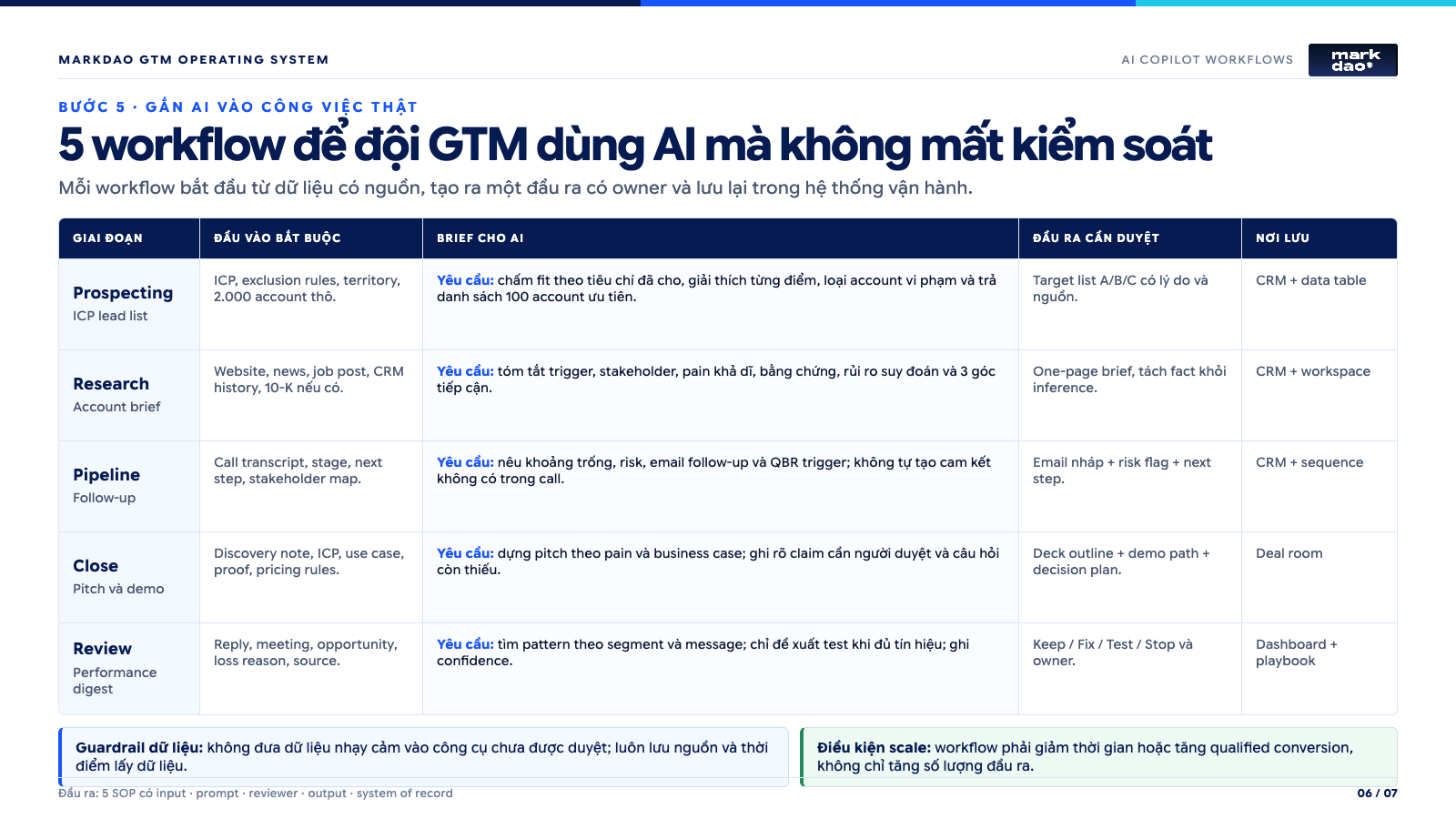
Workflow 1: Building an account list based on ICP
Inputs include the ICP scorecard, firmographic data, tech stack signals, and trigger events. AI assists in cleaning, enriching, segmenting, and explaining the scoring logic. The output should not just be a list of company names, but must include scores, signals, sources, and the date of the last update.
Human checkpoints involve sampling Tier A accounts, checking for industry misclassification, and verifying that high-potential groups were not accidentally excluded. The appropriate KPI is the lead acceptance rate and the conversion rate to opportunity, not the number of contacts collected.
Workflow 2: Creating an account intelligence brief
AI gathers public information, CRM data, past interactions, job postings, products, and change signals. A good brief answers four questions: why is this account a fit, what is changing, who might be interested, and what is the hypothesis for starting the conversation?
The owner must verify sources, remove unfounded inferences, and adjust based on industry expertise. KPIs include reduced preparation time, the quality of discovery questions, and the rate at which meetings progress to the next stage.
Workflow 3: Following up based on signals and pipeline stage
The system monitors meetings, emails, pipeline changes, page views, or account events to suggest the next step. AI can summarize, draft content, and remind the owner. Sensitive content should not be sent automatically without clear conditions and permissions.
KPIs include response time, next-step completion rate, number of stalled opportunities, and stage conversion. Email open rates are insufficient to prove that a workflow is driving progress.
Workflow 4: Preparing pitches and demos for the buying committee
AI uses discovery notes, attendee roles, use cases, and previous objections to suggest agendas, questions, demo paths, and proof points. A good pitch doesn't try to present every feature. It focuses on the three to five decisions the customer needs to believe in to move forward.
The sales lead is responsible for confirming the narrative, evidence, and ensuring content does not overpromise product capabilities. KPIs are the demo-to-proposal rate, number of objections handled, and preparation time.
Workflow 5: Analyzing sequence performance and feedback loops
AI synthesizes performance by segment, signal, messaging, offer, and sequence step. The system must distinguish between positive feedback, genuine objections, wrong audience, wrong timing, and data errors.
The output must be a testing proposal with one primary variable, such as changing the pain angle, the trigger, or the CTA. Do not change the list, message, offer, and send time simultaneously, as the team will not know which factor drove the results.
Minimum guardrails for GTM AI
- Define the AI data sources and the actions the AI is permitted to perform.
- Cite sources for research data and indicate when they were last updated.
- Do not allow AI to generate cases, statistics, testimonials, or product features on its own.
- Assign a responsible person for every workflow and approval standard.
- Maintain a history of prompt changes, data sources, and outputs.
- Implement a kill switch for when errors, complaints, or quality drops are detected.
- Measure time, cost, accuracy, and pipeline impact both before and after deployment.
Key insight: AI does not replace the need for a clear GTM strategy. It simply accelerates the execution of hypotheses. Therefore, an unclear GTM strategy will result in inconsistent content and activities at a larger scale.
Prerequisites for moving forward: every workflow must have defined goals, data, an owner, permissions, approval points, KPIs, and stop conditions.
Step 7: Establish capacity, KPI systems, and feedback loops before scaling.
AI-first does not mean reducing headcount by a fixed percentage. Businesses need to break down tasks, measure baselines, and redesign roles.
Calculate capacity based on actual workload.
The foundational formula can start as follows:
Workload equals the number of target accounts multiplied by the number of required activities per account, multiplied by the time spent per activity.
Available capacity equals the number of people multiplied by the actual hours spent on those activities, multiplied by the productivity rate after accounting for meetings, administration, and internal tasks.
If the workload exceeds capacity, businesses have four options: reduce the number of accounts, decrease the level of personalization, partially automate, or increase resources. Do not silently increase quotas and expect new tools to solve the problem on their own.
Assigning tasks between humans and AI.
AI is well-suited for gathering, standardizing, summarizing, pattern recognition, drafting, and reminders. Humans are best suited for defining strategy, evaluating context, building relationships, negotiating, approving risks, and taking accountability for outcomes.
The new role of personnel is not just to produce output. They must know how to write briefs, evaluate quality, refine context, and provide feedback into the system. Without investing in oversight capabilities, businesses will simply shift the bottleneck from production to error correction.
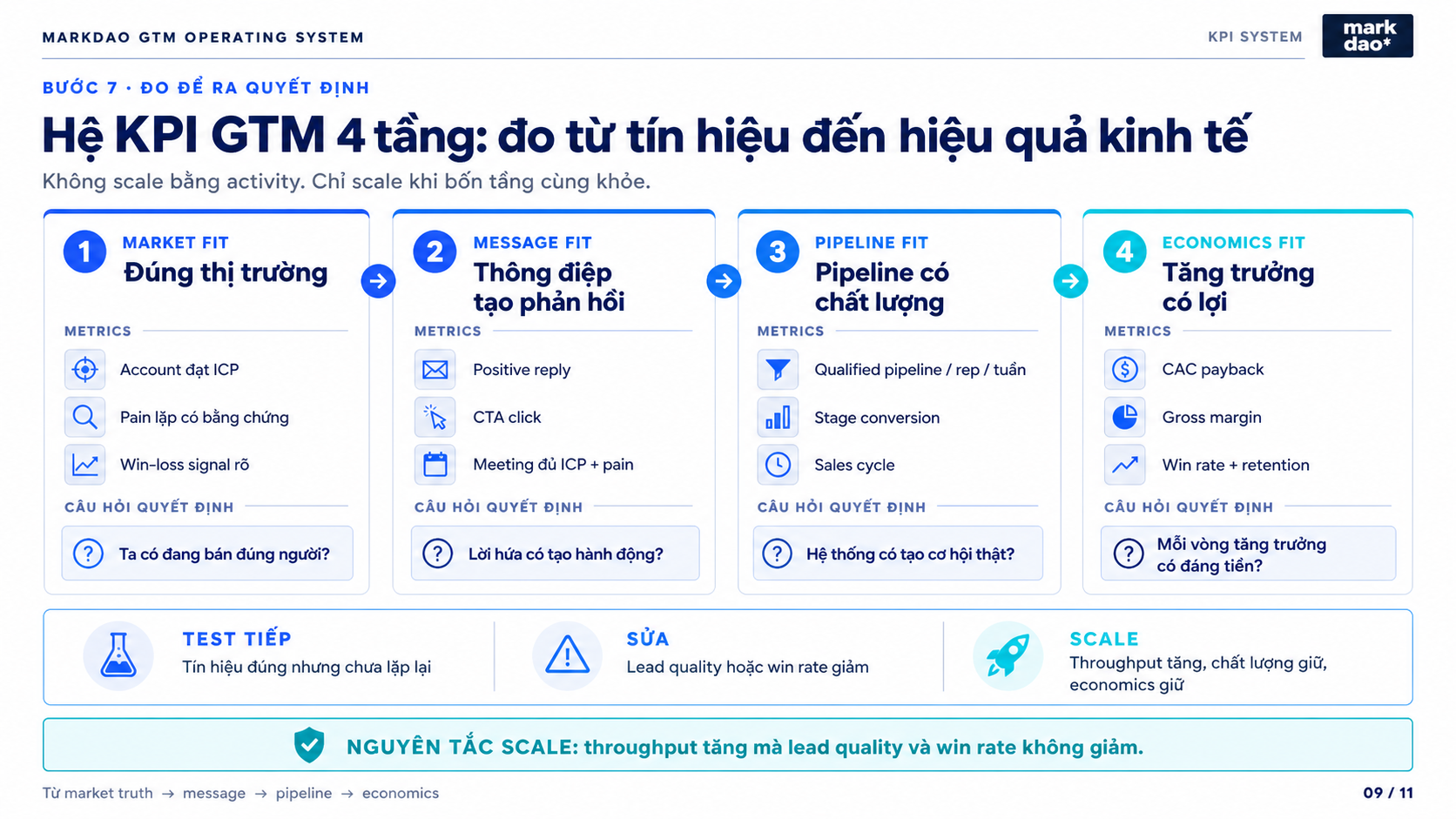
Four-tier KPIs.
Market fit layer:
- Percentage of accounts in the pipeline meeting the ICP threshold.
- Conversion rate of opportunities generated from identified buying triggers.
- Win, loss, and disqualification reasons.
Motion operations layer:
- Target account coverage.
- Meaningful response rate.
- Sales-accepted meeting rate.
- Stage conversion and time spent in each stage.
Economic layer:
- Customer acquisition cost.
- Contract value and gross margin.
- Payback period for acquisition costs.
- Sales cycle and win rate.
Growth quality layer:
- Activation and time-to-value.
- Retention, expansion, and churn.
- Customer advocacy and referral rate.
- Cost to serve and support hours per segment.
Weekly feedback loop design
Every week, the team should review a slice of data small enough to make decisions:
- Which segment is showing the most progress?
- Which trigger predicts a high-quality meeting?
- Which message is generating pushback, and why?
- Which stage has opportunities stalling?
- What content are sales reps actually using in real deals?
- What missing or incorrect data is leading to poor decision-making by both AI and humans?
- What is the one change we need to test next week?
Every month, review your unit economics and customer quality. Every quarter, update your market thesis, ICP, pricing, motion, and capacity. Don't wait until the end of the year to discover that the market or buying behavior has shifted.
Key insight: Your GTM North Star should not be traffic, lead volume, or emails sent. It must be tied to business value, such as qualified pipeline from your ICP, the number of customers reaching value, and revenue retention. Activity metrics are only useful when they explain the movement of those outcomes.
Conditions for scaling: The same segment and offer produce repeatable results over multiple cycles, unit economics are within acceptable limits, customers are realizing value, and the team understands the drivers behind the results.
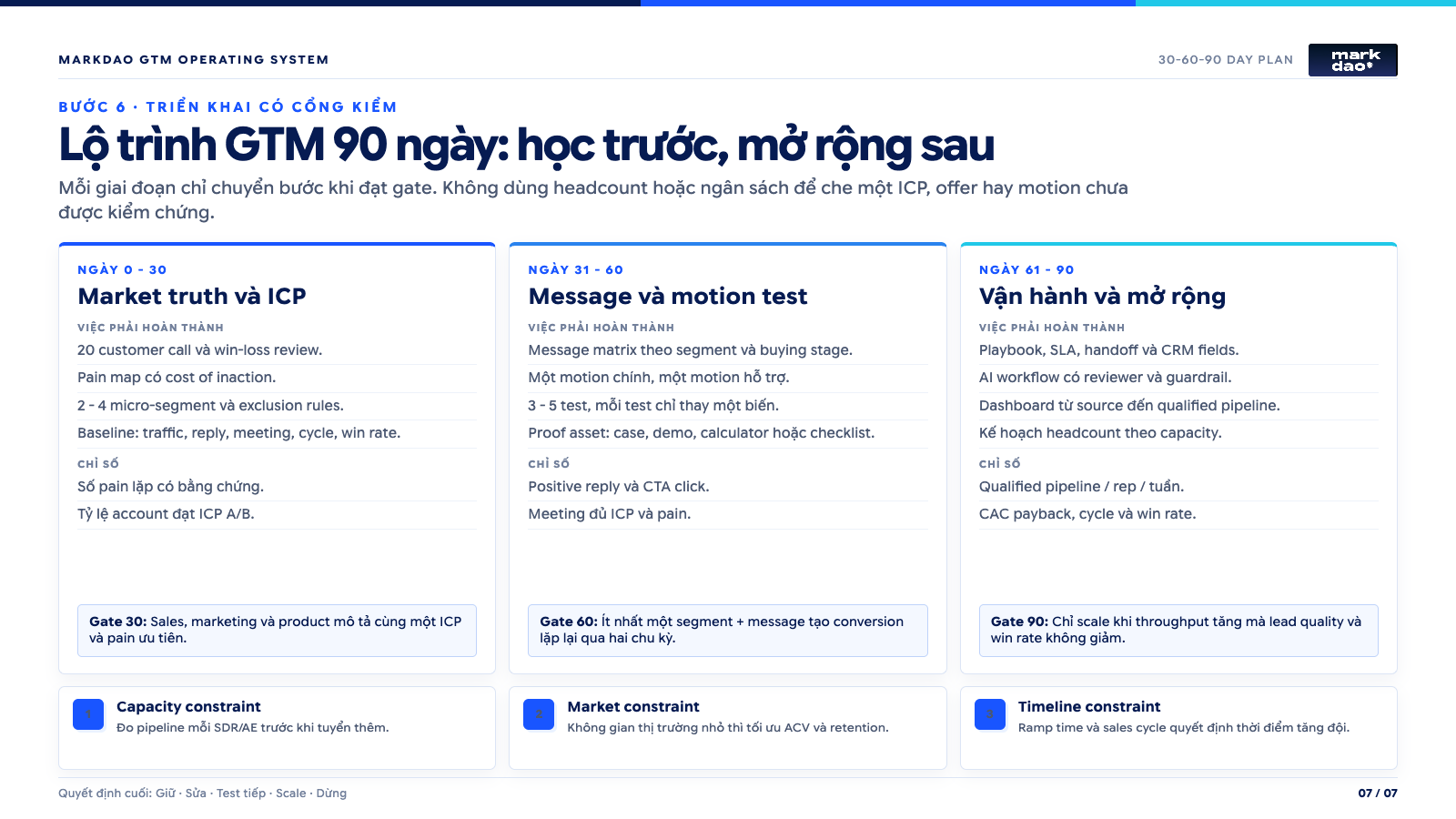
30-day roadmap to build your first GTM version
Week 1: Finalize market thesis and baseline data
- Compile a list of won, lost, and churned customers along with the reasons why.
- Interview sales, customer success, and a group of customers.
- Identify segments, problems, alternatives, and buying triggers.
- Choose one priority segment instead of trying to serve the entire market.
- Record baseline pipeline, win rate, sales cycle, activation, and current retention.
Output: A one-page market thesis, a list of hypotheses, and data points that need further verification.
Week 2: Refine ICP, positioning, and offer
- Build an ICP scorecard and create Tier A and B lists.
- Map out the buying committee and their roles in the decision-making process.
- Draft the problem statement, value proposition, and proof points.
- Select the pilot offer, scope, pricing, and success criteria.
- Develop a message matrix based on roles and buying stages.
Deliverables: ICP scorecard, target account list, message matrix, and a market-ready offer.
Week 3: Select the motion and build the minimum viable infrastructure.
- Choose the primary motion and supporting motions.
- Define the roles of the website, content, sales, and partners.
- Build or optimize a landing page for one ICP and one offer.
- Set up forms, CRM fields, source tracking, and stage definitions.
- Prepare case studies, FAQs, a sales deck, and a minimum viable demo path.
Deliverables: A functional journey from traffic source to the next step, with data tracking in place.
Week 4: Run the pilot and close the feedback loop.
- Select an AI workflow with low risk and clear value.
- Run the pilot on a specific group of accounts or a single use case.
- Review output quality daily during the first week.
- Hold weekly GTM meetings based on real data and feedback.
- Finalize the next experiment, identifying one thing to keep and one thing to stop.
Deliverables: Pilot results, key learnings, decisions to continue or pivot, and an improvement backlog.
Industry-specific GTM: Same framework, completely different execution
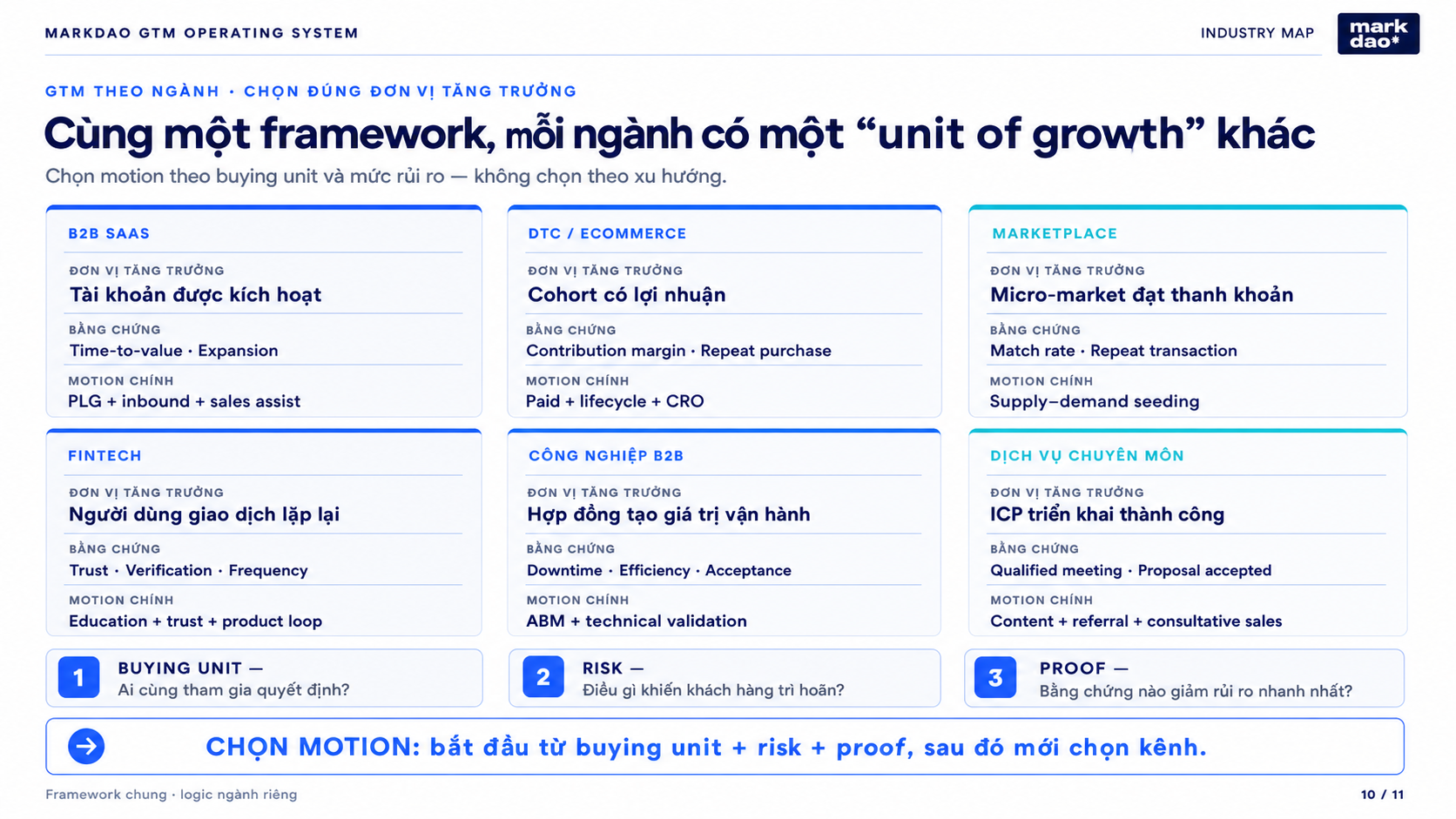
A GTM framework can be applied across many industries, but the priorities differ. B2B SaaS needs to prove that users reach value and expand their accounts. E-commerce needs to control customer acquisition costs and repurchase rates. Marketplaces must generate both supply and demand within the same niche. Fintech needs to build trust before requesting transactions. Industrial manufacturing must convince users, engineers, procurement, and finance teams alike.
Therefore, businesses should not copy the channel templates of famous companies. What you should learn is the logic behind them: who they target first, how they reduce purchasing risk, how they turn the product into proof, and what signals they use to decide when to scale.
Quick map: What should each industry prioritize?
- B2B SaaS: Prioritize time-to-value, activation rates, free-to-paid conversion, and account expansion revenue.
- E-commerce and DTC: Prioritize contribution margins, customer acquisition costs, repurchase rates, and cohort-based payback periods.
- Marketplace: Prioritize liquidity, time-to-match, transaction success rates, and retention on both sides.
- Fintech: Prioritize trust, transaction speed, fee transparency, verification completion rates, and repeat usage.
- Digital Education: Prioritize learning outcomes, usage habits, retention rates, and the optimal timing to upsell to paid plans.
- B2B Manufacturing and Industry: Prioritize total cost of ownership, downtime, service capabilities, and buying committee consensus.
- High-value Professional Services: Prioritize proof of expertise, qualified appointment rates, proposal acceptance rates, and project profit margins.
Cross-industry insight: Top-of-funnel metrics cannot replace value metrics. One industry might call it activation, successful transactions, completed lessons, zero downtime, or a qualified consultation. The names differ, but the question remains the same: has the customer received enough clear value to continue?
Industry 1: B2B SaaS, using the product to open doors and sales to expand
Buying logic
B2B SaaS usually has at least two layers of buyers. Users care about whether the product makes their work faster and easier. Budget holders care about security, integration capabilities, ROI, and switching risks. Therefore, selling to only one of these two layers will create a bottleneck.
The appropriate model is usually product-led combined with sales-assisted. Users can start on a small scale and experience the value themselves. As the number of users, data, or management needs grows, the sales and customer success teams step in to expand the contract.
What should the website be set up for?
- The homepage should clearly state the problem, the target audience, and the initial result the user can achieve.
- Use case pages categorized by role, industry, and the job to be done.
- Product tours or sandbox environments so customers understand the mechanics before booking a meeting.
- The pricing page is clear enough for customers to self-segment, with the requirement to speak with sales for specific needs.
- Integration library, technical documentation, security center, and resources for procurement teams.
- Case studies that present the initial state, implementation process, time-to-value, and final results.
- Two distinct conversion paths: a free trial for teams ready to self-serve, and a demo request for complex accounts.
Real-world case: Slack and the land-and-expand self-service model.
The core problem Slack solved wasn't just "lacking a chat app." Companies already had email and various communication tools. The real issue was that knowledge, decision-making, and workflows were fragmented, making it difficult for teams to collaborate and retrieve information.
The GTM strategy led by Stewart Butterfield and Cal Henderson focused on letting small teams adopt the product first, then spreading it across the organization. Slack maintained a free tier to lower the barrier to entry, while utilizing direct sales and customer success for large organizations with specific security, integration, and governance requirements.
As of January 31, 2019, Slack reported over 10 million daily active users, more than 600,000 organizations with at least three users, and 88,000 paid customers. Of those, 575 customers generated over $100,000 in annual recurring revenue. Fiscal year 2019 revenue reached $400.6 million, an 82% increase, with a net dollar retention rate of 143%. The S-1 filing also noted that growth was driven by the self-service model and product expansion within existing customers. See Slack's S-1 at the SEC.
The strategic value of this model was validated by the market when Salesforce announced an agreement to acquire Slack at an enterprise value of approximately $27.7 billion on December 1, 2020. See Salesforce's announcement of the Slack acquisition.
Why is this approach effective?
- Users don't have to wait for a lengthy procurement process to verify the product's value.
- Usage behavior provides tangible evidence for budget holders.
- Value increases as more members and workflows are integrated.
- Sales teams focus on accounts that already show usage signals rather than cold-pitching from scratch.
- Customer success is tasked with expanding value, not just handling support requests.
Limitations that must be faced head-on
Slack's net dollar retention has gradually declined as its revenue base has grown and its market penetration has matured. This shows that land-and-expand is not an infinite growth loop. Once usage is widespread, a business still needs new products, new use cases, and new segments.
Key takeaways
- Choose an activation event that demonstrates the customer has received value; do not use account registration as the activation milestone.
- Identify expansion signals, such as adding users, integrating data, inviting other teams, or increasing usage frequency.
- Pass leads with product-qualified signals to sales instead of requiring sales to contact every registrant.
- On your website, arrange use cases, integrations, security, and pricing in the order of the buying committee's questions.
- This week's task: select 20 active accounts and map out their activation, usage levels, decision-makers, and reasons for not yet expanding.
Industry 2: E-commerce and DTC, where creativity opens doors but unit economics determine long-term success.
Purchasing logic
DTC customers may make decisions quickly, but they can also leave just as fast. A viral video or an effective ad might generate the first order, but it doesn't prove a sustainable GTM model. A business should only increase its budget when margins remain healthy after accounting for product costs, shipping, promotions, returns, and customer acquisition costs.
A suitable GTM strategy often combines creative-led efforts, paid acquisition, user-generated content, referrals, and lifecycle marketing. A website's job is not just to complete an order. It must answer: what situation does the product solve, why is it trustworthy, how low-risk is the first purchase, and why should the customer return?
What does your website need?
- Focus the hero section on a clear purchasing benefit; do not open with a long brand story.
- Group products by needs or use cases, not just by internal categories.
- Include a "how it works" page, comparison options, and content that guides product selection.
- Place reviews, user-generated content, return policies, and shipping times near the buy button.
- Clearly present bundle pricing, savings, and subscription terms.
- Measure the cart, checkout, upsells, and post-purchase emails as a continuous system.
- Segment your dashboard by customer source, initial offer, and cohort to track repeat purchases.
Case study: Dollar Shave Club, their success in market entry and lessons learned during expansion.
Dollar Shave Club didn't start by claiming their blades had superior technology. The brand focused on the inconvenience and high cost of traditional razor shopping, then packaged their solution as a direct-to-consumer subscription service.
In their acquisition presentation, Unilever noted that Dollar Shave Club had 3.2 million loyal members, operated within a $42 billion men's grooming market, and utilized a direct-to-consumer subscription model. View Unilever's Dollar Shave Club acquisition presentation. Unilever completed the acquisition on August 10, 2016. A report from that same year stated that their direct-to-consumer channel grew by 47% year-over-year, largely driven by this deal. View Unilever 2016 Annual Report.
But it hasn't all been a success story. In their 2021 report, Unilever admitted that Dollar Shave Club had underperformed, primarily due to shifts in the economics of the direct-to-consumer model. View Unilever 2021 Annual Report.
Why was the initial phase successful?
- The messaging focused on a relatable pain point and an easy-to-understand offer.
- Subscriptions turned repeat purchases into a default behavior.
- Direct relationships provided customer data that manufacturers selling through retail typically lack.
- A distinct brand voice helped lower the cost of explaining a familiar product.
The bigger lesson from the less successful phase
Great creative can drive momentum, but it cannot fix weak profit margins. Subscriptions are only valuable if customers stay long enough. Customer data is only valuable when the business uses it to improve products, offers, and retention rates.
Actionable takeaways
- Measure contribution margin by customer cohort, not just revenue or first-order ROAS.
- Set a payback threshold before scaling budgets, accounting for discounts, shipping, and returns.
- Analyze subscription churn reasons by tenure and initial acquisition offer.
- Build post-purchase content to ensure customers use the product correctly, realize its value, and return.
- This week's task: take three customer segments from your three largest channels, calculate the cumulative profit after 30, 60, and 90 days, and then decide which channel is truly worth scaling.
Sector 3: Marketplaces, where you must create liquidity in a small market before thinking about scaling.
Purchasing logic
Marketplaces have two interdependent customer groups. Without enough sellers, buyers cannot find suitable options. Without enough buyers, sellers have no reason to maintain supply. Therefore, total registrations are not the core metric. The core metric is the probability that a specific demand is matched with a suitable supply within an acceptable timeframe.
A successful GTM strategy usually starts with a sufficiently narrow region, category, or use case. The team needs to build density first, then expand into adjacent markets.
What does the website need to be set up?
- Landing pages tailored to cities, categories, or use cases with genuine supply.
- Separate onboarding flows for the supply side and the demand side.
- Profiles, photos, ratings, reviews, verification, and dispute resolution mechanisms.
- Earnings or cost estimation tools to reduce uncertainty before joining.
- Filters, search, availability, and pricing clearly displayed before the checkout step.
- Guide pages and localized content to support regional SEO.
- A dashboard to measure time-to-match, fill rate, successful transaction rate, cancellations, and retention for each side.
Real-world case: Airbnb, where brand and liquidity create a greater advantage than paid media.
Airbnb didn't just need to convince travelers to book a new type of accommodation. The business also had to get hosts to list their properties on the platform, present them attractively, keep their calendars accurate, and trust that they would be paid securely.
As of September 30, 2020, Airbnb had over 4 million hosts and 7.4 million listings, with 5.6 million active listings. The platform had served over 825 million guest arrivals and helped hosts generate over $110 billion in cumulative earnings. Notably, approximately 91% of traffic in the first nine months of the year came from direct or unpaid channels. See Airbnb S-1 at the SEC
For the fiscal year ended December 31, 2025, Airbnb recorded 533 million nights and experiences booked, with a gross booking value of $91.3 billion, revenue of $12.2 billion, net income of $2.5 billion, and free cash flow of $4.6 billion. See Airbnb Q4 2025 Shareholder Letter.
Why is this approach effective?
- The marketplace builds a unique supply catalog rather than simply aggregating the same goods as competitors.
- Profile, review, and payment systems reduce the risks between strangers.
- Listing content generates a large volume of pages that can be discovered based on specific needs.
- A great experience builds brand equity, helping to reduce relative dependence on performance marketing.
- The scale of supply and demand creates a flywheel effect that a simple booking website cannot easily replicate.
Actionable takeaways
- Choose your first micro-market based on demand density and quality control capability, not just the largest TAM.
- Separate supply-side and demand-side KPIs, but link them through a shared liquidity metric.
- Only expand to new cities or categories once the existing market hits defined match rate and repeat rate thresholds.
- Invest in a trust layer from the start: verification, reviews, policies, and incident resolution processes.
- This week's task: select a small area, measure the number of requests with suitable supply within 24 hours, and list the three biggest reasons why transactions fail to complete.
Industry 4: Fintech, turning trust and product performance into growth channels
The purchasing logic
In fintech, users don't just ask if an app is convenient. They ask if their money will arrive at the right place, at the right time, at the right exchange rate, and if it is protected. A UI bug is annoying. A transaction error can destroy trust.
A suitable GTM strategy often combines product-led growth, referrals, educational content, transactional SEO, and partnerships. The website must demonstrate value before asking for registration, while clearly displaying licenses, security measures, fees, and processing times.
What does the website need to set up?
- A calculator for fees and the amount the recipient will receive, right on the homepage.
- Transparent comparisons with alternatives, featuring clear calculation methods.
- Pages tailored to specific remittance corridors, countries, currencies, and individual or business needs.
- Security, legal, licensing, system status, and support process hub.
- Proof of speed, fees, and transaction completion rates.
- Onboarding flow with segmented verification steps to reduce drop-offs.
- Dedicated structures for individual, business, and platform partner customers.
Case study: Wise, where a great product drives referrals and scale continues to lower costs.
Wise chose a verifiable promise: lower fees, faster transfers, and greater transparency. Instead of hiding prices behind a sign-up wall, the product lets users see the fees and the exact amount the recipient will receive upfront.
Wise's 2024 report states that over two-thirds of customers come from word-of-mouth, with a Net Promoter Score higher than 65. See Wise Annual Report 2024.
In the fiscal year ending March 31, 2026, Wise served nearly 19 million active customers, an increase of 21%, and processed $243.5 billion in cross-border transactions, up 31%. Net revenue reached $2.503 billion, an increase of 19%. The average fee dropped to 0.52%, and 75% of transactions in the fourth quarter were completed in under 20 seconds. See Wise Fiscal Year 2026 Results.
The GTM loop behind the results
Direct connections to payment infrastructure help increase speed and reduce costs. Better pricing and speed drive customer referrals. Higher transaction volumes spread infrastructure costs across more transactions. The resulting resources are then reinvested into licenses, connections, and new products.
It is important to note that this loop only works when operational efficiency is truly passed on to the customer. If a business raises prices without improving the experience, referrals will decline.
Actionable takeaways
- Turn a key outcome into verifiable proof that users can check before signing up.
- Measure the percentage of new customers acquired through referrals alongside retention and repeat usage rates.
- Segment your funnel for individuals, businesses, and partners, as their buying processes differ.
- Integrate trust content directly into your conversion flow rather than hiding it in the footer.
- This week's task: choose one promise regarding price, speed, or accuracy; measure its current value; then publicly display how it's calculated and track whether it boosts both conversions and referrals.
Sector 5: Digital Education—build habits and learning outcomes before optimizing for revenue.
Purchasing logic
Learners might download an app out of curiosity, but they only pay when they believe they can maintain the habit and get closer to their goals. Therefore, install counts do not prove an effective GTM strategy. Businesses need to track activation during the first session, weekly retention, completion rates, and learning outcomes.
A suitable GTM strategy is often freemium or free content combined with product-led growth, social sharing, creator content, and subscriptions. For products targeting schools or businesses, you also need a B2B motion and proof of administrative features, reporting, and security.
What does your website need to set up?
- Sample lessons or trial experiences before requesting payment.
- Goal-oriented roadmaps: communication, certification exams, career advancement, or academic programs.
- Evidence of methodology, results, and suitability for each proficiency level.
- Pricing structure that clearly explains free, paid, and family or team plans.
- Content that helps learners choose courses, maintain habits, and track progress.
- App deep links and flows to resume unfinished lessons.
- Dedicated pages for individuals, parents, teachers, schools, and businesses if there are multiple buying units.
Real-world case: Duolingo, providing value for free at scale and then converting a portion of the user base.
Duolingo does not place a hard paywall in front of the core experience. Learners can start for free, build streaks, and see their progress. The paid subscription sells convenience and an expanded experience only after the habit has been formed.
For the quarter ending December 31, 2025, Duolingo reported 52.7 million daily active users, 133.1 million monthly active users, and 12.2 million paid subscribers. The ratio of paid users to MAU increased from 5% at the time of IPO to 9.2%. See Overview of Duolingo's strategy. The company also announced that total bookings exceeded $1 billion for the first time in 2025. See Duolingo's 2025 business results.
Notably, Duolingo has announced it will prioritize improving the free learning experience and increasing word-of-mouth growth in 2026, even if it slows short-term financial growth. In the quarter ending March 31, 2026, the company published 20,500 learning skills, compared to 7,100 per quarter in 2025 and 1,800 per quarter in 2024, thanks to investments in AI and automation.
Why does this approach work?
- The free experience is deep enough to build habits and demonstrate value.
- Streaks, goals, and instant feedback increase the likelihood of returning.
- A brand with personality makes content sharing feel more natural.
- Paid plans are introduced only after users understand the value, not before.
- Technology helps scale content, but the product is still driven by learning outcomes and usage levels.
Key takeaways
- Define activation by meaningful learning behaviors, not by downloads or account creation.
- Choose a daily or weekly behavior as the core of your retention strategy.
- Convert to paid plans after the "aha moment," rather than relying solely on time elapsed since registration.
- Use AI to accelerate content creation, but validate it through learning outcomes and learner feedback.
- This week's task: compare the retention of users who complete the core behavior in their first session versus those who don't, then design onboarding to bridge that gap.
Sector 6: B2B Manufacturing and Industry, changing the offer can be more effective than changing the channel.
Purchasing logic
Industrial customers rarely buy based on a catchy ad alone. Decisions often involve operators, department heads, engineering, safety, procurement, and finance teams. The initial purchase price is only one factor. Downtime, maintenance, spare parts, training, and safety risks can be far more significant.
The appropriate GTM strategy is usually sales-led, account-based, and partner-led, supported by technical content, demos, site assessments, and pilots. The website plays a role in providing evidence for multiple stakeholders on the buying committee to evaluate.
What should the website include?
- Pages tailored to specific industries, applications, and operating environments.
- Specifications, certifications, standards, technical documentation, and integration capabilities.
- Tools for calculating total cost of ownership, downtime costs, or return on investment.
- Case studies featuring operating conditions, deployment scale, and measurable results.
- After-sales service page, response times, maintenance, and supply chain capabilities.
- Demo, survey, or quote request workflows with fields to help sales teams prepare.
- Tailored content for operations, engineering, procurement, and finance.
Case study: Hilti Fleet Management, shifting from selling tools to selling operational capacity.
Hilti did more than just improve how they marketed their tools; they transformed their entire offer. Instead of requiring customers to purchase, manage, and assume the risks of maintenance themselves, Fleet Management charges a monthly fee that covers the tools, repairs, periodic replacements, and management support.
The 2021 Hilti corporate report states that the program includes 3 million tools under Fleet contracts, with over 131,000 customers enrolled since 1999, and approximately 1 million tools, batteries, and chargers recovered annually for circular use. Hilti also noted that the concept and operational capabilities took nearly a decade to develop. See Hilti report on Tool Fleet Management.
Hilti’s service page highlights fixed fees, predictable costs, reduced tool redundancy, tracking by personnel or project, and streamlined procurement and repair processes. See Hilti’s Fleet Management model.
Why is this approach effective?
- The offer shifts the conversation from purchase price to total cost of ownership and uptime.
- Periodic fees make customer costs more predictable.
- Repair and replacement services create an ongoing relationship rather than a one-time transaction.
- Tool inventory data provides Hilti with deeper insights into customer needs and expansion opportunities.
- Contracts create barriers to switching, but only if service capabilities consistently deliver on their promises.
Actionable takeaways
- Before adding a channel, evaluate whether the offer can reduce financial or operational risks for the customer.
- Sell the total cost of ownership rather than just defending the product's price.
- Design pilots with clear acceptance criteria based on time, productivity, or downtime reduction.
- Do not sell subscriptions if your service capacity and cash flow cannot support long-term commitments.
- This week's task: select one product line and build a three-year comparison table between an outright purchase and a service package, including maintenance, downtime, spare parts inventory, and administrative costs.
Sector 7: High-value professional services, selling trust before selling scope
The buying logic
In consulting, web design, legal, finance, or technology implementation, customers struggle to assess quality before purchasing. The product is not sitting on a shelf. Buyers must trust that the team understands the problem, has a clear methodology, and possesses the capability to deliver.
The appropriate GTM strategy is usually founder-led, inbound authority, referral, partner-led, or account-based outbound. Your website shouldn't just showcase pretty images; it needs to reduce information asymmetry through processes, evidence, and clear qualification criteria.
What should your website include?
- Service pages organized by problems and outcomes, rather than just internal capability names.
- Industry-specific pages if the buying process, risks, and evidence requirements differ by sector.
- Case studies that detail the context, constraints, decisions, scope, collaboration methods, and results.
- An introduction to your methodology, including phases, deliverables, mutual responsibilities, and acceptance criteria.
- Team profiles linked to project roles, rather than just a list of job titles.
- Budget ranges or pricing structures to self-qualify leads and filter out those who aren't a fit.
- CTAs that lead to an assessment or diagnostic session with tangible value, rather than just a "contact us" form.
Businesses can refer to Markdao's SEO-standard website design process to visualize how to break down a service that is difficult to evaluate into stages with clear deliverables. When building a proof library, you should present your past website projects by focusing on the problems and decisions made, rather than just showing interface screenshots.
Actionable takeaways
- Choose an ICP narrow enough so that your case studies, messaging, and methodology make prospects feel, “They have already solved a problem just like mine.”
- Turn your initial consultation into a small, paid offer with clear deliverables, criteria, and duration.
- Measure your conversion rates for qualified appointments, proposals sent, proposals accepted, closing time, and profit margins by ICP.
- Segment your proof points by role: leadership needs business impact, marketing needs growth potential, and technical teams need feasibility.
- This week’s task: select your three strongest projects and rewrite each case study in six lines: context, root problem, options, approach, results, and lessons for similar clients.
Five cross-industry lessons: what can be replicated, and what cannot?
1. Replicate the principle of risk reduction, not the channel
Slack reduces risk with a free product. Dollar Shave Club reduces risk with a simple, clear offer. Airbnb reduces risk with a trust layer. Wise reduces risk with transparent pricing and speed. Hilti reduces risk with fixed fees and service. A Vietnamese business needs to find a risk-reduction mechanism that fits how its customers buy; it doesn't necessarily have to be freemium or a subscription.
2. Your website must contain proof that addresses the biggest risks in your industry
- SaaS needs product proof, integrations, security, and time-to-value.
- DTC needs reviews, policies, product quality, and proof of repeat purchases.
- Marketplaces need profiles, ratings, verification, and dispute resolution mechanisms.
- Fintech needs licenses, security, fees, and transaction speed.
- Education needs methodology, sample experiences, and learning outcomes.
- Industrial sectors need specifications, standards, total cost of ownership, and after-sales service.
- Professional services need case studies, methodology, team expertise, and project deliverables.
3. Each industry has a different unit of growth
For SaaS, the unit of growth might be an activated account. For DTC, it is a customer cohort that is profitable after payback. For marketplaces, it is a micro-market that has reached liquidity. For fintech, it is customers who transact repeatedly and provide referrals. For education, it is learners who maintain a habit. For industrial sectors, it is contracts that generate operational value. For services, it is an ICP that can purchase, implement successfully, and become a new success story.
If a business chooses the wrong unit, the dashboard will incentivize the wrong behavior. Marketing will optimize for form fills, while sales needs qualified accounts. Product will optimize for sign-ups, while revenue requires activation and retention.
4. Only scale once the loop is closed
A closed GTM loop must include four steps: customer signals, team actions, business results, and data that feeds back to inform the next decision. If the reasons for winning or losing do not feed back into the ICP, content, offer, and product, the business is merely repeating activities rather than generating insights.
5. Success stories are not a guaranteed formula
Slack, Airbnb, Wise, Duolingo, and Hilti operate within their own unique contexts, timing, and cost structures. Dollar Shave Club shows that a GTM strategy can open a market effectively but struggle when channel economics shift. The right lesson is not "do what they did," but rather "identify which of their hypotheses hold true for your market, and what data would disprove those hypotheses."
12-question checklist for choosing a GTM strategy by industry
- Who makes up the buying unit, and who has the authority to stop the transaction?
- What event makes the need urgent right now?
- Can customers experience the value before purchasing?
- Is the biggest risk of the decision financial, operational, legal, integration-related, or reputational?
- What evidence effectively mitigates that specific risk?
- Is the primary motion product-led, inbound, outbound, sales-led, partner-led, or marketplace-led?
- The website needs to guide customers to the conversion action at each stage?
- What behavior proves that the customer has reached the value?
- What signals indicate that an account is ready to expand or repurchase?
- Can your costs and operational capacity support the promise of the offer?
- What metrics must be met before increasing budget, headcount, or expanding into new markets?
- How do win-loss data points loop back to refine your ICP, messaging, and product?
This week's task: select one priority industry and answer all 12 questions using existing data. Any question lacking evidence becomes a hypothesis and a 14-day experiment. Do not increase the budget until you have defined the success threshold, the stop-loss threshold, and the person responsible for interpreting the results.
Example: GTM strategy for a SaaS platform managing retail chain operations
This is an illustrative example showing how decisions are interconnected. The figures and thresholds must be replaced with your business's actual data.
Market thesis
Retail chains with 20 to 100 locations are currently managing incidents, checklists, and reporting across fragmented tools. As the number of locations grows, leadership lacks consistent data, regional managers waste time on manual consolidation, and recurring errors are not addressed at the root.
ICP
Businesses with multiple locations that are currently expanding, have a regional operations team, and use POS software but lack a layer for cross-store process management. Buying triggers include opening new branches, hiring a new COO, implementing new operational standards, or seeing an increase in performance discrepancies between stores.
Buying committee
The COO is the economic buyer. The Head of Operations leads the project. Regional and store managers are the end-users. IT evaluates connectivity and security. Finance focuses on implementation costs and ROI.
Positioning and offer
The platform is positioned as an operational layer that provides visibility, task delegation, and consistent issue resolution across all stores. The initial offer is a six-week pilot at five locations, covering three specific use cases, with pre-defined criteria for adoption, resolution time, and reporting quality.
Motion
Inbound generates demand through content on standardizing chain operations. Outbound targets accounts showing expansion signals. Sales-led handles discovery, pilot, and the buying committee. Partner-led with POS providers can scale distribution once the playbook is stable.
Website
The homepage clearly states the target audience and outcomes. The solutions page is divided into three use cases. The industry page focuses on retail chains. The pilot case study presents the context, implementation process, and results. The demo booking form asks for the number of stores, current systems, and top priorities. The security and integration pages help IT teams self-evaluate.
AI workflow
AI aggregates expansion signals, creates account briefs, prepares discovery questions, and summarizes meetings into the CRM. Sales reviews all outgoing content. KPIs are not the number of briefs created, but rather preparation time, the conversion rate from meetings to pilots, and the pilot success rate.
Feedback loop
Every week, the team reviews which segments are responding, which triggers are valuable, which objections are recurring, and which use cases drive the fastest activation. Only after three pilot cycles does the team decide to expand the list and invest further in automation.
This example shows that GTM is not a series of independent activities. Each decision creates constraints for the next. The market determines the ICP. The ICP determines the offer. The offer and economics determine the motion. The motion determines the website, sales processes, AI workflows, and team structure.
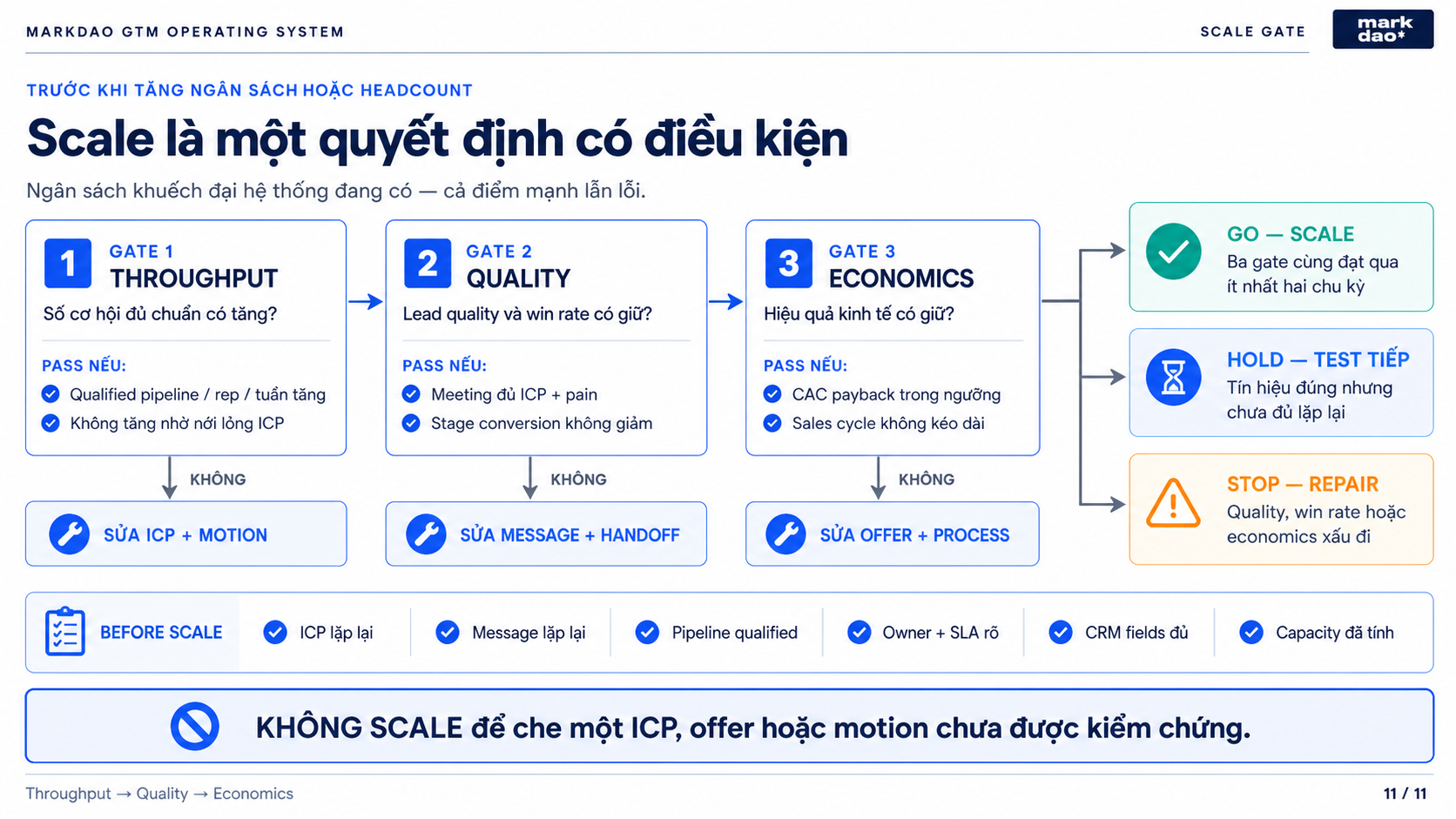
GTM expansion checklist
- Do we have a prioritized segment, rather than an overly broad market description?
- Does the ICP have exclusion criteria and is it validated by wins, retention, or usage levels?
- Are the buying committee, budget holder, and project champion clearly identified?
- Does the problem have a cost, urgency, and a triggering event?
- Does the offer have a clear scope, outcome, price point, proof, and next steps?
- Is the primary motion aligned with the buying complexity and economics?
- Does every website page have a specific role in the buying journey?
- Does the CRM record the source, ICP score, trigger, stage, and reasons for wins or losses?
- Do AI workflows have data, owners, permissions, approval points, and stop conditions?
- Does the dashboard measure qualified pipeline, stage conversion, economics, and customer quality?
- Has the pilot produced repeatable results over multiple cycles?
- Can customer success help clients reach value and generate proof for the next GTM cycle?
If you have three or more "no" answers, prioritize fixing the system before increasing budget, account volume, or headcount.
Common GTM mistakes
Choosing channels before choosing the market
Teams decide to run LinkedIn, SEO, or outbound because competitors are doing it. A channel cannot fix a segment with no demand or an offer that lacks differentiation.
Defining the ICP solely by firmographic characteristics
Industry and company size don't reveal pain, timing, or win probability. You need to look at behavior, operations, economics, and triggers.
Confusing replies with buying intent
An email might generate many replies because the topic is interesting, but that doesn't mean it creates an opportunity. Track your meeting acceptance rate, pipeline progression, and account quality instead.
The website tries to speak to everyone
The messaging becomes generic, the social proof lacks depth, and the CTA doesn't align with the buying stage. You should have dedicated pages for industries, use cases, or roles when needs differ significantly.
Using AI to increase volume before establishing guardrails
The result is often inaccurate data, repetitive content, and a poor user experience. Start with a clear workflow, a dedicated owner, and quality standards.
Measuring acquisition while ignoring activation and retention
A GTM strategy doesn't end when a contract is signed. If customers don't realize value, the business loses revenue, social proof, and referrals for the next cycle.
Conclusion: A good GTM strategy ensures the entire system learns the same lessons.
A good GTM strategy doesn't make a business busier. It helps the team know where to focus, which signals are reliable, what to stop doing, and under what conditions to scale.
The logical sequence is market, ICP, problem, positioning, offer, motion, website, workflow, resources, and measurement. Skipping a foundational layer often forces businesses to make more expensive fixes later. Conversely, when these layers align, the website becomes part of the revenue engine, sales spends time on better opportunities, and AI shortens feedback loops instead of creating more noise.
You can view the website projects Markdao has implemented to see how content strategy, user experience, and technology are translated into actual websites. If you need to determine whether your current website is supporting or hindering your GTM, talk directly with Markdao to review your ICP, page structure, messaging, social proof, conversion flows, and measurement plan.
FAQ

In this article, GTM refers to Go-to-Market Strategy, the plan for bringing a product or service to the right market to generate revenue. Always write out the full term upon first mention to avoid confusion with Google Tag Manager.
A marketing strategy focuses on the market, brand, demand, and promotional activities. GTM has a more cross-functional scope, connecting product, customers, pricing, channels, sales, customer success, operations, and revenue metrics for a specific product or market.
Yes. Most B2B businesses use one primary motion and several supporting ones. For example, inbound generates demand, outbound activates accounts with intent signals, sales handles complex transactions, and partners expand distribution.
An ICP identifies the type of account or customer that is the best fit. A buyer persona describes the individuals involved in the decision-making process within that account. The ICP helps you decide where to focus, while the persona helps you craft your messaging, evidence, and approach.
Teams should review signals and the pipeline weekly, check unit economics monthly, and update major decisions—such as ICP, pricing, motions, or capacity—quarterly or whenever there is a significant shift in the market.