



Keyword research is the most critical phase for the success of an SEO project, yet it is also the most frequently rushed. People open a tool, export a list of a few hundred keywords, sort them by search volume, and start writing from the top down.
That approach ignores three questions far more important than search volume: what is the user actually looking for, is your website competitive enough to rank for it, and if they do visit, will they actually buy anything?
This article covers the entire process, from understanding the nature of keywords to selecting, grouping, and optimizing them. It also includes data on search behavior that might make you rethink a few things you've long believed.
Four criteria for evaluating whether a keyword is worth pursuing
These four criteria should be applied in the order listed above. Search volume is not on the list because it only holds meaning after a keyword has passed all four. A keyword with 20,000 searches per month is worth nothing if you have no chance of reaching the first page.
What are keywords?
A keyword is a word or phrase that a user types into a search bar when they need something. For SEO professionals, keywords are not the goal; they are clues. They are the only trace you have of a need existing in someone's mind.
This perspective changes how you work. If you treat keywords as the goal, you will try to stuff them into your content as much as possible. If you treat them as clues, you will ask further questions: where is the user in their journey, what do they already know, what are they missing, and which page will solve their problem?
Classification by length
Short-tail keywords, one to two words, for example, "running shoes." High search volume, fierce competition, and vague intent. The person typing this might want to buy, learn more, or is simply curious.
Mid-tail keywords, three to four words, for example, "running shoes for women." The intent is clearer, and the competition is moderate.
Long-tail keywords, five words or more, for example, "running shoes for women with flat feet." Low search volume, but the intent is very clear and conversion rates are usually significantly higher.
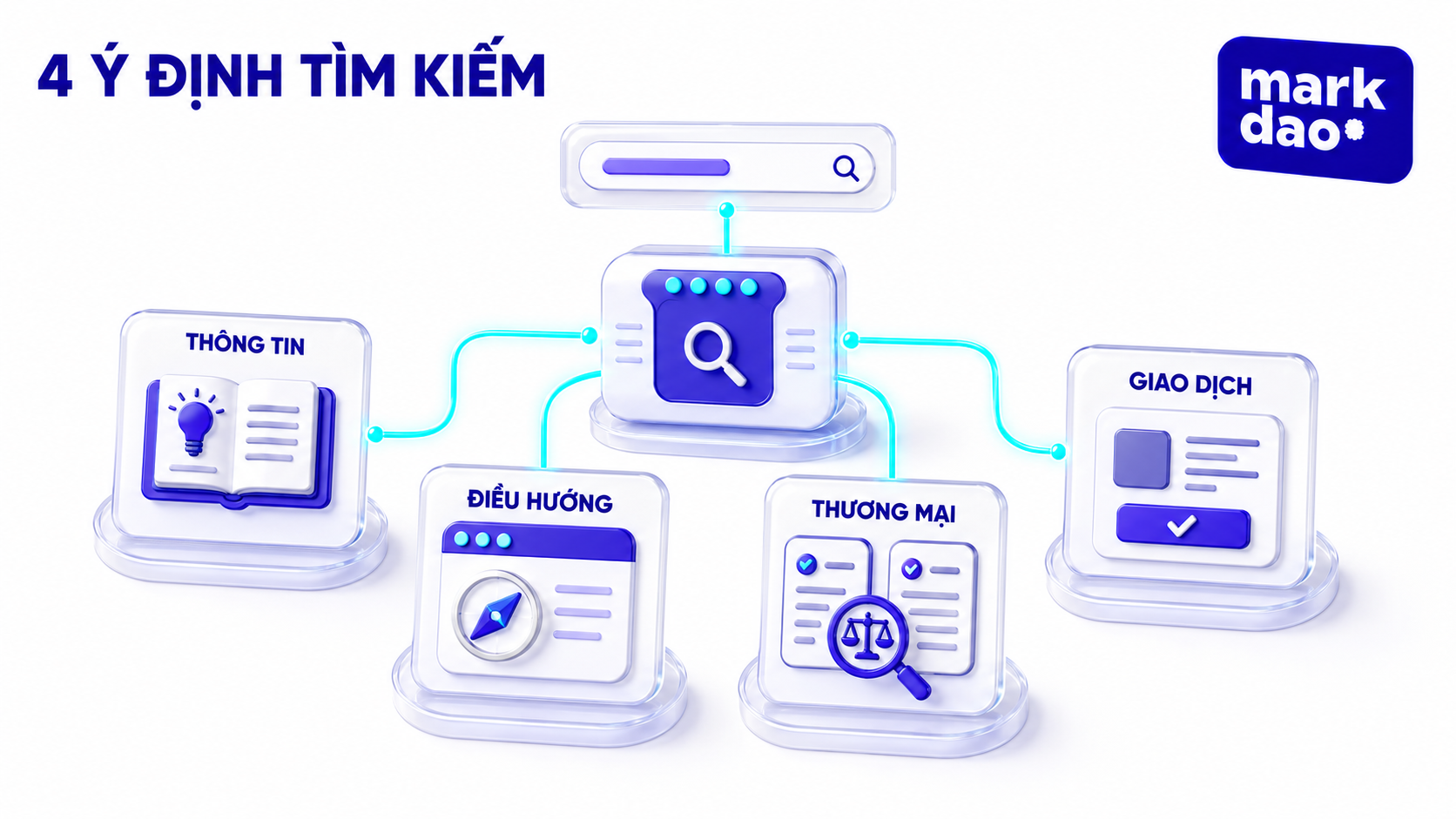
Classification by search intent
This is a more important classification, as it determines the type of page you need to create.
The most common mistake in keyword research isn't choosing the wrong words, but choosing the right words and then creating the wrong type of page. If you build a sales page for an informational intent keyword, that page won't rank, no matter how well you optimize it.
The real picture of search demand
This section contains some figures that contradict what most Vietnamese SEO resources keep repeating.
Research by SparkToro and Datos, published by Rand Fishkin and Search Engine Land reported and analyzed nearly 332 million queries with over 320,000 different phrases, collected from approximately 130,000 devices over 21 months, from January 2023 to September 2024.
Four notable findings:
Just 148 phrases account for 15% of all searches. Demand is more concentrated at the head than most of us think, and this concentration is gradually increasing.
The long tail is much smaller than imagined. The group of keywords with fewer than 11 searches per month accounts for only 3.6% of total demand. This figure directly contradicts the common advice that the long tail accounts for 70% of search volume.
Branded searches account for 44%. Nearly half of all searches are people typing in a specific brand name. The remaining 56% is the real playing field for content SEO.
Intent distribution is heavily skewed toward informational. Informational 51%, navigational 33%, commercial 14.5%, and transactional only 0.69%.
That final figure is worth pausing over. Queries with direct purchase intent account for less than one percent. If your content strategy only targets keywords containing "buy," "price," or "quote," you are fighting over a tiny slice of the market and ignoring the 51% of demand sitting at the informational stage.
A note on scope: this data was collected from devices in the US. Search behavior in Vietnam differs, particularly with a higher proportion of searches occurring via Zalo, Facebook, and TikTok. Read these figures as indicators of demand structure, not as specific market data for Vietnam.
The takeaway for your daily work: don't build your entire content plan around ultra-niche long-tail keywords in the hope of scraping together traffic. They have their place, but they are not the backbone. The backbone lies in mid-range keywords with clear intent, where you have both a chance to compete and sufficient demand.
Four criteria for evaluating a keyword
The table at the beginning of the article is a summary. Here is an explanation of each criterion.

Criterion 1: Search intent
The most reliable way to check is not the "intent" column in your tools, but opening the actual search results page to see for yourself.
Type the keyword into Google in an incognito window and observe the top ten results. If they are how-to guides, the intent is informational. If they are product and category pages, the intent is transactional. If they are "top 10" lists, the intent is commercial.
Google has spent years observing millions of people typing those phrases and seeing where they click. The displayed results are their conclusion about the intent. No tool has better data than that.
Criterion 2: Winning page format
While observing the intent, take note of the type of page dominating the top 10.
This is a hard constraint. If eight out of ten results are product category pages, writing a blog post for that keyword is almost certain to fail, no matter how good it is. You aren't losing because your content is poor; you're losing because you've chosen the wrong format.
Also, pay attention to other elements on the search results page: are there featured snippets, "People Also Ask" boxes, video blocks, maps, or AI Overviews? These indicate the format in which Google expects the answer.
Criterion 3: Authority Gap
The question here is: are you entering a closed field?
There are three signs of a closed field. The top 10 is dominated by government websites or large organizations. The top 10 is filled with international brands that have hundreds of times your resources. Or, the top 10 consists of sites that have existed for years with a massive number of backlinks.
In these three cases, better content alone isn't enough. The logical strategy is to take a step back, target more specific satellite keywords, build topical authority first, and then return to the head keywords after a few months.
Criterion 4: Business Value
Ultimately, a keyword must connect to sales, even if the path is long.
A simple scoring method is to categorize each keyword into one of three levels. Direct, the searcher is looking for exactly what you sell. Indirect, the searcher has a problem that your product solves, but they don't know it yet. Irrelevant, the searcher just happens to use the same terminology.
Group three keywords are the most common trap. They often have very high search volume and look attractive in a spreadsheet. They bring in nice traffic for reports but don't generate a single cent.
Keyword Research Process
Step 1: Build a seed list
Seed keywords are the most basic terms that describe your field. Don't get them from tools; get them from real-world sources:
- How customers name your products when they message or call you, which is often completely different from how the company names them.
- The question that sales and customer support teams hear over and over again
- Category names on competitor websites
- Terminology appearing in industry groups on Facebook and forums
- Google autocomplete suggestions when you start typing a phrase
- The People Also Ask and Related Searches sections at the bottom of the results page
The first two sources are the most valuable yet the most overlooked. They provide the actual language your customers use, which no tool can generate.
Step 2: Expand using tools
Once you have your seed list, use tools to expand it. Here is a basic, free toolkit:
Google Search Console is the most underrated source on the list. It shows you the queries your website is appearing for that you haven't even targeted yet. This is your own real data, not estimates. The article What is Google Search Console and its 8 key features provides a guide on how to leverage it.
If you need a step-by-step guide on how to research and select keywords directly on Google, the article 5 steps to check Google keywords will dive deep into those operations.
Step 3: Filter by four criteria
Run your entire list through the four criteria mentioned above. Most keywords will be eliminated at this stage, and that is a good sign. Narrowing a list of 500 keywords down to 60 worth pursuing is a normal result.
Record the reasons for elimination. Six months later, when your website is stronger, some keywords previously discarded due to authority gaps will become viable, and you won't have to start from scratch.
Step 4: Grouping
This is the step that separates the professionals from the amateurs.
Many keywords differ in wording but share the same intent, and they should be covered on a single page. "How to research keywords," "keyword research methods," and "keyword research guide" are three ways of expressing the exact same need.
How to check: search for each keyword one by one and compare the top 10 results. If seven out of ten results overlap, they belong to the same group and require a single page.
Splitting them into three separate articles just creates three weak pages that compete against each other, instead of one strong page.
Step 5: Assign keywords to each URL
Each primary keyword belongs to exactly one URL. Create a tracking table including the URL, primary keyword, secondary keywords, intent, and status.
This table is your tool to prevent keyword cannibalization. Before writing a new post, check the table. If the keyword is already assigned to another URL, update that page instead of writing a new one.
Self-assessing keyword difficulty without paid tools
Difficulty scores from Ahrefs or Semrush are convenient, but they are primarily based on the number of backlinks and know nothing about your website. A "difficulty 25" keyword might still be out of reach if your site is only three months old.
The evaluation method below costs nothing and provides more realistic results because it directly compares you to the pages currently ranking there.
Open search results in incognito mode, look at the top ten results, and score them according to this table. Add points for each row that applies.
How to interpret the results:
Total below 0. This is a great opportunity. There is a genuine gap, and you have a shot at the top 10 with a well-crafted article.
Total from 0 to 3. Feasible but requires investment. Your article must be significantly better than the top 10 in at least two specific areas and needs internal linking support.
Total above 3. The door is closed for new websites. Step back, target more specific long-tail keywords within the same topic, build authority first, and come back later.
This table cannot replace paid tools when you are handling thousands of keywords. But for a list of a few dozen keywords you need to decide on, it provides a better answer than a single number.
Branded and non-branded keywords
The SparkToro data above shows that branded searches account for 44% of total search volume. This is a figure that needs to be handled carefully when reading SEO reports.
These two groups are fundamentally different:
The problem lies in reporting. If you combine the two groups, a strong brand advertising campaign will boost brand searches, driving up total search traffic and making it look like SEO is working. In reality, content SEO might be stagnant.
Always separate the two groups when reporting. In Google Search Console, use query filters to exclude terms containing your brand name; the remainder provides the true picture of your SEO performance.
For branded keywords, the goal isn't to optimize for rankings, as you're already there. The goal is to ensure the landing page is relevant and to capture variations like "brand name + reviews," "brand name + pricing," and "is brand name good." If you don't capture those terms, someone else will.
A complete end-to-end example
The theory above becomes much clearer when applied to a real-world case. Suppose you are doing marketing for a custom wooden furniture workshop in Ho Chi Minh City that builds residential furniture on demand.
Step 1: Seed list. Don't open your tools just yet. Ask your sales team three questions: what do customers call our products, what do they keep asking about, and who do they usually compare us with?
The results: customers call it "cabinet making," "built-in wardrobe installation," or "industrial wood furniture" rather than "interior construction." The most frequent questions are about price and whether industrial wood is durable. Customers often compare the workshop with smaller shops and large showrooms.
Seed list: custom wardrobe, wooden kitchen cabinets, industrial wood furniture, what is industrial wood, full-service interior construction.
Step 2: Expansion. Type each phrase into Google and pull from the autocomplete suggestions and the "Related searches" section. The list grows to about 150 phrases, including things like "how much do industrial wood kitchen cabinets cost," "what is the difference between MDF and HDF," "do built-in wardrobes take up much space," and "moisture-resistant wooden furniture for homes in Saigon."
Step 3: Filter by four criteria. This is where the list gets significantly narrowed down.
"Interior" is immediately discarded because the intent is too broad and the top 10 results are dominated by large e-commerce platforms, making the authority gap too wide.
"What is industrial wood" is kept. It has informational intent, the top 10 results are blog posts from similar-sized workshops and stores, and the authority gap is acceptable. Indirect business value: people researching industrial wood are likely considering custom furniture.
"How much do industrial wood kitchen cabinets cost" is kept and given high priority. The commercial intent is clear; the searcher is comparing options before making a decision. The top 10 results are workshops of a similar scale.
"Buy MDF wood" is discarded. The search volume is decent, but the searchers are other craftsmen and workshops buying raw materials, not end customers.
From 150 phrases, about 35 remain that are worth pursuing.
Step 4: Grouping. If you search for "what is industrial wood," "types of industrial wood," and "how many types of industrial wood are there," you'll find that eight out of the top 10 results are identical. These three phrases should be covered in a single article.
Conversely, "what is MDF wood" and "difference between MDF and HDF wood" share only three results in the top 10, so they should be split into two separate articles.
Step 5: Assign URLs and determine the order. The final table contains 12 URLs. The implementation order isn't based on search volume, but on the ease of winning; we tackle topics with the smallest authority gap first to build up website signals before gradually moving on to more competitive clusters.
This entire process takes about one working day, and it determines the results for the next six months.
Keyword cannibalization: the silent killer
Keyword cannibalization occurs when two pages on the same website target the same search intent. Google is forced to choose one, often picking the wrong page, which weakens both.
Symptoms to look for:
- In Google Search Console, a single query shows two different URLs at different times.
- Keyword rankings fluctuate significantly for no apparent reason.
- A newly published article causes a drop in the ranking of an older article on the same topic.
- Multiple pages receive impressions, but none of them can reach the first page.
How to handle it, in order of priority: Merge two articles into one stronger piece and 301 redirect the weaker one to the stronger one. If both articles have unique value, clearly differentiate the intent of each and update the titles and content accordingly. If one article is clearly inferior, merge the usable content and redirect.
Do not simply delete a URL that already has rankings. Always use redirects to preserve the accumulated value.
On-page keyword optimization
Keyword density: a misconception to discard
This needs to be addressed directly, as incorrect advice on this topic is still being copied everywhere.
Keyword density is not a ranking factor. Google's John Mueller has confirmed this repeatedly over the past decade, with a consistent message: keyword density is not a ranking factor and never has been.
There is no ideal number. Recommendations like "aim for 2% to 3%" have no basis from Google, and trying to hit a specific percentage will only make your writing sound unnatural without providing any benefit.
What truly matters is topical coverage. A comprehensive article on organic keyword research will naturally touch upon search intent, search volume, difficulty, clustering, and tools. Not because you are forcing them in, but because you cannot fully cover the topic without them. That is the signal search engines actually read.
Keyword placement is truly important
Instead of density, focus on placement.
Regarding character limits for titles and descriptions, it is important to understand that Google truncates based on display width in pixels, not character count. The numbers 60 and 160 are convenient best practices, not hard thresholds set by Google.
The introduction deserves special attention, as it is where the primary keyword should appear naturally for the first time and is also the section most frequently cited by AI tools. The article what is a lead paragraph and how to write a compelling one discusses this section in detail.
Keywords in the age of AI search
A shift is underway, and it is changing how we think about keywords.
When users ask ChatGPT or read an AI Overview, they no longer type keywords; they ask full questions in natural language. The content selected for citation is not the content stuffed with keywords, but content that provides clear answers, evidence, and a coherent structure.
This does not make keyword research obsolete. It simply shifts the focus from "which phrase" to "which question." A practical approach is to take each primary keyword, write down five real questions users would ask about it, and ensure the article answers all five. The article what is GEO and the roadmap for setting up a website for AI Search dives deep into this topic.
Measuring keyword performance
Keyword research does not end when the article is published. Four metrics to track:
Impressions by query. This indicates whether Google understands what your article is about. If your article appears for queries you did not target, your content is misaligned with the intent.
Average position. Positions 5 to 15 are the easiest to improve. A post ranking at 11 usually only needs additional content and a few internal links to reach the first page.
Click-through rate. High impressions with low clicks mean the title isn't compelling enough, or AI Overview is stealing your traffic. The post What is CTR explain acceptable thresholds.
Conversion by keyword group. The final and most important metric. Which keyword groups bring in actual customers, and which ones only bring in views.
Reasonable evaluation milestones are 30, 60, and 90 days. Before 30 days, there isn't enough data to draw conclusions.
Six common mistakes
Choosing keywords based on search volume. Sorting a spreadsheet by volume in descending order and working from the top down is the fastest way to waste your budget on terms you have no chance of winning.
Skipping the step of checking actual search results. Trusting the "intent" column in tools instead of opening Google yourself. Tools guess intent using algorithms, and they get it wrong quite often with Vietnamese queries.
Trying to hit a specific keyword density. As mentioned above, this is baseless advice that ruins the flow of your writing.
A separate post for every variation. Three ways of typing the same need should be one page, not three. This is the leading cause of keyword cannibalization.
Researching once and stopping. Search intent changes with seasons, trends, and new competitor products. You should review your keyword set every quarter.
Only targeting keywords with purchase intent. With transactional queries accounting for less than 1% of total demand, this strategy ignores the vast majority of the market. Informational content is where you meet customers before your competitors do.
Conclusion
Keyword research isn't just about generating a list. It’s a series of decisions about where to focus and what to ignore, and most of the value lies in the keywords you decide not to target.
Three things worth doing right now: Open Google Search Console and filter for queries currently in positions 5 through 15; that’s where you’ll see the fastest improvements. Create a table mapping keywords to each URL to prevent keyword cannibalization before it happens. And if keyword density is still part of your editorial process, remove it entirely.
If you want to see the bigger picture of content production, continue reading our article What is content and how to write content that attracts readers.
And if you need a team to work with, Markdao's website SEO services include keyword research and content production with a step-by-step audited process, or contact us so we can review your current keyword set.
FAQ

A keyword is a word or phrase that a user types into a search engine when they need something. For SEO professionals, keywords are clues about an existing need, not targets to be stuffed into an article.
There is no universal threshold. For new websites, keywords with 100 to 1,000 monthly searches are usually a sweet spot because they offer sufficient demand without being overly competitive. More important than the numbers is whether you have a realistic chance of ranking on the first page and whether those searching are likely to become customers.
One primary keyword and three to seven secondary keywords that share the same search intent. Targeting multiple different intents in one article will result in content that fails to serve any of them well.
There is no exact standard for this, but a keyword density of 1-3% is generally considered natural for SEO-optimized content. Google has repeatedly stated that keyword density is not a ranking factor. Instead of counting percentages, focus on ensuring your article covers all aspects of the topic naturally.
Yes, but do not build your entire strategy around them. Data from research by SparkToro and Datos shows that search queries with fewer than 11 searches per month account for only 3.6% of total demand. Long-tail keywords are great for supplementing your strategy and achieving quick wins early on, but they are not suitable as the backbone of your SEO.