
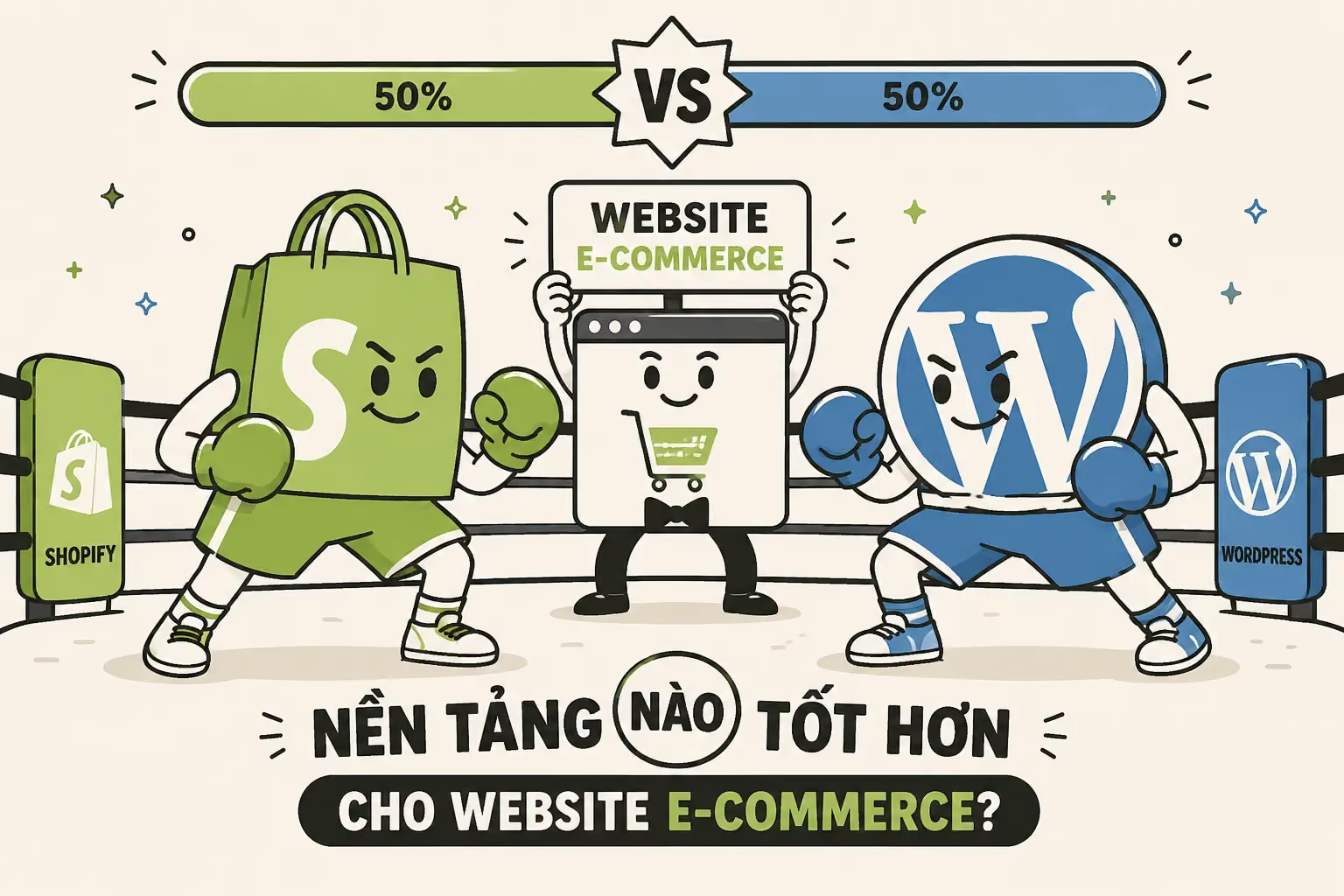

Shopify is a great fit when a business wants to launch a store quickly, minimize technical tasks, and operate on a centralized, managed system. WordPress combined with WooCommerce is more suitable when a business needs deep control over the interface, data, content, and specific sales workflows.
There is no single platform that is best for every situation. The decision should be based on your business model, team capabilities, total cost of ownership, and the level of customization required. This article compares Shopify and WordPress based on practical criteria to help businesses choose the right e-commerce platform.
How do Shopify and WordPress differ?
Shopify is a centralized e-commerce platform
Shopify is a software-as-a-service (SaaS) e-commerce platform. Hosting, content delivery infrastructure, and platform updates are all managed by Shopify. Businesses subscribe to a plan and set up their interface, products, payments, and shipping all within the same system.
According to Shopify's hosting documentation, hosting and platform updates are included in the service plans. Shopify also states that stores on its platform are compliant with PCI DSS Level 1. This helps reduce infrastructure workload, but businesses are still responsible for managing accounts, permissions, third-party applications, and their own data protection processes.
WordPress and WooCommerce are open-source systems
WordPress is a content management system. To build a store, businesses typically install WooCommerce along with extensions for payments, shipping, marketing, and product management. WooCommerce confirms that the core platform is open-source, allowing website owners to choose their own hosting and maintain full control over their website, source code, and data.
This level of control comes with operational responsibilities. The business or its technical partner must manage hosting, backups, and updates for WordPress, themes, plugins, security, and compatibility. WordPress documentation also notes that plugin quality varies, so the selection, testing, and updating of plugins must be carefully managed.
Comparing Shopify vs. WordPress across 8 key criteria
1. Operational model and control
Shopify: The platform's infrastructure and core are managed by the provider. Businesses can customize within the scope of themes, apps, APIs, and the capabilities supported by their service plan.
WordPress + WooCommerce: Businesses choose their own hosting, have access to the source code, and can design the architecture according to their needs. This offers greater control but also requires a clear technical management process.
If a business wants to reduce infrastructure responsibilities, Shopify is generally easier to operate. If data ownership, customization capabilities, and vendor choice are critical requirements, WooCommerce has the advantage.
2. Total Cost of Ownership
Do not just compare initial subscription prices. The total cost of ownership must include design, development, hosting, apps or plugins, payment processing fees, maintenance, security, technical support, and the costs of system changes.
- Shopify: Costs typically include subscription plans, themes, apps, custom development, and payment-related fees depending on the configuration.
- WordPress + WooCommerce: The core software is free to use, but businesses must account for hosting, themes, paid extensions, development, monitoring, and maintenance.
Shopify is usually easier to budget for when needs are relatively standardized. WooCommerce allows for flexible budget allocation, but costs can rise if the store uses many plugins, custom integrations, or complex infrastructure.
3. Deployment Speed
Shopify has a centralized setup process, making it suitable for projects that need to get a store up and running quickly without many unique requirements. However, a complete sales website still requires preparation of product structure, content, payments, shipping, tracking, and testing.
WordPress requires additional time for hosting, plugin architecture, interface development, and compatibility testing. The actual time depends on the project scope rather than just the platform. Businesses can refer to the website design timeline by phase before planning.
4. Interface Design and Functional Customization
Both platforms support themes and custom interface development. The difference lies in the level of system access and control.
- Shopify: suited for standard sales workflows, with a robust ecosystem of apps and APIs. Certain advanced requirements may be subject to platform limitations, service plans, or third-party apps.
- WordPress + WooCommerce: suited for content-driven models or businesses requiring deep customization. System quality depends heavily on architecture, source code, and testing processes.
Businesses should clearly define their requirements before choosing a platform: product types, variants, promotions, payments, shipping, inventory management, membership, ERP/CRM integration, and target markets.
5. Ecommerce capabilities and integration
Shopify provides a wide range of built-in ecommerce features within a unified system. This approach reduces the number of components to manage and is ideal for teams that want to focus on products, operations, and marketing.
WooCommerce expands through plugins, APIs, and custom code. This model is suitable when a business needs to connect proprietary processes, but each additional component must be evaluated for quality, security, performance, and compatibility.
6. SEO and content strategy
Both Shopify and WordPress are capable of strong SEO performance. The platform alone does not guarantee rankings. Results depend on search intent, content quality, website structure, internal linking, structured data, speed, crawlability, and brand authority.
Shopify provides a relatively consistent technical foundation and supports standard SEO configurations. WordPress allows for deeper control over templates, content, and URL structures, but installing numerous plugins does not automatically mean the site is properly optimized. With either choice, businesses still need a URL-specific On-page SEO process.
7. Security, updates, and maintenance
Shopify manages the majority of the infrastructure, platform updates, and system PCI compliance. Store owners remain responsible for passwords, staff permissions, installed apps, domain names, and data processing procedures.
With WordPress, responsibility is shared between the website owner, hosting provider, development team, and plugin developers. The website requires a schedule for updates, backups, monitoring, security scans, staging environments, and disaster recovery plans.
8. Scalability and platform migration
Both Shopify and WooCommerce can support large-scale stores if implemented correctly. Shopify scales based on the infrastructure and ecosystem managed by the platform. WooCommerce scales based on hosting quality, application architecture, database optimization, caching, and technical expertise.
Businesses must also evaluate future migration costs. Migrating products, customers, orders, URLs, content, and tracking data between the two systems is not fully automated. A platform migration plan must include redirects, data testing, order reconciliation, and post-launch SEO monitoring.
When should a business choose Shopify?
Shopify is generally a good fit when a business meets the following criteria:
- Needs to launch the store quickly with a relatively standard sales workflow.
- Has a small technical team or prefers not to manage hosting and core platform maintenance.
- Wants to manage products, orders, apps, and operations within a centralized ecosystem.
- Accepts a subscription-based model and platform customization limits in exchange for simpler operations.
- Critical integrations already have suitable apps or APIs available.
Before deciding, check the required apps, payment gateways, target markets, data export capabilities, and total cost of ownership for at least one budget cycle.
When should you choose WordPress and WooCommerce?
WordPress combined with WooCommerce is generally a good fit when:
- The website needs to combine e-commerce with a large content system, blog, resources, or landing pages.
- Businesses need deep control over data, source code, hosting, and deployment processes.
- There are specific business requirements, product structures, or integrations that are not compatible with off-the-shelf solutions.
- There is an in-house technical team or partner responsible for security, updates, performance, and maintenance.
- The business is willing to invest in system administration in exchange for a high level of customization.
If you choose this option, you should define your hosting standards, approved plugin list, access permissions, backup schedules, and maintenance responsibilities from the start. Learn more about custom WordPress website design services from Markdao.
Checklist for choosing between Shopify and WordPress for Ecommerce
Before choosing a platform, answer these eight questions:
- When does the website need to launch, and what is the minimum viable scope for operation?
- Can your current team manage hosting, updates, and security on their own?
- Which features are mandatory, and which can be implemented later?
- Which payment, shipping, ERP, CRM, or POS systems does the store need to connect with?
- What role do content and SEO play in your customer acquisition strategy?
- What does the three-year budget include beyond the initial build costs?
- What level of control over data and source code does the business require?
- Who is responsible for operations, troubleshooting, and upgrades after the website is handed over?
A clear requirements document will help you compare two platforms more fairly. You can use our checklist of essential website components for launch before working with a development agency.
Frequently asked questions about Shopify vs. WordPress
Is Shopify or WordPress better for SEO?
Neither platform is inherently better for every SEO project. Shopify reduces some infrastructure work and offers a relatively consistent technical structure. WordPress allows for deep control over templates and content but requires strong technical management. The quality of implementation and content matters more than the platform name.
Is WooCommerce actually free?
The core WooCommerce software is open-source and free to download. However, businesses must still account for costs related to hosting, domain names, themes, extensions, development, maintenance, security, and support. Therefore, you should compare the total cost of ownership rather than just software fees.
Is Shopify suitable for small businesses?
Shopify can be a good fit for small businesses that need a quick launch, have relatively standard sales processes, and have limited technical resources. However, businesses should still review app costs, payment fees, and customization limitations before making a decision.
Is it possible to migrate from Shopify to WooCommerce or vice versa?
It is possible, but migrating platforms requires a solid data and SEO plan. Businesses must audit products, variants, customers, orders, images, URLs, redirects, content, tracking, and integrations. It is recommended to perform reconciliation and monitor for errors after the migration.
Conclusion: Choose the right operating model, not just the platform name.
Shopify is ideal for businesses that prioritize deployment speed, centralized system management, and reduced technical overhead. WordPress combined with WooCommerce is better suited for businesses that prioritize control, content, and deep customization capabilities.
Before making a decision, compare options based on the same set of requirements and operational stage: functionality, integrations, total cost, maintenance responsibility, data, SEO, and scalability plans. If you need to determine the right platform for your business goals, you can refer to professional website design services from Markdao to build your scope and implementation roadmap.