
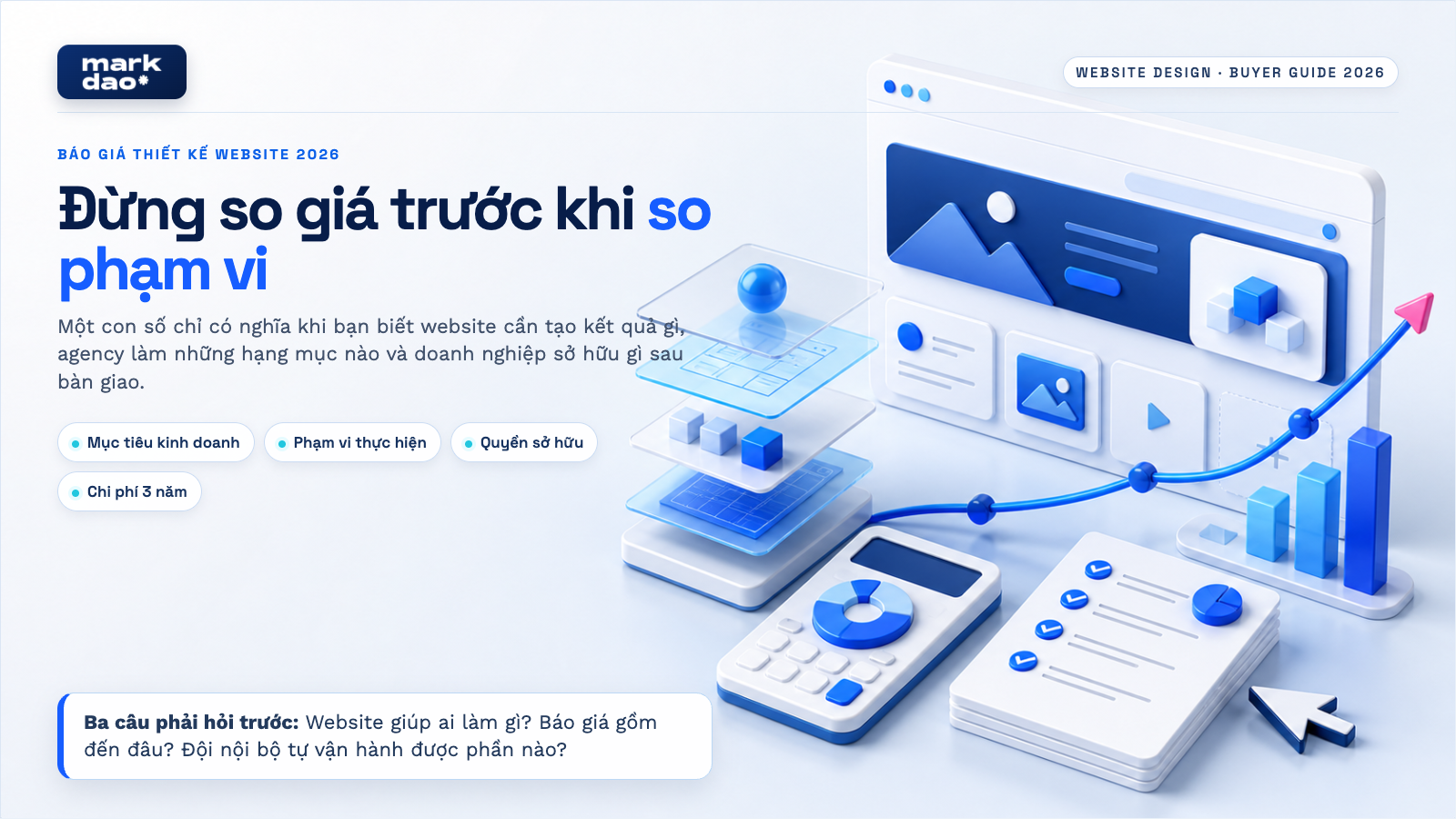

You ask three different companies the same question: “How much does a website cost?” One quotes a few million, another a few tens of millions, and the third over a hundred million. Looking at these three figures, it’s hard to tell which one is reasonable.
The reason is that these quotes may be referring to three completely different products. One side uses a pre-made template and just swaps the logo. Another researches your customers, rewrites the content, creates a custom design, and connects it to a sales system. The third builds an experience featuring 3D elements, motion, and multiple layers of interaction.
Therefore, a website design quote is only meaningful when it answers these three questions:
- What results should the website help the business achieve?
- What specific tasks will the implementation team perform?
- After handover, what does the business own, and how much can they manage on their own?
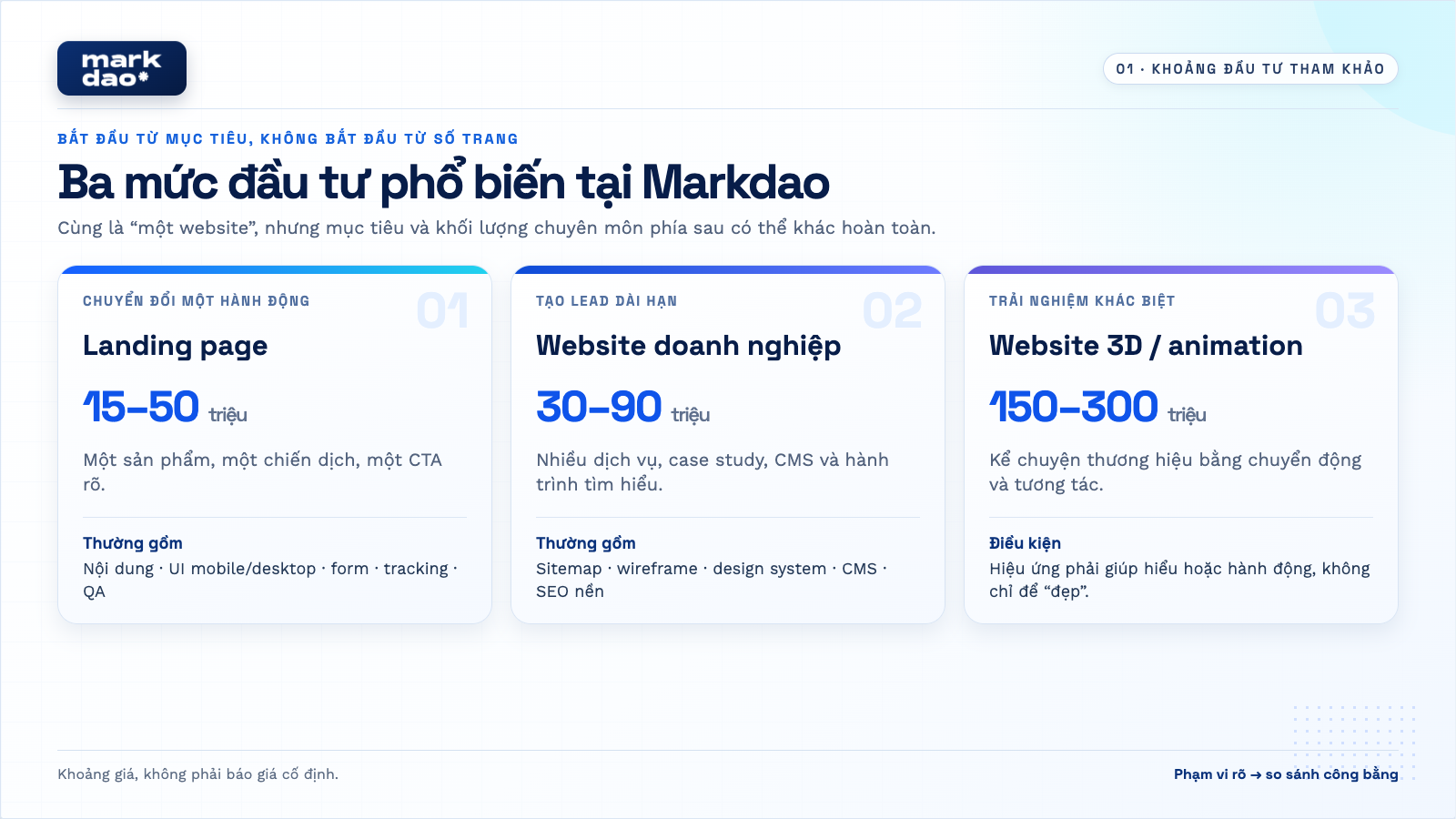
At Markdao, our current reference investment levels are:
- Landing page: from 15 to 50 million VND.
- Corporate website: from 30 to 90 million VND.
- Website with 3D, animation, or complex interactions: from 150 to 300 million VND.
These are reference price ranges, not fixed figures for every project. An accurate quote must be based on your goals, the number of page templates, content readiness, features, integrations, and post-launch operational requirements.
If you just want a quick number, remember this principle: don't compare prices before comparing scope. Two quotes that both say “10-page website” can still differ significantly in terms of workload and the value you receive.
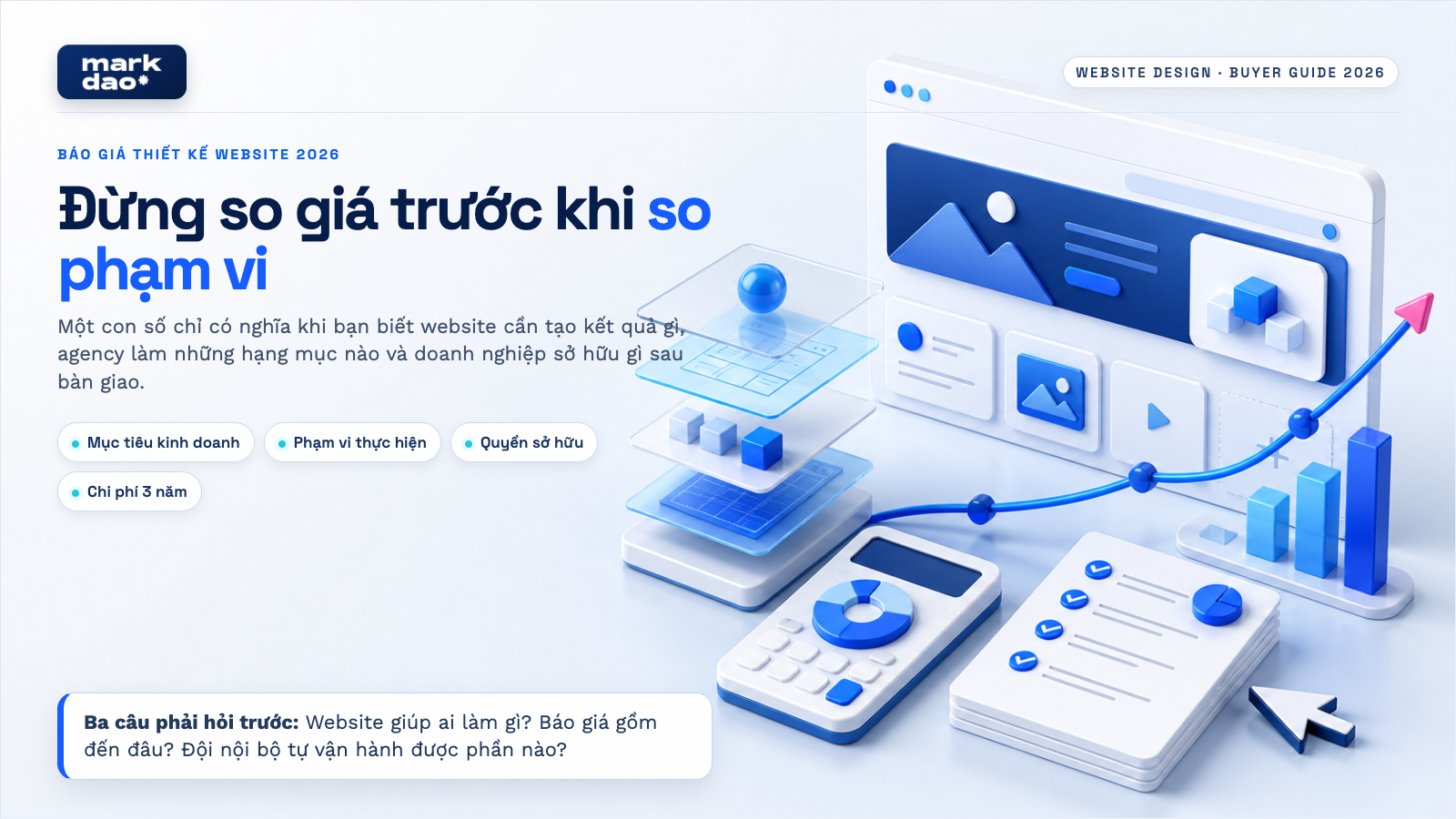
2026 Website Design Price List by Business Goal
The easiest way to estimate a budget is to start with your goals. Does your business need a page for ad campaigns, a lead-generation website, a sales system, or an interactive brand experience? Each goal requires a different scope.
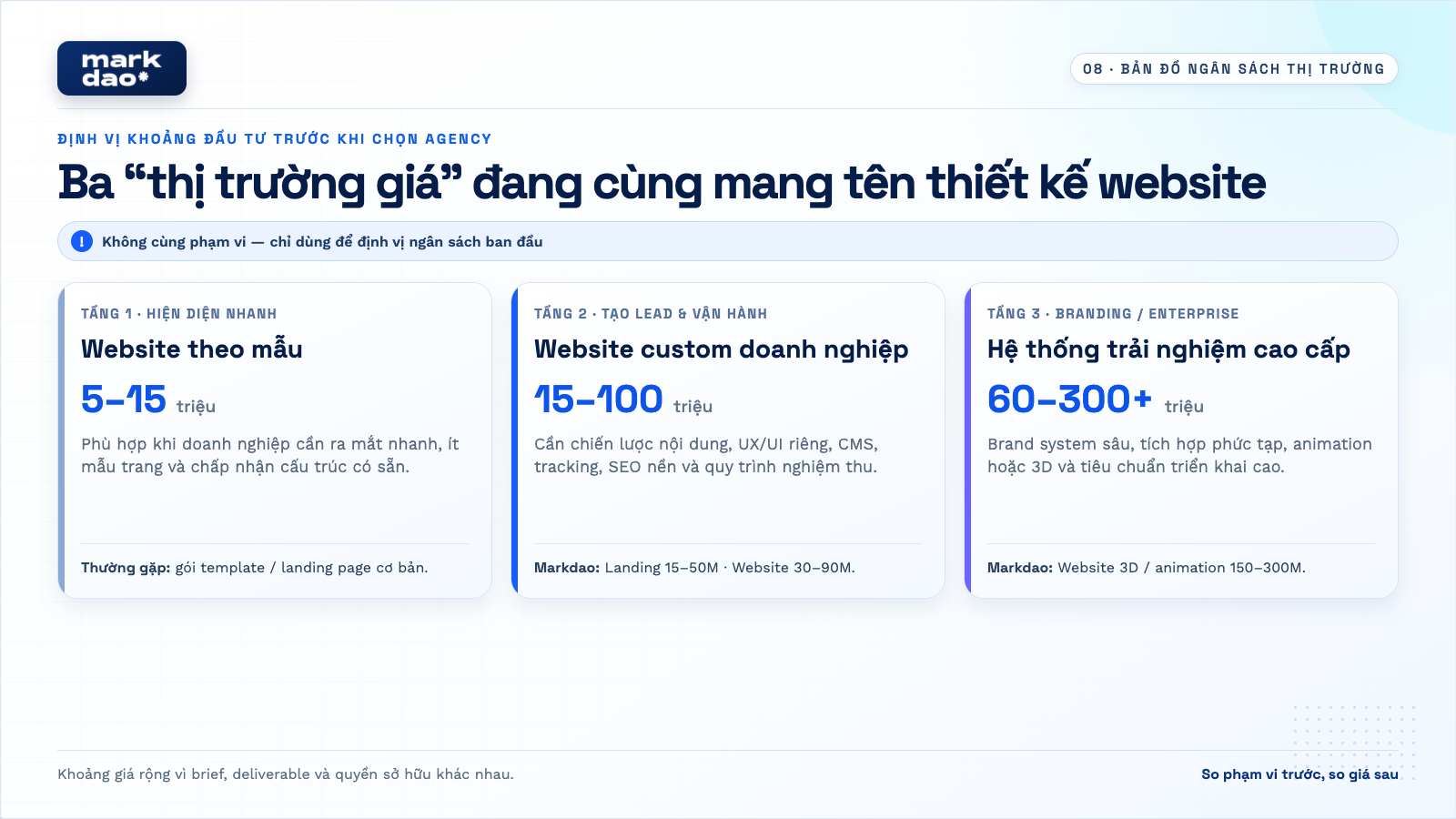
Website Design Price Comparison: Markdao vs. Industry Peers
The table below summarizes public pricing or reference budgets from the official websites of reputable web design agencies in Vietnam. These prices do not represent identical scopes, so they should be viewed in the context of the website type, level of customization, and deliverables included.
Convention: "From" indicates a starting price; "contact" means the agency provides a quote only after the scope is finalized. Click on the agency name to view the source and verify pricing before signing a contract.
Methodology note: These are prices self-published on each agency's website, not quotes for the same brief verified by an independent party.
How to read the table to avoid miscomparisons
Markdao does not compete directly with template-based websites priced at 3–10 million VND. In the 30–90 million VND range for corporate websites, the scope focuses on target audience and user research, content strategy, custom UX/UI and design systems, CMS development, technical SEO foundations, tracking, and handover of ownership. The 150–300 million VND range applies only when a project truly requires 3D, animation, or specialized interactions.
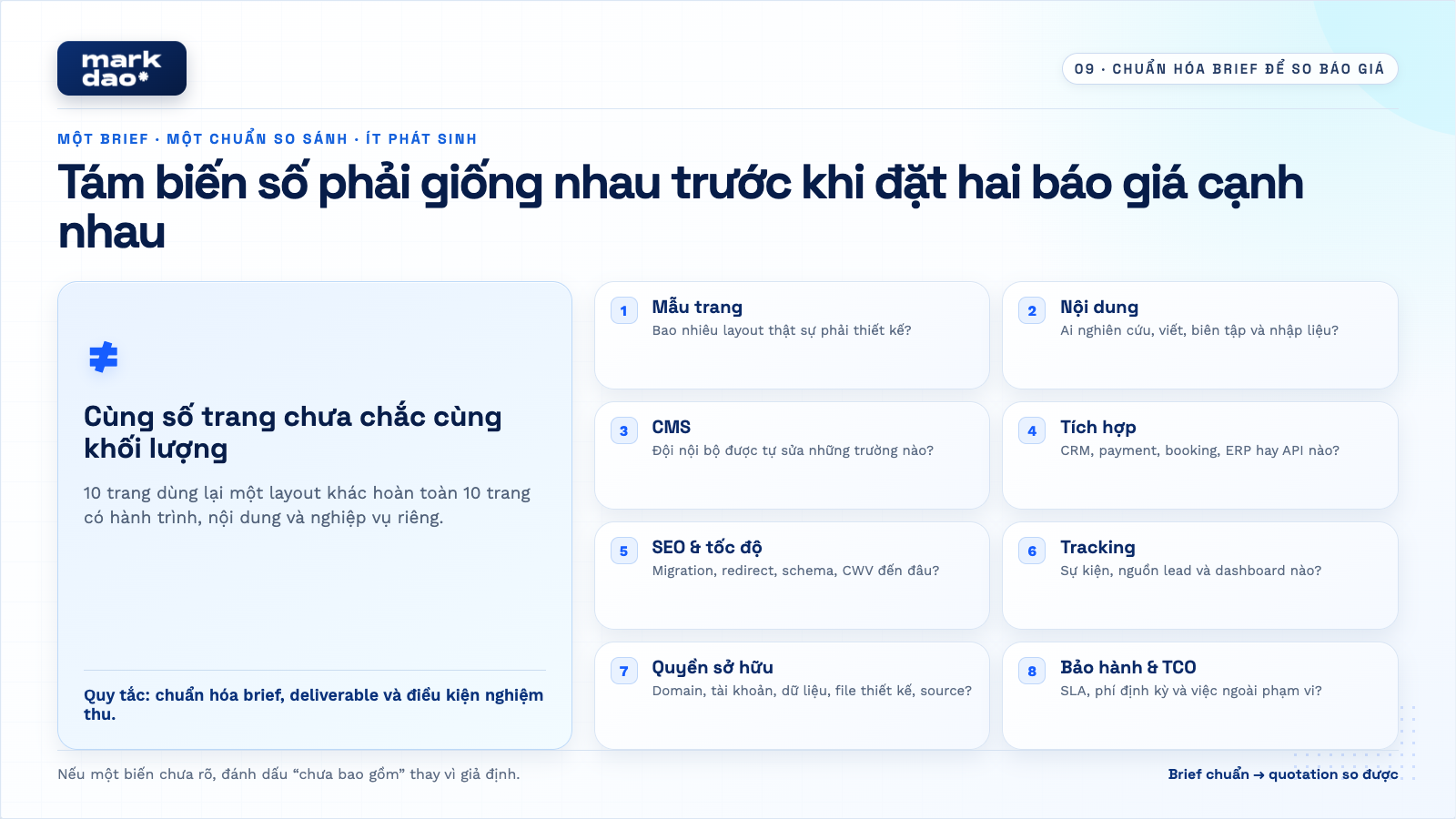
For a fair comparison, ask every agency to fill out the same scope table, including: number of layouts, content, CMS, integrations, SEO and performance, tracking, ownership rights, warranty, and total maintenance costs for three years. A lower price does not mean an equivalent scope; a higher price does not automatically guarantee better results.
Landing page design quotes for a campaign or product
A landing page is a page built around a single primary action, such as signing up for a consultation, booking an appointment, downloading a document, or purchasing a product.
Reference investment levels at Markdao: 15 to 50 million VND.
This price range is typically suitable when the scope includes:
- Clarifying the target audience and the desired action.
- Structuring content based on a persuasive journey.
- Writing or editing core content.
- Custom interface design for desktop and mobile.
- Programming forms, thank-you pages, and conversion tracking.
- Testing speed, display, and errors before running ads.
A landing page that simply swaps text and images on a pre-made template will be cheaper. A page requiring custom photography, original illustrations, complex effects, A/B testing, or CRM integration will cost more.
A landing page is ideal when a business has a single product, a specific campaign, and a clear call to action. If customers need to explore multiple service categories, review company capabilities, and read case studies before reaching out, a corporate website is a more suitable choice.
You can learn more about how Markdao builds SEO-optimized landing pages to understand what needs to be prepared before the design process begins.
Pricing for Lead-Generating Corporate Website Design
A corporate website does more than just introduce your company. It needs to help the right people find the right information, understand why they should trust you, and know exactly what the next step is.
Reference investment range at Markdao: 30 to 90 million VND.
The scope typically includes:
- Researching business goals and key user segments.
- Developing a sitemap, which maps out the pages and their relationships.
- Crafting messaging for the homepage, service pages, and case studies.
- Designing wireframes to establish content layout before applying colors and imagery.
- Designing the user interface and a shared component system.
- Developing a CMS so your marketing team can update content independently.
- Setting up the SEO foundation, forms, tracking, and providing operational handover.
Pricing starts at the lower end for projects with a lean structure, ready-to-use content, and minimal integrations. Costs increase for websites with multiple user groups, extensive service offerings, multilingual support, data migration requirements, or CRM connectivity.
This project category is well-suited for B2B businesses, service firms, schools, industrial companies, and brands that need a website as a long-term lead generation channel. You can view Markdao's website design projects to compare styles and scope of implementation.
Pricing for e-commerce or operation-integrated website design
E-commerce websites involve more layers of work than a simple landing page. Beyond the interface, the project encompasses products, variants, inventory, payments, shipping, promotions, customer accounts, and reporting.
Do not base pricing solely on the number of products. A store with 2,000 products that share the same structure may be easier to implement than a service with only 20 products, where each requires its own filters, pricing logic, and checkout flow.
Questions to answer before providing a quote include:
- How many product types and variants are there?
- Does pricing change based on the customer, quantity, or region?
- Is there a need to synchronize inventory, orders, or data from other systems?
- Do customers pay immediately, or do they submit a request for a quote from your staff?
- Does the business need to manage loyalty programs, discount codes, or memberships?
- Who will update the products after the site is handed over?
For this category, Markdao needs to conduct a survey before providing a figure. If the business requirements are unclear, a very low initial price often leads to numerous additional costs once work actually begins.
Pricing for website design with 3D, animation, or storytelling experiences
Reference investment level at Markdao: 150 to 300 million VND.
Costs are higher because these projects require additional expertise: motion design, 3D modeling, image processing, interactive programming, and performance testing across multiple devices.
3D and animation are only worth the investment when they clarify the product, tell the brand story, or create an experience that cannot be replicated with static images. Effects without a clear purpose only make the page heavier and force users to wait longer.
A principle Markdao follows is: motion must help the viewer understand or take action, not just make the page look flashy..
What is included in website design costs? 12 essential items for your quote
Many quotes only list "interface design, programming, and SEO optimization." These three lines are not enough for a business to know what they are actually getting. A clear quote should break down at least the following 12 items.
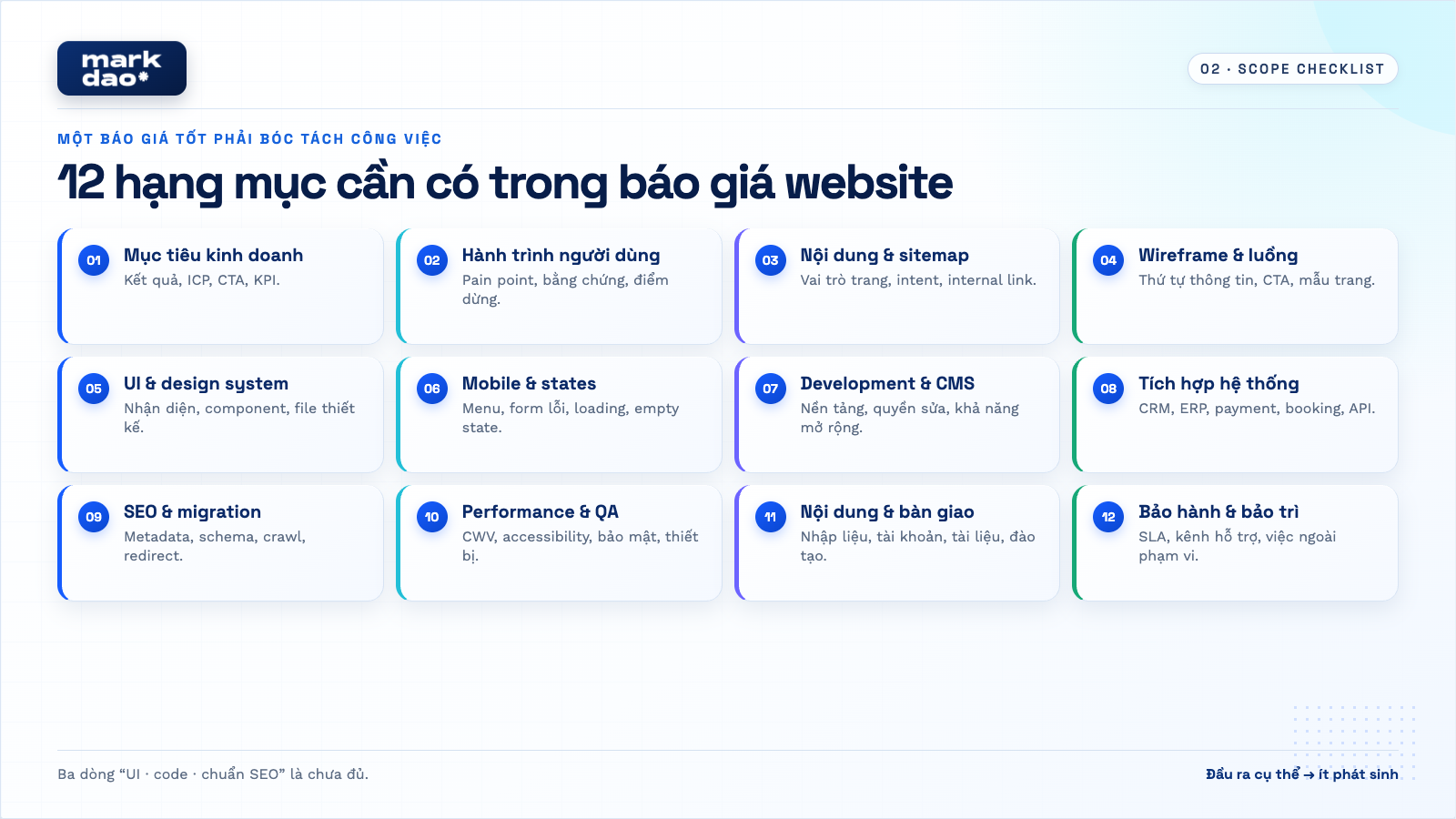
1. Business goal assessment
This step determines who the website serves and what actions it needs to drive. Without clarifying this from the start, the design team might create a beautiful interface without knowing which content to prioritize.
The output should include:
- Primary website goals.
- Priority user groups.
- Primary conversion actions.
- Metrics to track after launch.
For example, "making a professional website" is too broad a goal. "Generating 30 qualified consultation requests per month from factory managers" is a goal that can be used to drive decision-making.
2. Customer personas and user journeys
Businesses often know their customers by industry, age, or job title. A website needs to go deeper: what problems are they facing, what evidence do they need, who is involved in the decision-making process, and what causes them to drop off?
If the user is a purchasing manager, they may need specifications, supply capacity, and quality control processes. If the user is a marketing director, they may be interested in how the internal team updates content and measures leads.
For the same service, these two groups require two different paths on the website.
3. Content strategy and sitemap
A sitemap is a map that shows which page groups a website has and how they are linked. A good sitemap helps users find information quickly while helping Google understand the topic structure.
This section should clearly state:
- List of pages and content groups.
- The role of each page.
- Primary keywords or search intent.
- Desired call to action.
- Existing content versus content that needs to be created.
If content is prepared after the interface is finished, the writing team often has to force text into pre-existing frames. The result is a beautiful page with a disjointed message. Markdao incorporates real content early on so that the layout serves the information, not the other way around.
4. Wireframes and conversion flows
A wireframe is a simple layout that doesn't focus on colors or images. It shows what content appears first, where call-to-action buttons are placed, and how users navigate through the page.
Think of a wireframe like a floor plan for a house. A beautiful paint job can't save a house with an inconvenient layout. The same applies to websites. You need to finalize the arrangement before you start decorating.
The quote should specify the number of page templates requiring wireframes and the number of revision rounds.
5. UI design and component systems
UI design includes colors, typography, imagery, spacing, and how elements respond to user interactions.
A design system—a set of shared design standards—helps keep the website consistent and scalable. When you need to add a new landing page or service, the marketing team won't have to design everything from scratch.
The quote should clearly distinguish between:
- Using pre-made templates versus custom design.
- The number of page templates to be designed.
- Whether a component library will be built.
- Whether design files will be provided upon handover.
6. Mobile design and interface states
"Responsive" is not a sufficient acceptance criterion. The quote must clearly state which screen sizes are covered and whether special interface states are designed.
For example:
- Mobile menu.
- Form states for valid input, invalid input, and successful submission.
- Empty state.
- Loading state.
- Button states for active or disabled.
- Long data tables on small screens.
Google uses the mobile version for indexing and ranking. Therefore, important content and links should not be hidden on mobile just to make the interface look cleaner. Refer to Google's mobile-first indexing guide.
7. Website development and content management system
This is the phase where the design is turned into a functional website. The quote should clearly specify the platform, scope of development, CMS structure, and which sections the internal team can edit themselves.
A good CMS is more than just a place to input content. It should allow non-technical users to replace images, edit text, add posts, create new pages, and preview them before publishing.
Businesses should ask directly: "After handover, what tasks can the marketing team handle without needing to call a developer?". The more specific the answer, the easier it is to predict future operating costs.
8. System integration
A contact form can simply send an email, or it can push data into a CRM, track campaign sources, categorize leads, and notify the appropriate staff member.
Integrations that typically affect the quote include:
- CRM or sales software.
- ERP and inventory management.
- Payment gateways.
- Booking and appointment scheduling.
- Email marketing or Zalo.
- Membership system.
- Third-party APIs.
Each integration requires documentation, test accounts, a point of contact, and error handling scenarios. If you simply write "CRM integration" without specifying the system, data, and workflow, the scope remains unclear.
9. SEO foundation and data migration
An SEO-friendly website does not mean it will automatically rank at the top once designed. The technical aspect only creates the foundation for Google to properly crawl, understand, and index your content.
The scope of foundational SEO should include:
- A clear heading structure, with only one H1 per page.
- Editable title tags, meta descriptions, and URLs.
- Canonical tags, sitemap.xml, and robots.txt.
- Alt text for images.
- Structured data appropriate for the page type.
- Internal linking between relevant pages.
- Crawl and index verification after launch.
- URL redirects for old pages if redesigning the website.
If your business needs to grow content and keywords after launch, that is a separate program. You can view Markdao's website SEO services to distinguish between foundational work and long-term growth.
10. Speed, accessibility, security, and testing
A high PageSpeed score is not enough to conclude that a website is fast for real users. Google evaluates Core Web Vitals based on three main user experience metrics:
- LCP: main content displays quickly, with a good threshold of 2.5 seconds or less.
- INP: responsive interactions, with a good threshold of 200 milliseconds or less.
- CLS: minimal layout shifts, with a good threshold of 0.1 or less.
These thresholds are evaluated at the 75th percentile, meaning the majority of actual visits should meet the good standard. See Core Web Vitals thresholds on web.dev.
Accessibility must also be checked: contrast, keyboard navigation, focus states, form labels, error messages, and touch target sizes. This makes the website easier for everyone to use and is not just an optional add-on.
11. Content entry, training, and handover
The quote should clearly state who is responsible for content entry, the quantity, and the required format. If the client handles entry, does the design agency provide templates and instructions?
The handover package should include:
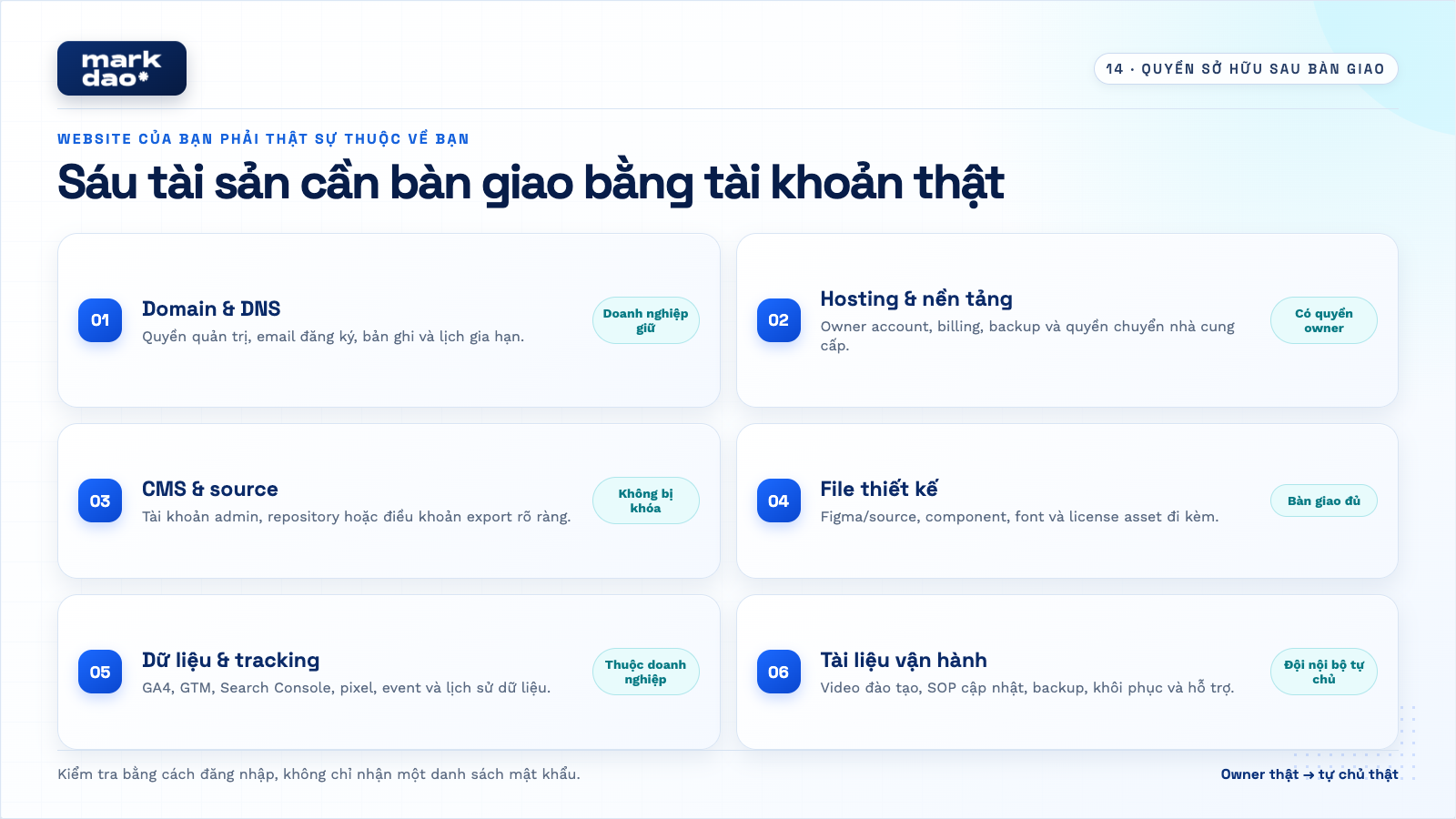
- Administrator accounts.
- Domain and hosting or platform accounts.
- Design files and source code as agreed.
- CMS user documentation.
- Training session for the internal team.
- List of paid plugins, apps, or services.
- A backup copy at the time of handover.
12. Warranty, maintenance, and support levels
Warranty covers fixing errors within the agreed scope. Maintenance is periodic work to keep the website stable, secure, and compatible with new updates.
These two concepts are not the same. A six-month warranty does not mean the developer will handle content updates, backups, security monitoring, or speed optimizations during those six months.
Businesses should request quotes that clearly specify response times, communication channels, supported request types, and out-of-scope costs. If you need a team to support you after the handover, check out Markdao's website maintenance services.
7 factors that increase or decrease website design costs
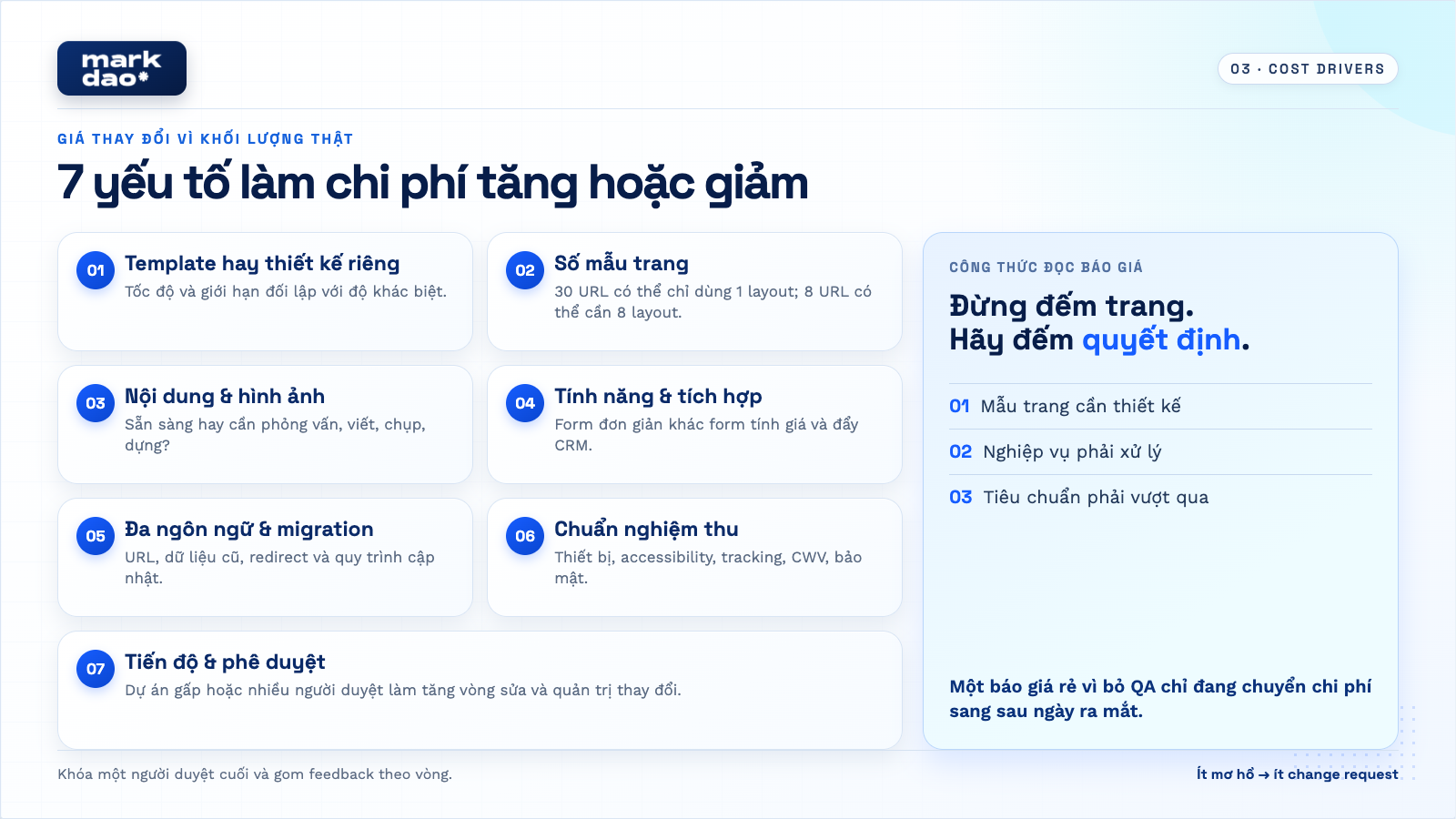
1. Website design quotes: Templates vs. custom design
Templates allow for a quick launch and lower initial costs. In return, the structure and scalability are limited by the pre-existing framework.
Custom design requires more time for research, testing, and refinement. While the cost is higher, the website can accurately reflect your brand, customer journey, and internal operational workflows.
There is no one-size-fits-all choice. If your business only needs a basic landing page, a template may suffice. If the website is a primary lead generation channel, integrates with multiple systems, or needs to establish brand authority, custom design is usually the better investment.
2. Website design quotes based on page templates, not just URL count
This is where many quotes are most misleading.
A website might have 30 articles but only use one article template. The design team only needs to create one layout, which is then populated via the CMS. Conversely, a website with 8 pages where each page has a unique structure and interaction may require 8 distinct templates.
Therefore, ask "how many page templates need to be designed and coded?" instead of just asking "how many pages does the website have?".
3. Website design quotes based on content and image readiness
If your business already has messaging, properly sized images, and clean product data, the implementation time will be shorter.
If the agency needs to conduct interviews, write copy, take photos, produce videos, create illustrations, or overhaul your data, this must be billed separately. Do not treat content as mere "filler text." It determines whether users understand your message and take action.
4. Website design quotes based on feature complexity and integrations
A five-field contact form is entirely different from a form that calculates prices, stores data, segments customers, syncs with a CRM, and creates tasks for the sales team.
When quoting, each feature should be defined by its inputs, processing logic, outputs, and error handling. The word "integration" is too broad to be used as a unit of pricing.
5. Website design quotes for multi-language support, user permissions, and data migration
A bilingual website is more than just doubling your text. You need to handle URLs, language switching, metadata, missing translations, and ongoing update workflows.
Similarly, migrating hundreds of articles or products from an old system requires data cleaning, URL preservation, redirect setup, and post-import verification. This is a migration project, not a simple copy-paste task.
6. Website design quotes based on acceptance standards
If the requirement is just for a "working site that looks like the design," the cost will be lower than a project that requires testing across browsers, devices, accessibility, tracking, Core Web Vitals, and security.
The clearer the standards, the easier it is for a business to know what quality they are paying for. A quote that is cheap because it skips QA isn't a saving; it just shifts the costs to a later stage.
7. Website design quotes based on timeline and number of approvers
Urgent projects require more resources and reduced processing time between steps. Projects with multiple departments involved in approvals also require more time for meetings, consolidation, and change management.
A simple way to reduce costs is to designate one final decision-maker, consolidate feedback into rounds, and finalize criteria before design begins.
Website design price is not the total cost of ownership
A website with a low initial price can still be an expensive choice if you have to hire a developer for every minor edit, if your data is locked into a provider's account, or if you have to rebuild it after just one year.
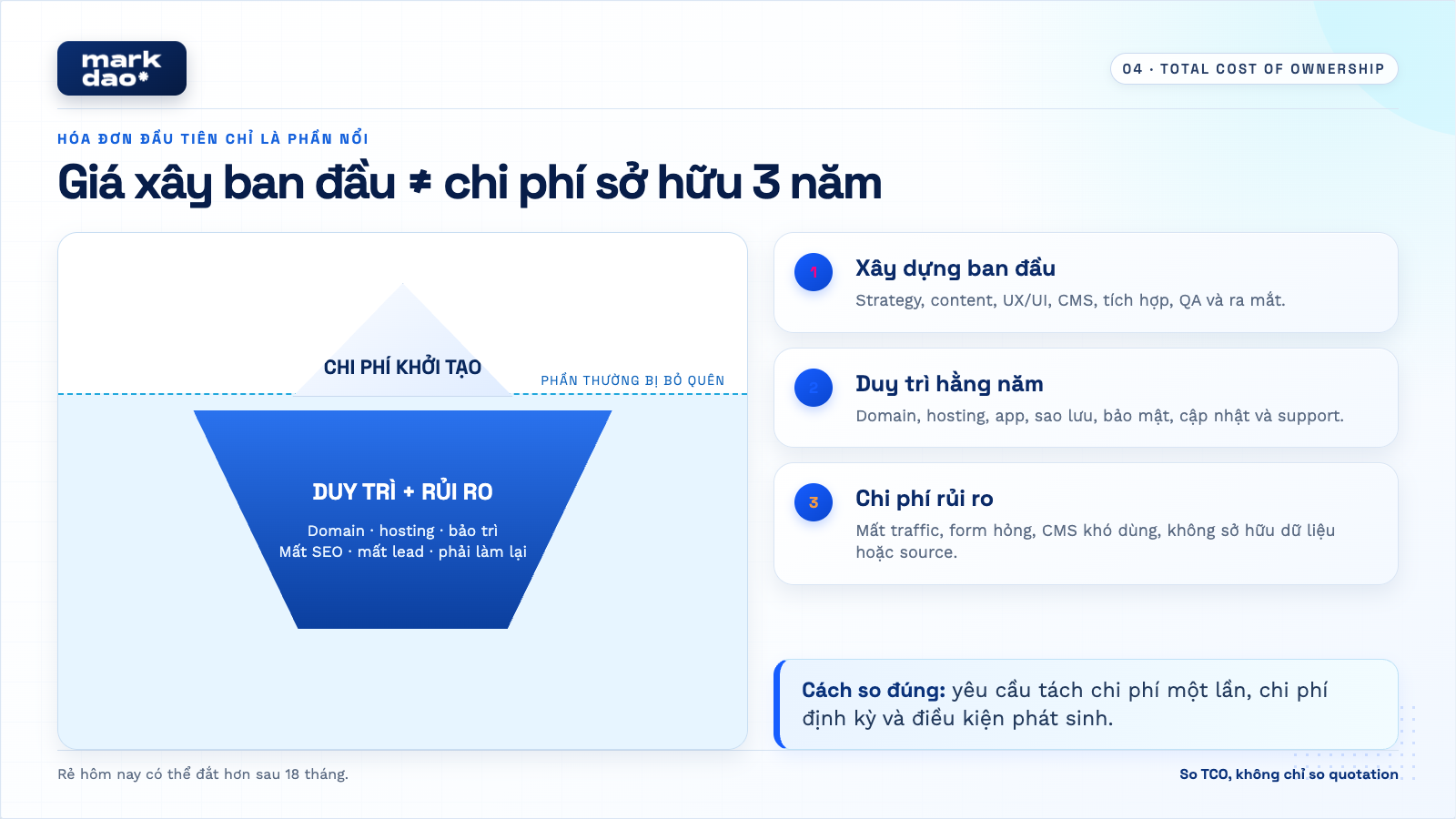
Total Cost of Ownership, or TCO, consists of three main categories.
Initial development costs
- Research and strategy.
- Content and imagery.
- UX/UI and design system.
- Programming and CMS.
- Integration and data migration.
- Testing, training, and launch.
Annual maintenance costs
- Domain.
- Hosting or platform fees.
- Paid plugins and applications.
- Maintenance, backups, and security.
- Content updates.
- Technical support.
Risk costs
- Loss of search rankings due to URL changes without redirects.
- Loss of leads due to broken or untracked forms.
- Having to rebuild due to a CMS that is too difficult to use.
- Inability to retrieve data or source code when switching providers.
- Website slowdowns caused by installing too many third-party tools.
A simple example: Option A is $20 million cheaper upfront, but the marketing team has to pay for monthly fixes and needs a rebuild after 18 months. Option B costs more initially, but the internal team can manage updates themselves and it has a scalable structure. If you only look at the first invoice, A is cheaper. If you look at three years, B is likely more cost-effective.
Businesses should require every vendor to clearly state one-time costs, recurring costs, and potential additional fees. Only when these three figures are transparent can you make a fair comparison.
Templates, WordPress, Webflow, or custom code: which platform should you choose?
The platform should be chosen after understanding your goals and operational workflow. Choosing technology first and then trying to force your needs into it often creates unnecessary limitations.
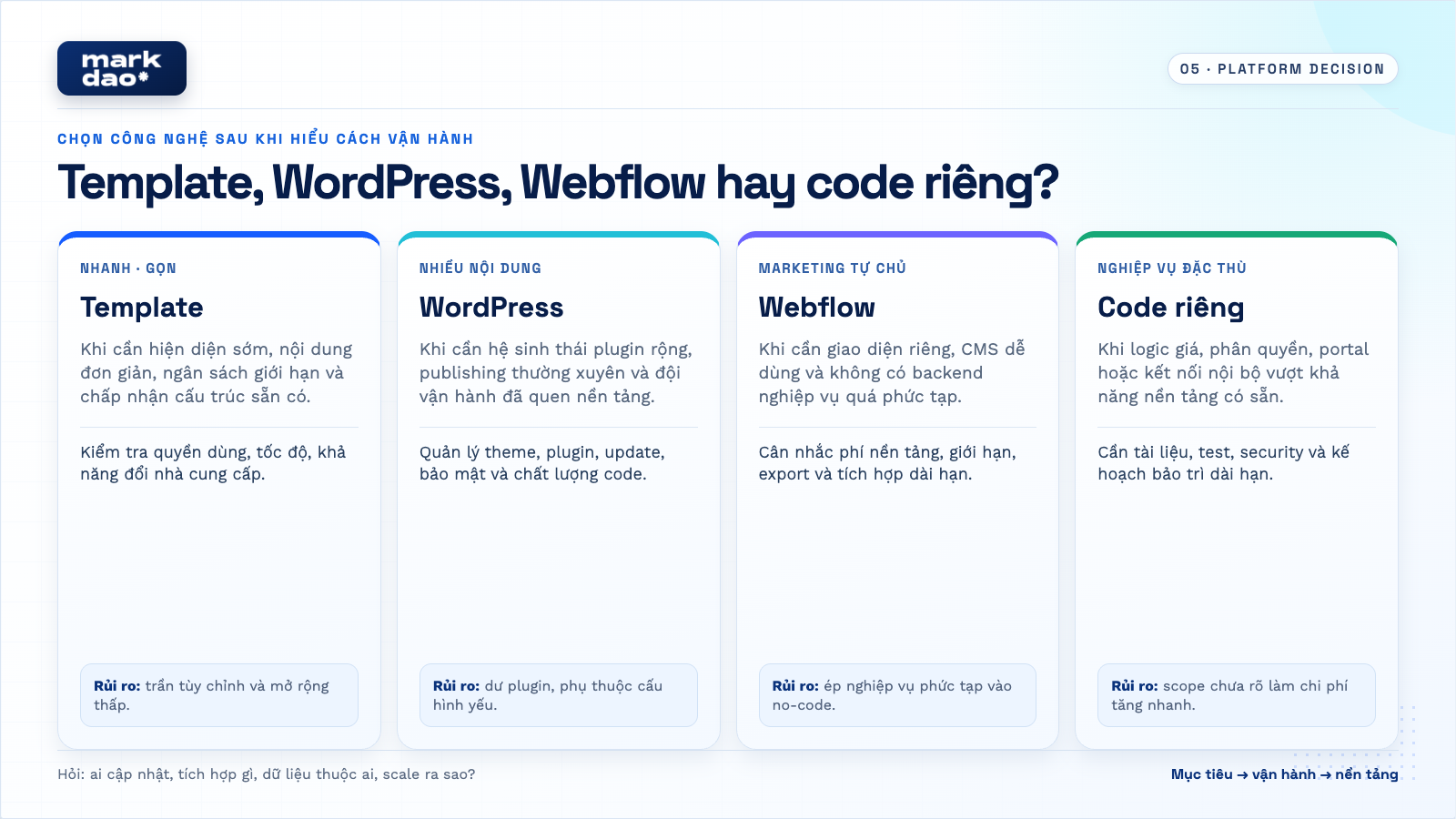
When should you choose a template?
Templates are suitable if your business needs a quick launch, has a limited budget, requires simple content, and is comfortable using a pre-built structure.
Check the usage rights, level of customization, speed, ease of updates, and what happens if you decide to switch providers.
When should you choose WordPress?
WordPress is suitable for content-heavy websites that require a vast plugin ecosystem and for teams already familiar with the platform. Key areas to manage include plugin quality, updates, security, and the development team's code organization.
WordPress is not inherently slow or insecure. A slow website is usually the result of heavy themes, excessive plugins, large images, weak hosting, or poorly controlled implementation.
When should you choose Webflow or a no-code platform?
Webflow is a great fit when a business needs a custom interface, the marketing team wants to manage content independently, and the project does not involve overly complex backend operations.
The advantage is that the design and development processes are closely aligned, the CMS is easy to manage, and there is less reliance on plugins. You should consider platform fees, functional limitations, data export options, and long-term integration.
When should you choose custom code?
Custom code is suitable when a website requires specific business logic that off-the-shelf platforms cannot handle well, such as complex pricing systems, portals for multiple user groups, or deep integration with internal systems.
This option requires thorough documentation, rigorous testing, and a long-term maintenance plan. If the business requirements are not yet clear, custom code can lead to rapidly increasing costs without adding proportional value.
Questions to determine your platform before requesting a website design quote
Before choosing, answer these six questions:
- What does your internal team need to update on their own?
- How many types of content does the website have, and what is the publishing frequency?
- What systems need to be integrated?
- How must data and accounts be owned?
- What is the maintenance budget for the next three years?
- If traffic or features triple, can the platform scale?
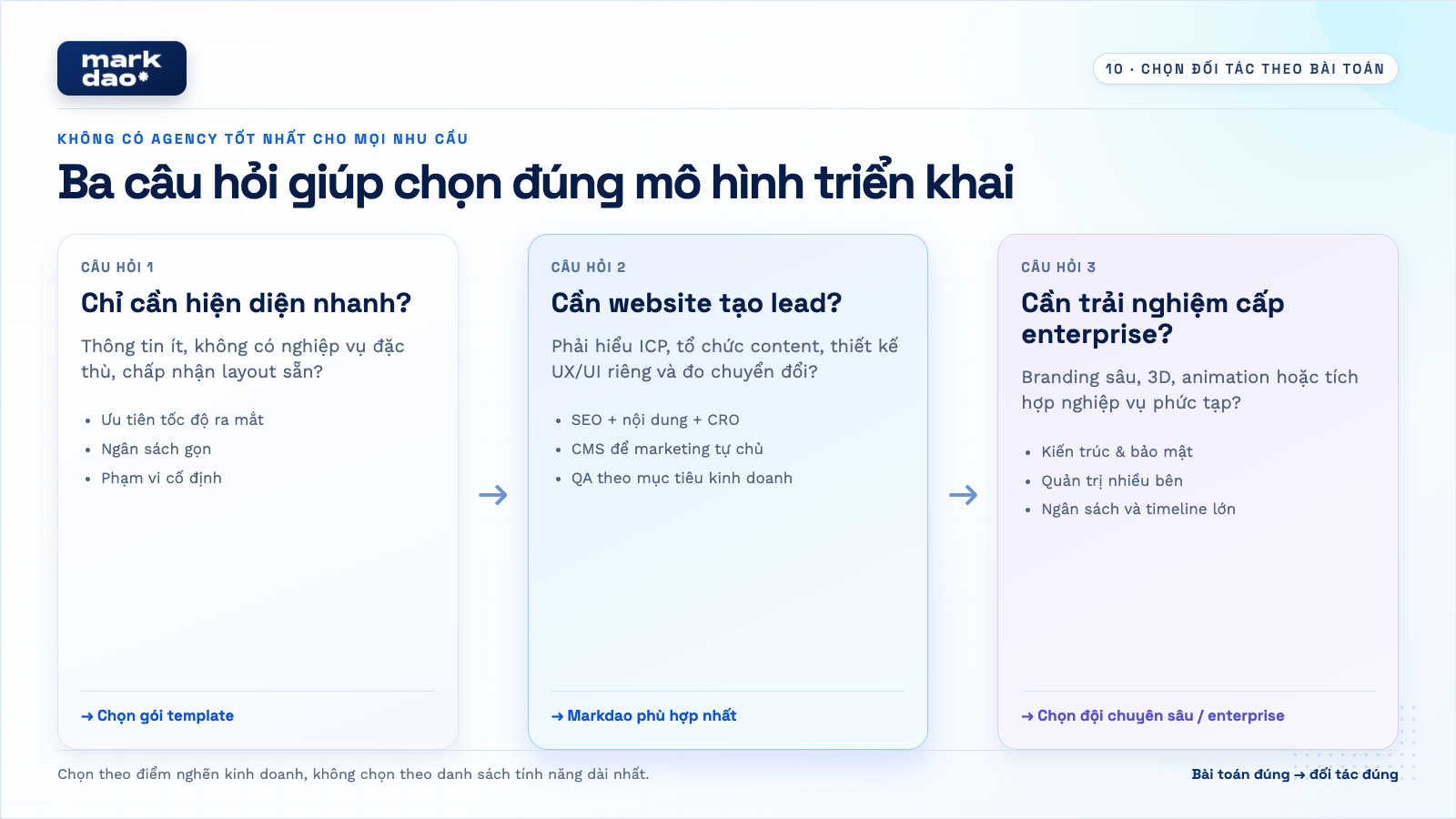
3 scenarios to help businesses estimate their website design needs
The following scenarios are for illustrative purposes to help define scope and are not fixed quotes. Final figures can only be determined after Markdao understands the project's true goals and requirements.
Scenario 1: Service company needing lead generation
The challenge: A consulting firm with three service lines. Clients typically review the company profile and past projects before booking a consultation.
Reasonable scope:
- Homepage, about us, three service categories, projects, insights, and contact.
- Approximately 8 to 12 page templates.
- Copywriting for key pages.
- Booking form with source tracking and CRM integration.
- CMS for the marketing team to publish articles and case studies.
- SEO foundation, analytics setup, and handover training.
Estimated investment: falls within the 30 to 90 million VND range for corporate websites, depending on the complexity of content, design, and integrations.
Key metrics to track: qualified leads, form submission rate, case study views prior to form submission, and lead sources.
Scenario 2: B2B industrial enterprise needing to shorten the sales cycle
The challenge: Products have complex technical specifications, multiple industry applications, and long decision-making cycles. The sales team frequently sends the same set of documents to every client.
Reasonable scope:
- Structure organized by industry application and client pain points.
- Technical document library with gated downloads.
- Industry-specific case studies.
- Bilingual website.
- Quote request form with needs categorization.
- CRM integration with automated routing to the appropriate staff.
- URL redirection strategy for website migration.
Factors that increase costs: multilingual support, volume of documentation, legacy data migration, CRM integration, and permission-based access requirements.
Key metrics to track: quote requests, document downloads from corporate accounts, qualified leads, and time from first visit to appointment.
Scenario 3: Brands requiring a unique experience
The challenge: Products with high aesthetic value. The website needs to tell the brand story through imagery, video, 3D elements, or motion graphics.
Recommended scope:
- Experience concept development.
- Motion storyboarding.
- Production or processing of imagery, video, and 3D assets.
- Interactive development.
- Lightweight version for low-end devices.
- Performance and accessibility testing.
Estimated investment range: 150 to 300 million VND.
Metrics to track: completion rate of the main experience, product interaction, consultation requests, and actual speed on target devices.
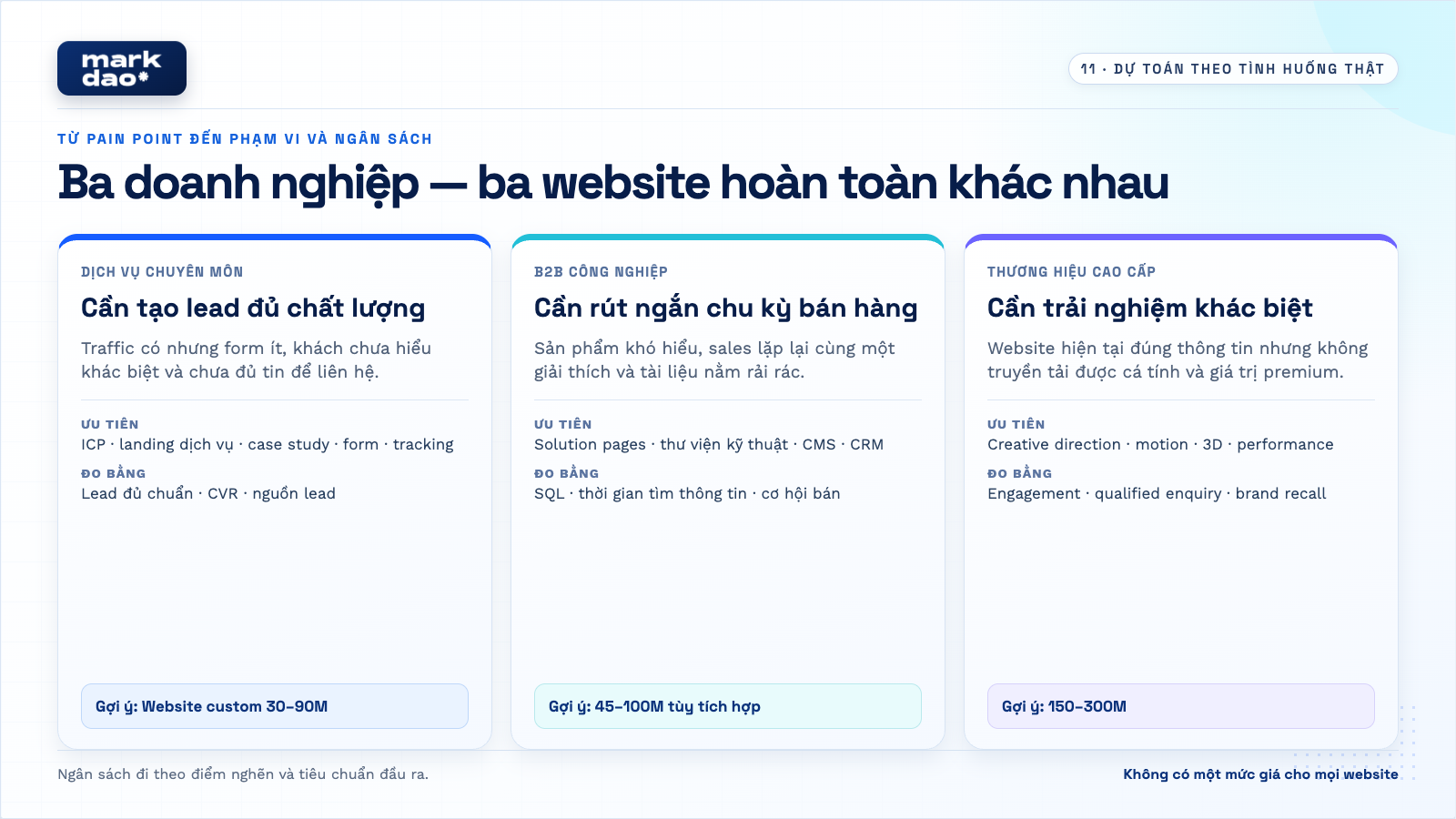
How to get an accurate website design quote in a single meeting
You don't need to write a lengthy technical document. Just prepare eight clear answers:
- What business results should the website generate?
- Who are the three most important user groups?
- What tasks do they need to perform on the website?
- What is the current state of your existing content and imagery?
- Is there an old website or data that needs to be migrated?
- Do you need to integrate with CRM, ERP, payment, booking, or other systems?
- What do you want your internal team to be able to update after handover?
- What is the launch deadline and who is the final approver?
These eight answers help the agency identify the project type, number of page templates, resource requirements, and potential risks. A data-driven discussion saves multiple rounds of Q&A and reduces the likelihood of scope creep after signing.
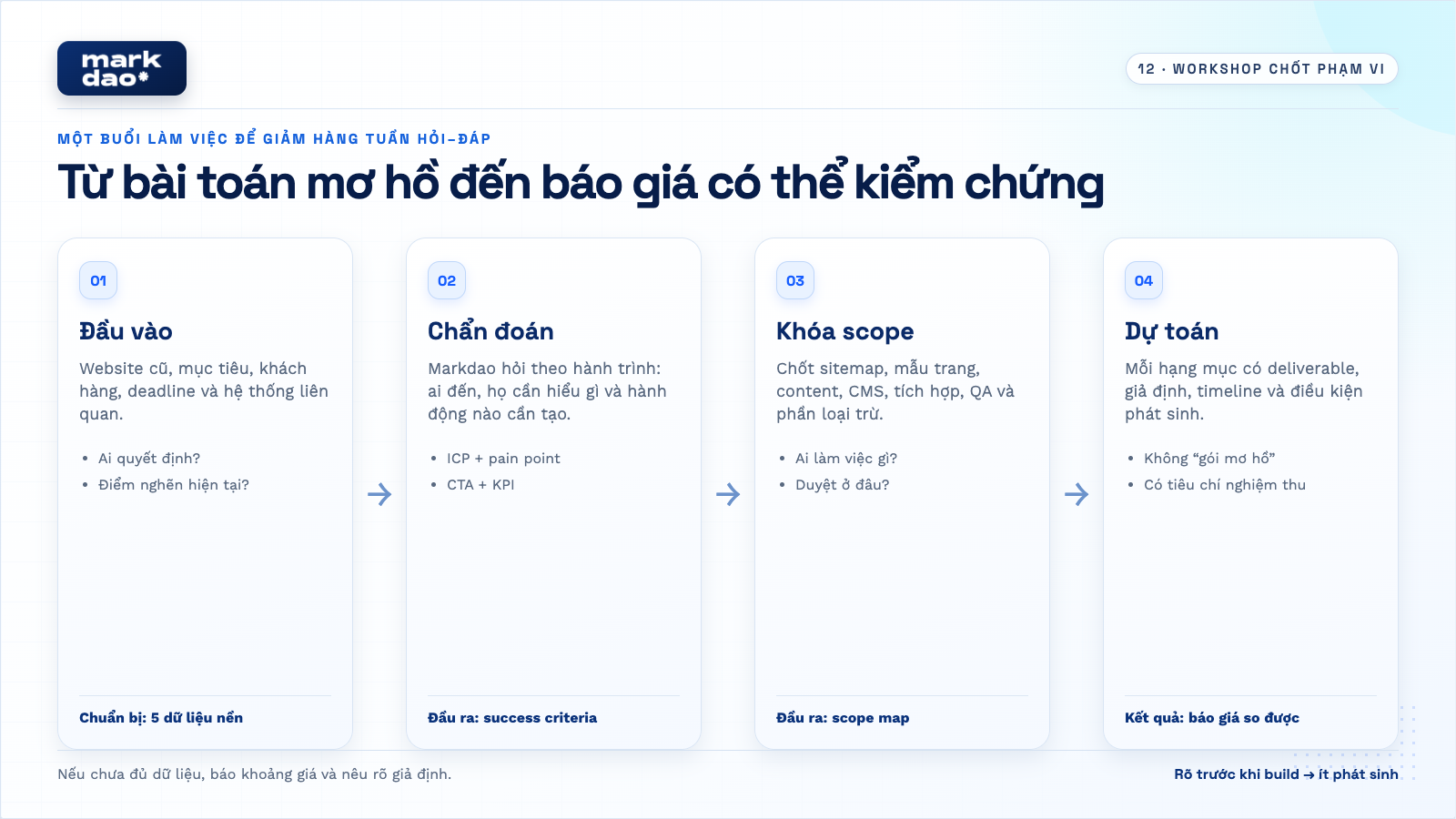
15-point checklist for comparing two website design quotes
Don't just put two numbers side-by-side and choose the lower one. Put the two scopes side-by-side and ask:
- Are both parties solving for the same business goal?
- Is the quote based on the number of URLs or the number of page templates to be designed?
- Who is responsible for writing the content and preparing the images?
- Are there sitemap and wireframe stages before the interface design begins?
- Are you using pre-made templates or custom designs?
- Is the mobile version custom-designed, or is it just a scaled-down version of the desktop interface?
- What specific tasks are included in "SEO-friendly" development?
- If replacing an old website, who handles the redirects and checks the indexing?
- Are forms, CTAs, and conversion data being tracked?
- What tools and conditions are used to test Core Web Vitals?
- Who owns the domain, hosting, CMS, and other account credentials?
- Are the design files, source code, and user documentation handed over?
- How many rounds of revisions are included, and how are out-of-scope changes billed?
- What is the difference between warranty and maintenance?
- What are the annual costs and potential additional expenses?
If a quote doesn't answer most of these questions, the final figure isn't enough to make a decision.
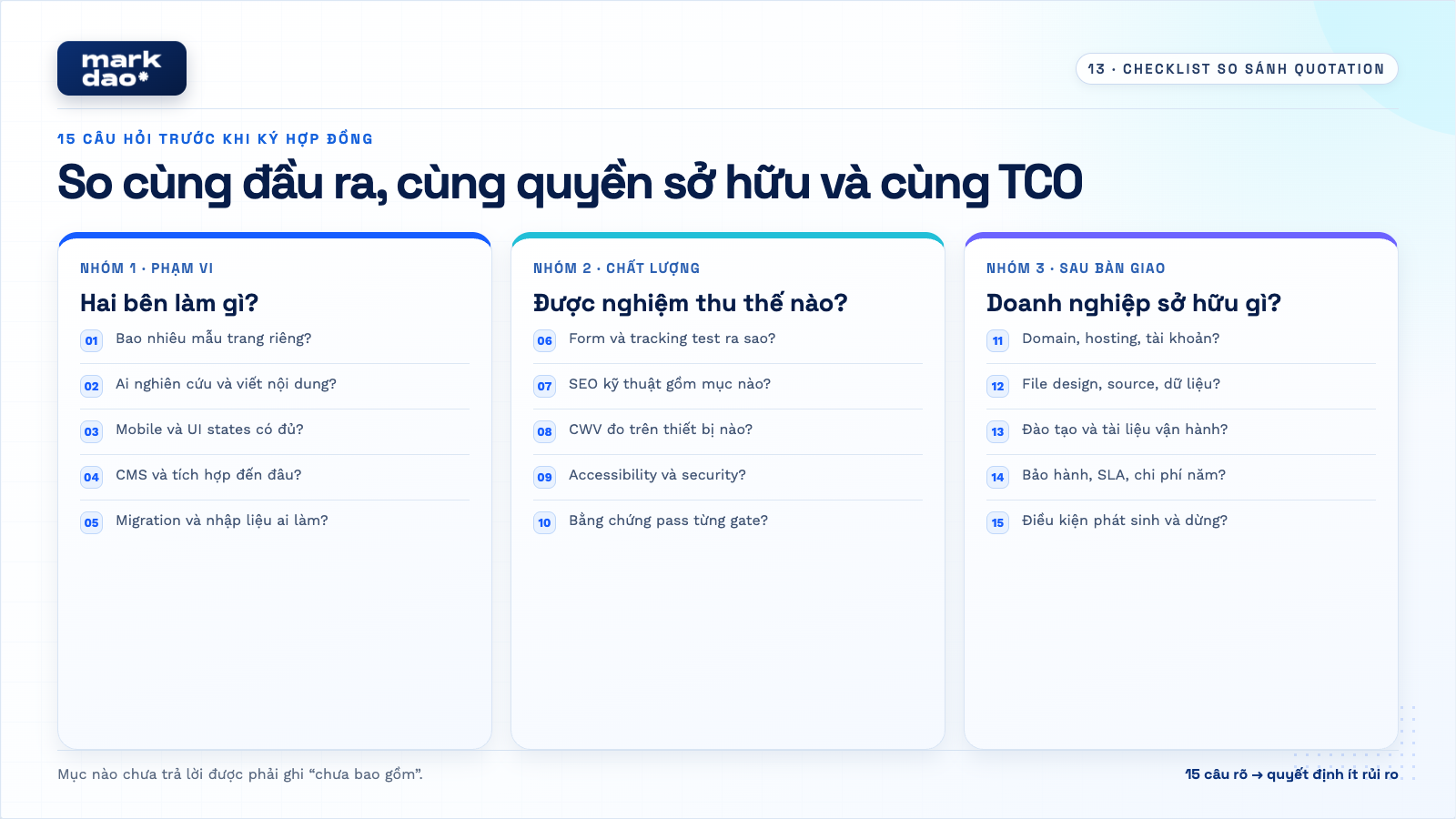
How is the all-inclusive website design quote at Markdao structured?
Markdao doesn't start by asking how many pages a business wants. The process begins with goals, users, and content, and only then do we decide on the interface and technology.
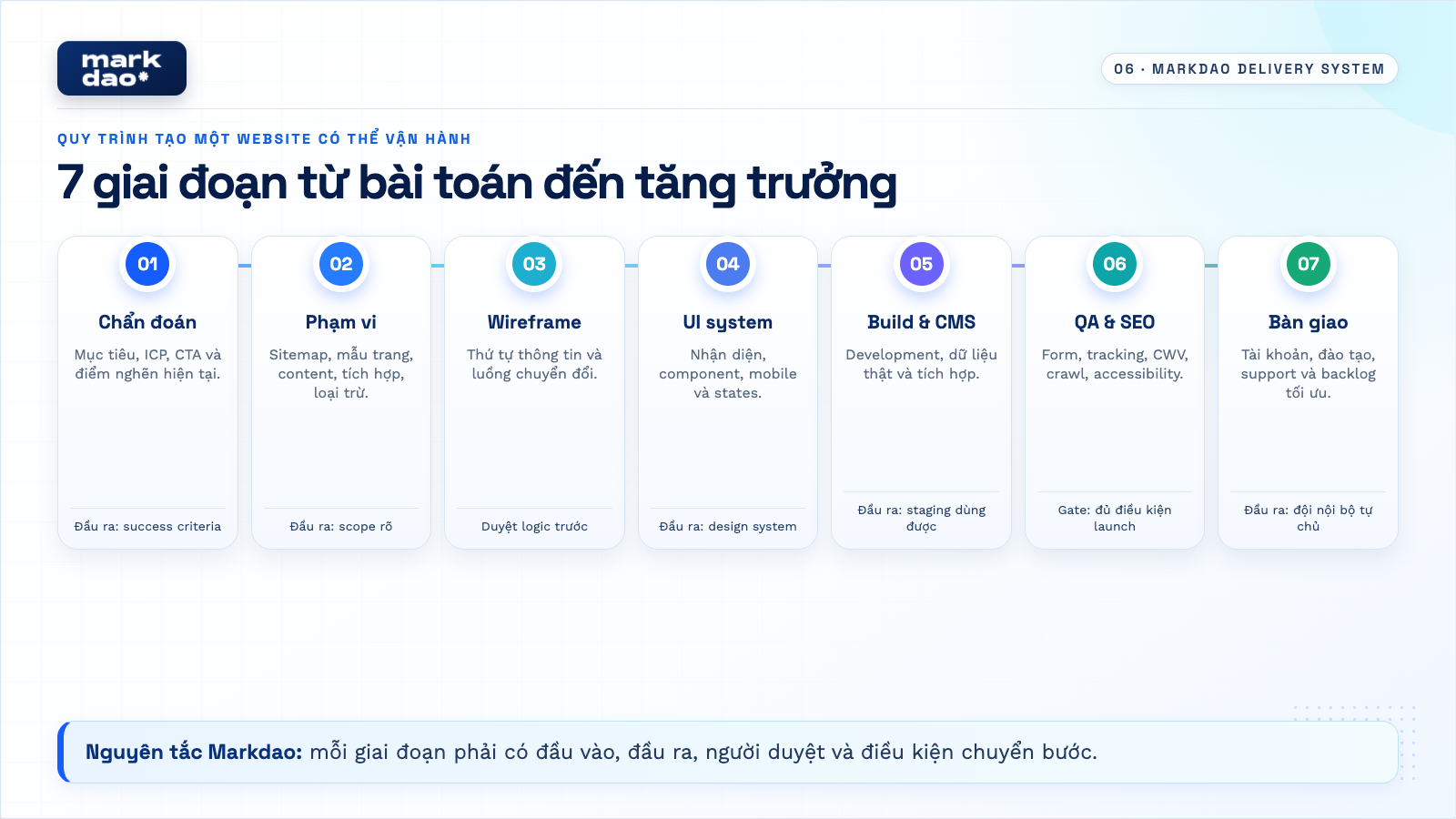
Stage 1: Diagnosing goals and users
The project team clarifies business outcomes, user groups, key actions, and issues with the current website. If the goals aren't clear, Markdao doesn't rush to finalize the feature list.
Phase 2: Finalizing scope, sitemap, and content
Both parties agree on the list of page templates, required content, integrations, legacy data, project leads, and exclusions. This serves as the foundation to ensure the quote remains fixed throughout the project.
Phase 3: Wireframing and conversion flow
Markdao organizes content and actions for each page template. The business approves how the pages function before we dive into colors and imagery.
Phase 4: UI, design system, and responsiveness
The interface is developed based on brand identity and shared components. The mobile version is optimized for actual user behavior, rather than just shrinking the desktop version.
Phase 5: CMS development and integration
The development team builds the website, configures the CMS, and connects the agreed-upon systems. Real content is used to test layouts, avoiding placeholder text until the final delivery date.
Phase 6: Testing, SEO, and measurement
The website is tested for display, forms, links, data, speed, SEO foundations, and tracking. Bugs are resolved before migrating to the main domain.
Phase 7: Handover and post-launch support
Markdao hands over accounts, provides CMS training, and establishes a support protocol. Once real data is available, the business can continue to improve content and conversion rates, rather than viewing the launch date as the end.
If you are comparing service providers, check out Markdao's professional website design services to understand how Markdao connects content, experience, technology, and operations.
When is a website considered complete?
"Going live" does not mean "accepted." A website should only be considered complete once it passes five categories of testing.
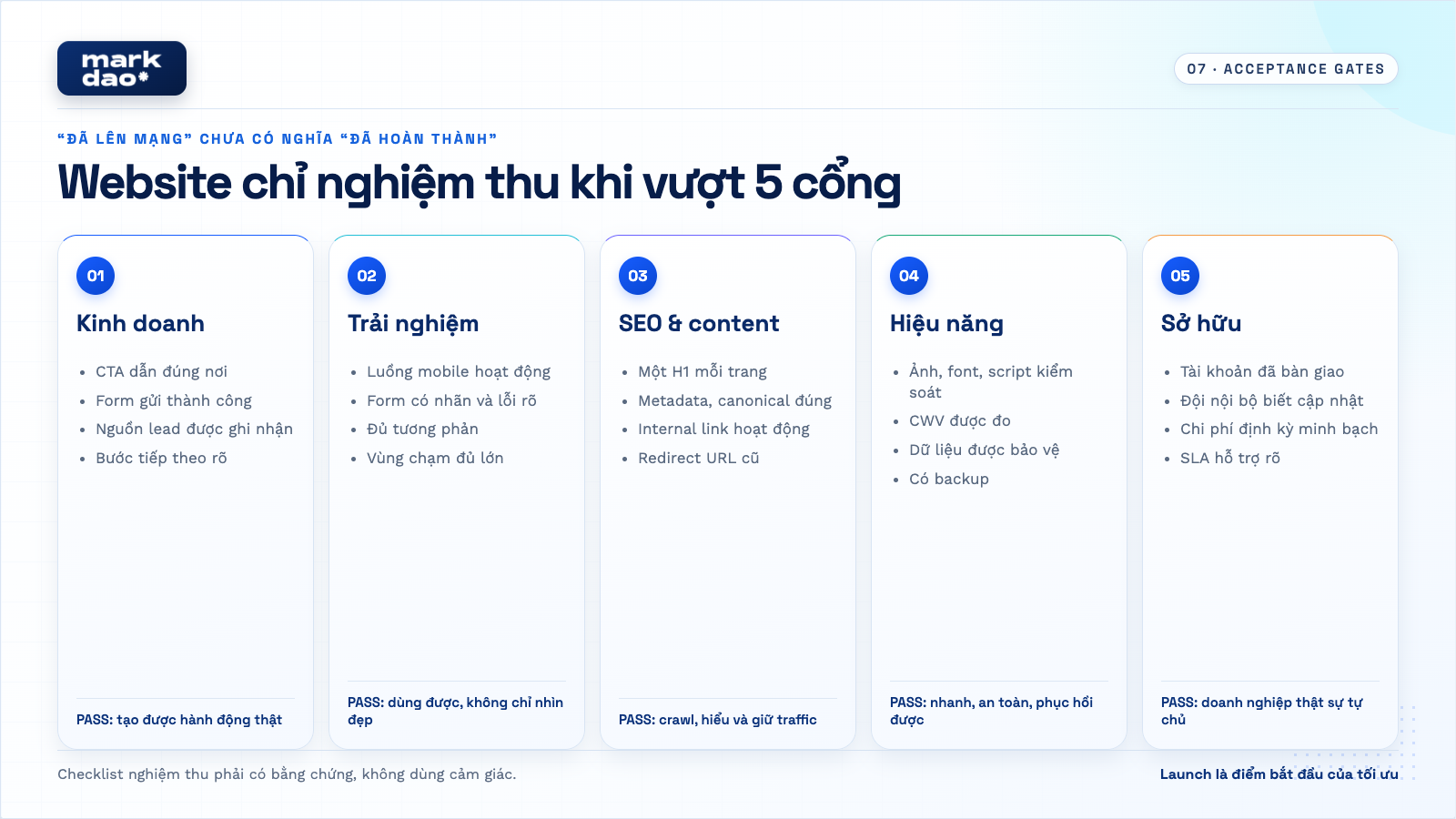
Business results
- CTAs lead to the right destination.
- Form submitted successfully and data routed to the right person.
- Lead source tracked.
- Thank you page and next steps are clear.
Experience and accessibility
- Main flow works on mobile.
- Users can navigate using a keyboard.
- Form has clear labels, error messages, and instructions.
- Text has sufficient contrast and touch targets are large enough.
SEO and content
- Each page has only one H1.
- Title, meta, canonical, sitemap, and robots are correct.
- Internal links are functional.
- Images have appropriate alt text.
- Old URLs are redirected when necessary.
- Important content is visible on mobile.
Performance and security
- Images, fonts, and scripts are optimized.
- Core Web Vitals are measured under agreed-upon conditions.
- Forms and sensitive data are protected.
- Backup and recovery plans are in place.
Ownership and operation
- Accounts registered under the business name or clearly handed over.
- Internal team knows how to update content.
- Recurring costs are listed.
- Support channels and response times are agreed upon.
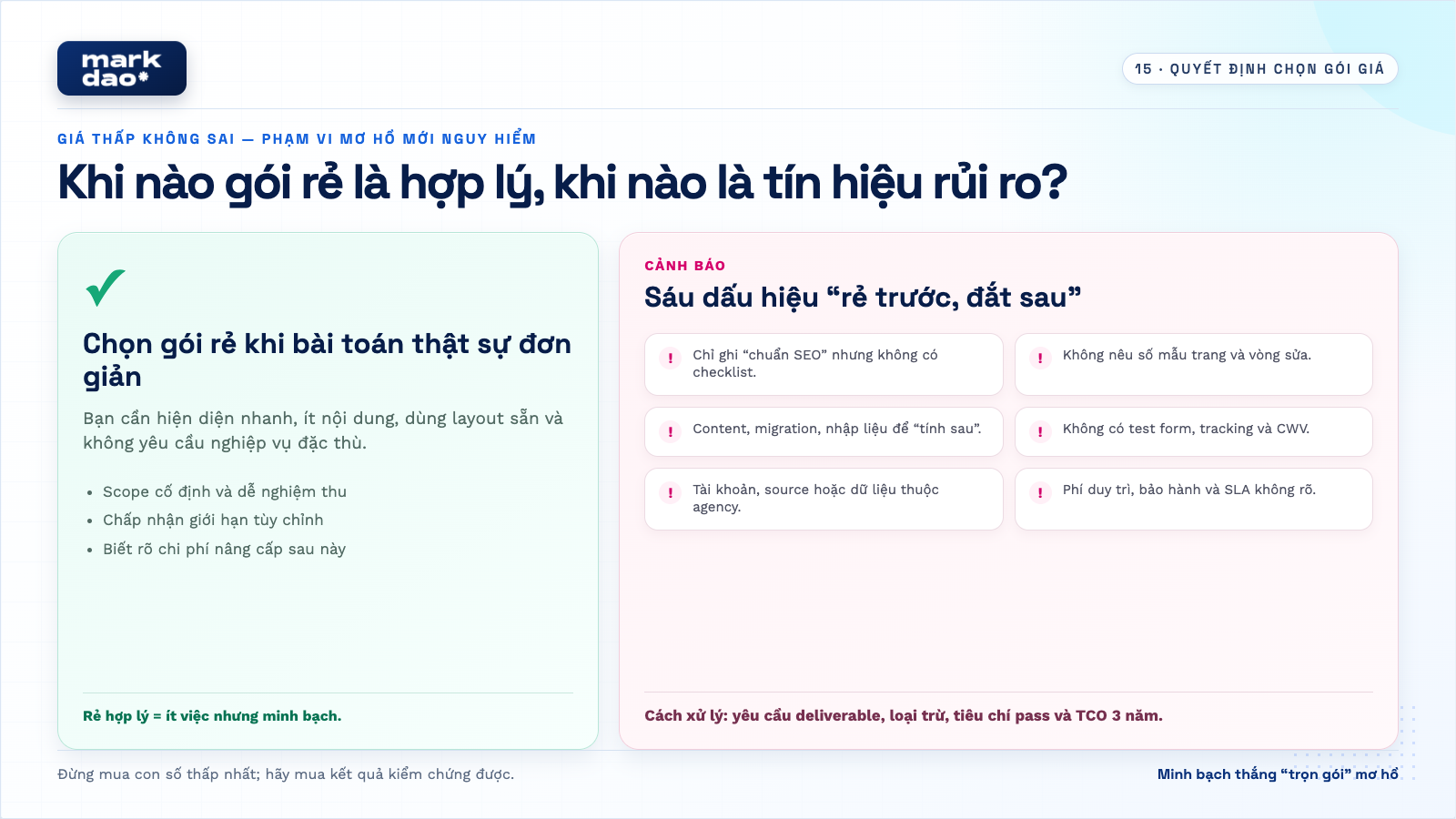
When should you avoid the cheapest package?
A low-cost package may be suitable when the business only needs a basic presence, has minimal content, requires no integrations, and is comfortable using a pre-made template.
You should not choose based on price alone when:
- The website is your primary channel for lead generation or revenue.
- The business has existing SEO traffic that needs to be preserved.
- Multiple systems need to be integrated.
- The marketing team needs to manage the site independently in the long term.
- The brand competes on reputation and user experience.
- A single lead is worth far more than the difference in quoted prices.
The right price is not the lowest one. It is the one that helps the business achieve its goals with a clear scope, manageable risks, and acceptable operating costs.
Get a website estimate based on scope, not guesswork
If you have two or more quotes but aren't sure if they cover the same scope, Markdao can start with a needs-clarification session.
You provide eight answers regarding your goals, users, content, features, and operations. Markdao will then propose:
- Suitable website type.
- Minimum required scope.
- Items to prioritize and items to defer to a later phase.
- Estimated budget range.
- Risks to address before design begins.
Submit our 8-question brief to receive a scope-based estimate, along with a sample quote.
You don't need technical documentation ready. Just describe your business challenge, and Markdao will work with you to clarify the rest before finalizing the quote.
FAQ

At Markdao, landing pages typically range from 15 to 50 million VND; corporate websites from 30 to 90 million VND; and projects involving 3D, animation, or complex interactions from 150 to 300 million VND. Exact pricing depends on your goals, number of page templates, content, features, integrations, and delivery requirements.
Agencies may use different platforms, conduct varying levels of research, offer different numbers of page templates, and have different responsibilities regarding content, SEO, integrations, or maintenance. You should compare individual items and acceptance criteria before comparing total prices.
There is no standard definition for "all-inclusive." Some providers include the first year, others charge separately, and some bill monthly. Quotes should clearly specify which costs are one-time, which are recurring, and who owns the accounts.
The foundation includes editable headings, titles, and meta tags, clean URLs, canonical tags, sitemaps, robots.txt, image alt text, appropriate structured data, internal linking, and optimized speed for crawling and indexing. To improve rankings, you also need a content strategy, demonstrated expertise, and ongoing post-launch improvements.
Prepare these eight pieces of information: goals, target audience, primary actions, existing content, legacy data, integrations, self-management needs, and launch timeline. A clear brief helps an agency estimate the scope much better than just saying, "I need a website with about 10 pages."